How Often Should You Replace a Bearded Dragon UVB Bulb?
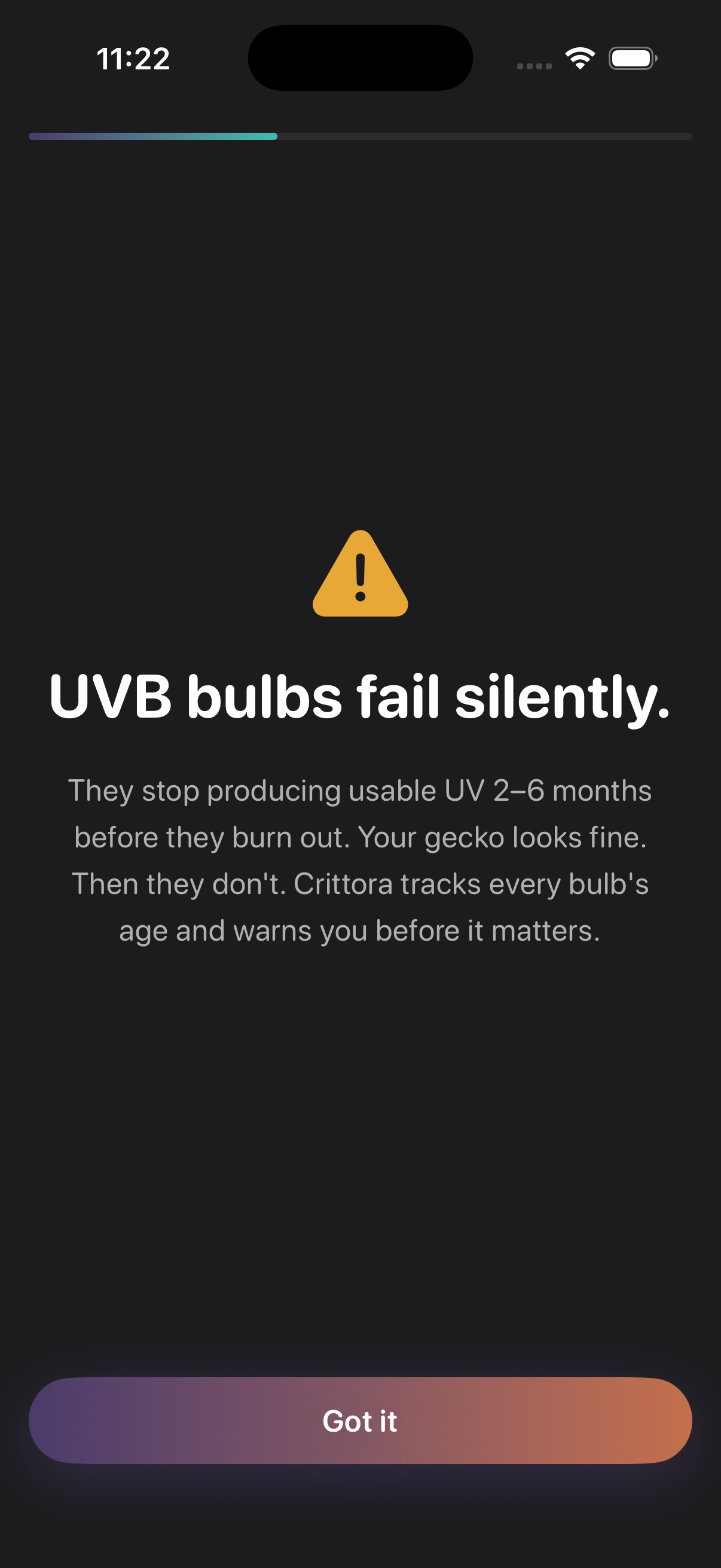
A bearded dragon's most dangerous husbandry trap is invisible. The UVB bulb keeps shining white light for years, so it looks fine, while the UVB wavelengths that drive vitamin D3 synthesis quietly decay. By the time a dragon shows soft jaw, trembling limbs or a bent spine, the bulb has often been dead in the way that matters for many months. The fix is a calendar, not your eyes.
How often should you replace a bearded dragon UVB bulb?
Replace high-output T5 linear UVB tubes about every 12 months, and compact or coil UVB bulbs about every 6 months. The bulb may still produce visible light long after its UVB falls too low to be useful. Log the install date and set a reminder so the swap happens on schedule rather than after symptoms appear.
Brand and model matter. Reputable linear T5 tubes such as those from Arcadia or Zoo Med hold useful UVB output for roughly a year of daily use, while cheaper compact bulbs degrade faster. The Arcadia guidance and most reptile vets converge on this 6 to 12 month window. Because the decay is gradual and invisible, the safest practice is a fixed replacement interval logged from the day you install the bulb.
Why does UVB matter so much for a bearded dragon?
Bearded dragons use UVB radiation to synthesize vitamin D3 in their skin, which lets them absorb dietary calcium. Without enough UVB they cannot use the calcium they eat, no matter how much you dust their food. The result is metabolic bone disease, where bones soften and deform, a leading cause of suffering in captive dragons.
As desert baskers from inland Australia, bearded dragons evolved under intense sun. In a tank, a UVB bulb stands in for that sun. The dragon needs an unobstructed basking spot within the bulb's effective range, with no glass or plastic between bulb and animal, since ordinary glass blocks UVB. Pairing UVB with the correct basking temperature lets the dragon process calcium and stay structurally sound.
How do you know if a UVB bulb is still working?
The only reliable test is a Solarmeter 6.5, which reads UV index output directly. Visible brightness tells you nothing about UVB. If you do not own a meter, replace on schedule instead. Watch for early metabolic bone disease signs like trembling, lethargy, soft jaw or reluctance to climb, and treat them as a UVB emergency.
A solar meter pays for itself across several bulbs by telling you the real UV index at the basking spot. Position matters as much as bulb age: distance, mesh screens and fixture reflectors all cut output. Measure at the height where the dragon actually basks. If you track install dates and occasional meter readings together, you stop guessing and start replacing on evidence.
What UVB replacement interval fits each bulb type?
Linear T5 HO tubes last around 12 months; T8 linear tubes about 6 to 9 months; compact and coil bulbs about 6 months. Mercury vapor bulbs that combine heat and UVB last roughly 12 months. These are daily-use estimates, so heavy cycling or a dusty fixture shortens them. Confirm with a meter when you can.
| Bulb type | Typical replacement | Notes |
|---|---|---|
| T5 HO linear tube | ~12 months | Strongest, most consistent output |
| T8 linear tube | 6 to 9 months | Lower output, fades sooner |
| Compact / coil | ~6 months | Smallest coverage, fastest decay |
| Mercury vapor | ~12 months | Heat plus UVB in one bulb |
Key takeaways
- Replace T5 UVB tubes about yearly and compact or coil bulbs about every 6 months.
- Visible light is not UVB; a bulb can glow for years while its UVB is effectively dead.
- Without UVB a dragon cannot make vitamin D3, leading to metabolic bone disease.
- A Solarmeter 6.5 is the only sure test; otherwise replace on a fixed schedule.
- Never put glass or plastic between the UVB bulb and the basking dragon.
Frequently asked questions
- Can a bearded dragon get UVB through a window?
- No. Standard window glass blocks almost all UVB, so sunlight through a closed window gives no usable D3 benefit and only adds heat. Direct outdoor sun in a safe, supervised, escape-proof setup does provide UVB, but indoors a dragon needs a proper UVB bulb with nothing blocking the rays.
- What UV index should a bearded dragon basking spot read?
- Most keepers target a UV index of roughly 3 to 4.5 at the basking spot for an adult bearded dragon, measured with a Solarmeter 6.5. Hatchlings often sit slightly lower. Output depends on bulb model, distance and any mesh, so measure at the exact height where the dragon basks rather than assuming the box figure.
- Do I still need calcium supplements with good UVB?
- Yes, usually. UVB lets a dragon use calcium, but a balanced diet still needs calcium and limited D3 dusting, especially for growing juveniles and egg-laying females. The supplement schedule depends on diet, age and UVB strength. Over-supplementing D3 carries its own risk, so follow a reptile vet's plan rather than guessing.
- Is my UVB bulb too far from the dragon?
- It can be. UVB output falls sharply with distance, so a tube mounted high above a tall enclosure may deliver almost nothing at the floor. Follow the manufacturer's distance chart for your specific bulb and any mesh screen, and confirm with a meter. Move the basking platform closer if readings come back low.
Exotic Pet Husbandry Research, BigBalli. We translate species care sheets into daily, trackable numbers, cross-checked against sources including VCA Hospitals and the RSPCA.
Crittora provides husbandry and educational information, not veterinary diagnosis or treatment. Signs of metabolic bone disease such as tremors, soft jaw or bent limbs need prompt care from a qualified reptile or exotic vet.