How Long Should a Bedtime Story Be?
Length is the most adjustable variable in a bedtime routine and the least discussed. Parents choose a book by appeal and then discover it takes twenty-five minutes, by which point the child is either asleep three pages in or wide awake and asking questions.
How long should it be by age?
Roughly five minutes for younger toddlers, five to ten for two to four year olds, ten to fifteen for four to six, and fifteen to twenty for school-age children who can follow chapters. These track attention span rather than reading ability.
Treat them as starting points and adjust to the individual child. A three-year-old who reliably follows a fifteen-minute story is not unusual, and neither is a five-year-old who settles best with something short. Observation beats the table.
What is the right way to choose length?
Time how long the child normally takes to become drowsy after lights out, then choose a story slightly shorter than that. The aim is for the story to finish just before settling begins, so the ending marks the transition rather than interrupting it.
Stories that run long create a specific problem: the child fights sleep to hear the end. That is the opposite of what bedtime reading is for, and it is why an engrossing chapter book can be counterproductive at the wrong hour.
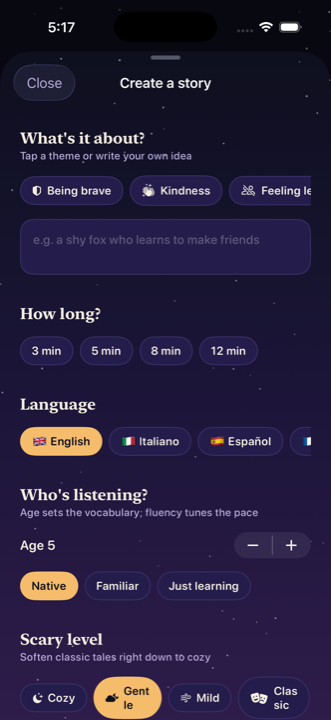
Does one long story beat several short ones?
Usually yes at bedtime. Multiple short stories create multiple endings, and each ending is an opportunity to negotiate for another. A single story of the agreed length gives one clear boundary, which reduces the just-one-more exchange considerably.
Where several short pieces work is with very young children whose attention cannot sustain a longer arc. In that case, agreeing the number in advance, two stories, then lights out, restores the single boundary at the end of the pair.
Should the content change with the length?
Yes. A short bedtime story should be calm throughout, since there is no time to bring arousal back down after excitement. Longer stories can carry more incident provided the final few minutes settle, ending quietly rather than on a cliffhanger.
Chapter books used at bedtime often break this rule by design, since chapters are written to pull the reader forward. Stopping at a natural pause rather than at a chapter end sometimes settles a child better, even though it feels wrong.
Key takeaways
- Five to ten minutes suits most toddlers; fifteen to twenty suits school-age children.
- Choose a length slightly shorter than the child’s usual settling time.
- A story that outruns settling keeps a child awake waiting for the ending.
- One story of agreed length gives a cleaner boundary than several short ones.
- Short stories should be calm throughout; longer ones must end quietly.
Frequently asked questions
- Is it bad to stop mid-story?
- Not if it is planned and consistent. Stopping at an agreed point each night, particularly with chapter books, works well provided the child knows in advance. What causes conflict is stopping unpredictably because time ran out, which reads as arbitrary rather than as routine.
- How many books should you read?
- Agree the number before starting rather than deciding at the end of each one. Two short books or one longer one are both reasonable. The number matters less than it being fixed in advance, since that is what removes the negotiation.
- Should the child choose the book?
- Giving a choice between two or three options preserves autonomy without opening the whole shelf. Unlimited choice at bedtime tends to extend the routine and can become the negotiation itself. A limited choice satisfies most children as fully as an open one.
- Does reading speed matter?
- Slower is generally better at bedtime. A calm, unhurried pace signals winding down and gives a child time to process, whereas a brisk reading raises energy. Many parents find deliberately slowing down does more than changing which book they read.
Children’s Sleep & Story, BigBalli. We follow AAP and paediatric sleep guidance and turn it into practical routines. General information, not medical advice.