What Is the HYROX Race Format?
The fixed sequence is not arbitrary. It alternates upper-body pulling, heavy pushing, full-body work and legs, which prevents any single system from recovering while another works. Understanding where each station sits in that pattern is what separates a paced race from a survived one.
What is the exact station order?
Station one is SkiErg for 1000 metres. Two is a 50-metre sled push. Three is a 50-metre sled pull. Four is 80 metres of burpee broad jumps. Five is a 1000-metre row. Six is a 200-metre farmers carry. Seven is 100 metres of sandbag lunges. Eight is 100 wall balls.
Each is preceded by a 1-kilometre run, so the race opens with a run and closes with wall balls. That final station is where races are decided, because it arrives with roughly 7 kilometres of running and seven stations already in the legs.
Which stations hurt most, and when?
The sled push at station two spikes heart rate early and can wreck pacing for the next hour if attacked too hard. Burpee broad jumps at station four are the longest single station for most athletes. Wall balls at station eight are where accumulated fatigue meets 100 repetitions.
The common first-race error is treating the sled push as a strength test and emptying the tank on it. It arrives after only 2 kilometres, when you feel fresh, and the cost is paid across the remaining six stations rather than immediately.
How should you split the running?
Slower than your standalone 8-kilometre pace, and evenly. A common approach is to target a pace roughly 30 to 60 seconds per kilometre slower than a fresh 8k, accepting that later runs will drift regardless. Running the first kilometre at open pace is the most reliable way to blow up.
Compression happens naturally: runs one through three feel comfortable, four through six feel like work, and seven through eight become a matter of not walking. Planning for that drift produces a better finishing time than planning for even splits you will not hold.
What happens between stations?
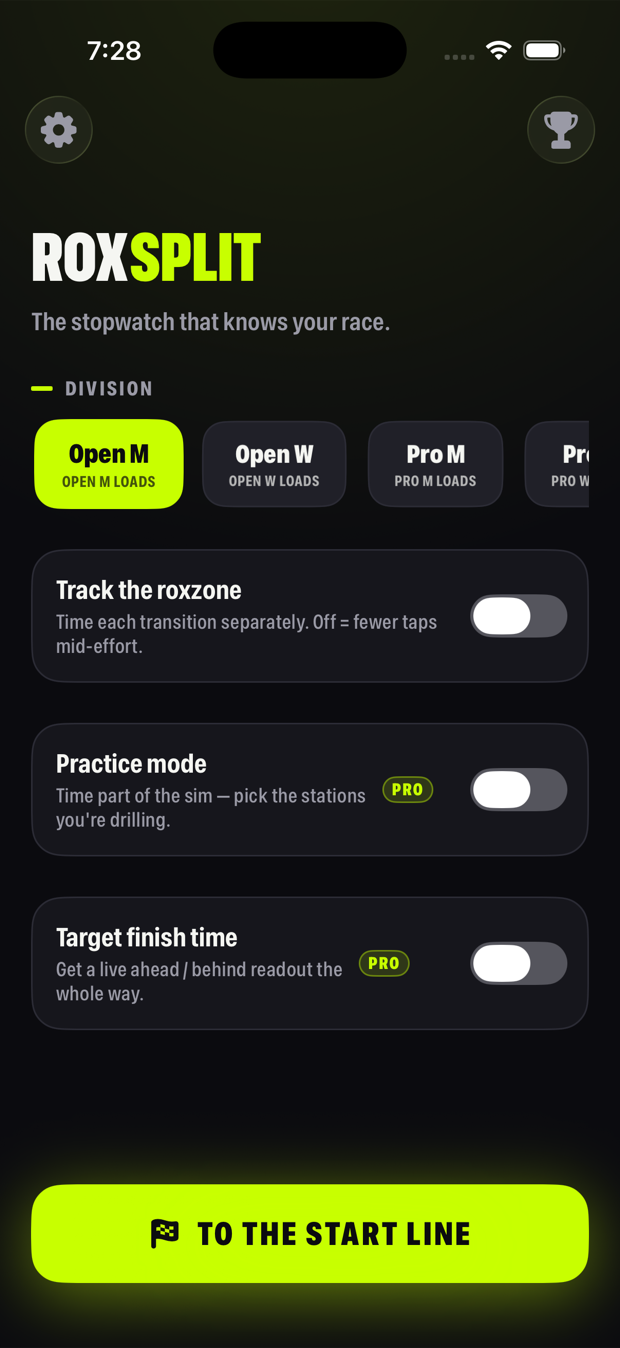
The roxzone, the transition area you cross between finishing a station and starting the next run. Its length varies by venue and the time spent in it counts towards your finish. It is the most overlooked minutes in the entire race.
Nothing about the roxzone is timed separately or skippable, so treating it as recovery is expensive. Athletes who jog it rather than walk it recover almost as well and save several minutes across eight transitions.
Key takeaways
- Eight rounds of 1km run plus one station, in a fixed and unchanging order.
- The sequence opens with SkiErg and closes with 100 wall balls.
- The sled push arrives early and punishes athletes who attack it fresh.
- Run 30 to 60 seconds per kilometre slower than a standalone 8k pace.
- Roxzone transitions count towards your time and are widely underestimated.
Frequently asked questions
- Does the station order ever change?
- No. The order is fixed across all HYROX events worldwide and is fundamental to the comparability of results. This is deliberate: a leaderboard only works if every athlete performed the same tasks in the same sequence under the same accumulated fatigue.
- Can you rest during a station?
- Yes, the clock simply keeps running. There is no requirement for continuous work within a station, so breaking wall balls into sets is a normal strategy rather than a penalty. What you cannot do is skip repetitions or shorten distances.
- What happens if you fail a repetition?
- Judges enforce movement standards, and repetitions not meeting them are not counted, so you repeat them. On wall balls in particular, failing to hit the target or reach depth costs repetitions you must make up, which is why technique under fatigue matters more than raw capacity.
- Is the running on a track or a loop?
- A marked indoor loop inside the venue, typically flat with turns. The turns matter more than people expect, since they break rhythm and add distance if run wide. Practising sharp corners at pace is a small but genuine improvement for a first-time racer.
Hyrox Racing & Pacing, BigBalli. We track the official HYROX race format, divisions and station standards so pacing guidance stays accurate.