How Does Singles Scoring Differ From Doubles?
Singles scoring is simpler than doubles and yet trips up more players, because the positioning rule replaces the rotation rule and nobody explains the substitution. Once you know that your score alone determines which side you serve from, the rest follows.
How does the singles call work?
Two numbers: your score then your opponent’s. There is no server number because you are the only server on your side. Lose the rally and the serve passes directly to your opponent, with no second serving turn to work through first.
This makes singles side-outs much faster than doubles. A team in doubles can absorb one fault and keep serving; in singles a single lost rally hands over the serve immediately, so scoring runs tend to be shorter.
How do you know which side to serve from?
Your own score decides it. Serve from the right-hand court when your score is even, including zero, and from the left when it is odd. The receiver stands diagonally opposite. This single rule replaces all the partner rotation logic of doubles.
The check is quick and worth doing before every serve while it is unfamiliar. If your score is 4 you are on the right; at 5 you are on the left. Getting it wrong is a fault, and it is the most common singles error among players who mostly play doubles.
How does doubles differ in practice?
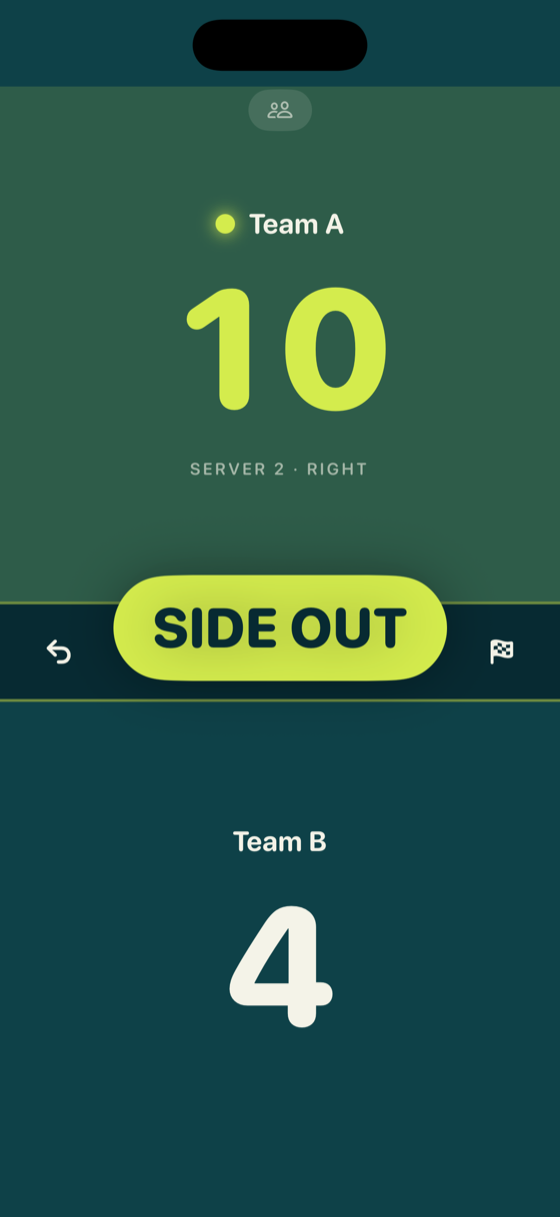
Doubles adds the server number, gives each team two serving turns per side-out, and requires partners to swap sides after each point won on serve. Positions are fixed at the start of each side-out, with the player on the right serving first.
The partner rotation is what generates most confusion, because players move only when their team scores. If your team wins a rally while receiving, you gain the serve but stay where you are, which feels wrong until you have done it a few dozen times.
Do the other rules change?
No. Court dimensions, the non-volley zone, the two-bounce rule, serve requirements and faults are identical in singles and doubles. Only the scoring call and the positioning logic differ, which is why singles feels familiar immediately despite the different rhythm.
The strategic difference is coverage rather than rules. One player defending 20 feet of width makes angles far more valuable, and the dinking exchanges that dominate doubles are less common because there is more open court to attack.
Key takeaways
- Singles uses two numbers; there is no server number because there is one server.
- Even score serves from the right, odd score from the left, based on your own score.
- Losing a rally in singles hands over the serve immediately.
- Doubles adds two serving turns per side-out and partner side-swapping on points won.
- Court, kitchen, two-bounce rule and faults are identical in both formats.
Frequently asked questions
- Does the receiver move in singles?
- The receiver stands diagonally opposite the server, so they move to whichever side receives the serve. There is no fixed receiving position; it follows the server’s side, which in turn follows the server’s score. Standing on the wrong side does not fault the receiver but concedes an easy serve.
- Is skinny singles a real format?
- It is a widely used practice format rather than a rulebook one, where players use only half the court diagonally. It concentrates practice on cross-court dinks and drives and is popular as a drill, but it is not a sanctioned competitive format.
- Which is harder, singles or doubles?
- Singles is far more demanding physically, since one player covers the full width and every rally involves more running. Doubles is arguably harder tactically, because positioning, partner communication and the dinking game introduce complexity singles does not have.
- Does the two-bounce rule apply in singles?
- Yes, exactly as in doubles. The serve must bounce, the return must bounce, and only then may either player volley. It is the same rule with the same purpose: preventing the server from rushing the net and ending rallies immediately.
Pickleball Rules & Scoring, BigBalli. We track the USA Pickleball rulebook as it is revised each year so scoring guidance stays current.