What Does 0-0-2 Mean in Pickleball?
New players hear “zero, zero, two” and reasonably conclude someone has miscounted. The third number is not a score at all, and the fact that a game starts on the second server rather than the first is a deliberate correction for a structural imbalance rather than a quirk.
Why start on the second server?
Because each team normally gets two serving turns before losing the serve, one per partner. If the first-serving team also received two, they would gain a full extra turn of scoring opportunity before their opponents ever served. Starting at server two gives them one turn only.
The effect is small over a whole game but real at the start, when neither team has scored and momentum is unformed. It is the same logic behind alternating first possession in other sports: remove the free advantage that comes from going first.
What happens after the first fault?
The serve passes immediately to the opposing team, who then get the normal two serving turns. From that point the game proceeds conventionally: each side-out gives the incoming team a first server and a second server before the serve changes hands again.
So 0-0-2 applies only once, at the very start of each game. If a match goes to three games, each game begins at 0-0-2 again for whichever team serves first in that game.
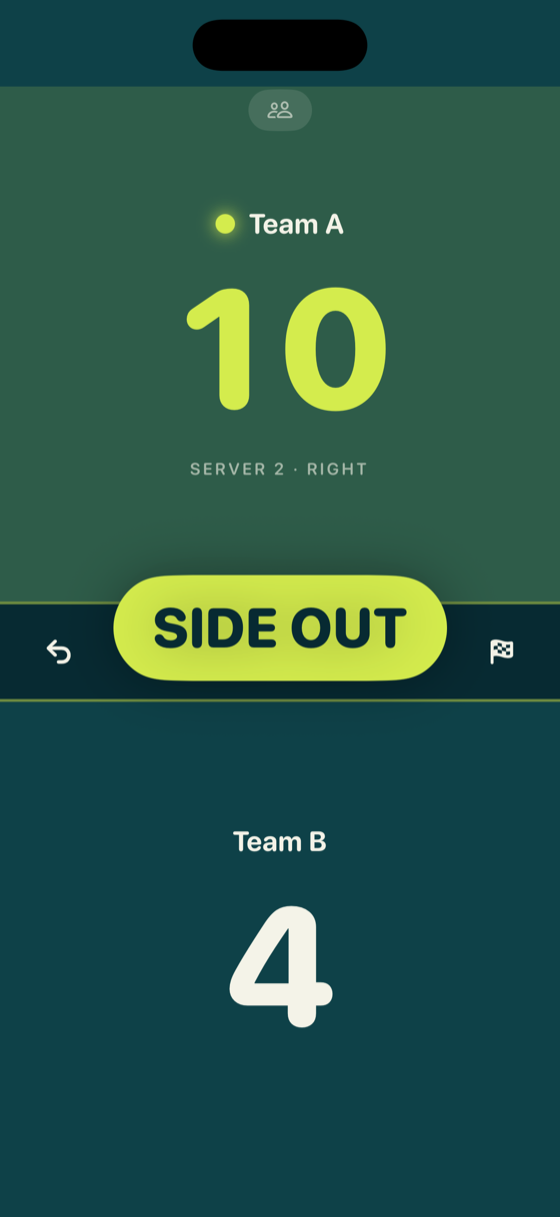
Who serves first and from where?
The first serve is taken from the right-hand service court, and the player standing there serves. Which team serves first is decided by a coin toss, a spin of the paddle or any agreed method; the winner may choose to serve, receive, or pick an end.
A useful rule follows from this: when your team’s score is even, the player who started on the right serves from the right. That relationship holds throughout the game and is the quickest way to check whether you are positioned correctly.
Does 0-0-2 apply in singles?
No. Singles uses a two-number call, the server’s score followed by the receiver’s, with no server number because there is only one player per side. A singles game simply starts at 0-0, and the serve changes hands on every fault by the server.
Rally scoring formats also drop the third number, since the concept of first and second server does not apply when every rally produces a point. If you hear only two numbers, you are in singles or a rally-scored game.
Key takeaways
- 0-0-2 means no score either side, and the serving team is on its second server.
- The starting team gets one serving turn rather than two, removing a first-move advantage.
- After the first fault, normal two-server rotation begins for both teams.
- Each game of a match starts at 0-0-2 again.
- Singles and rally scoring use two numbers and never call a server number.
Frequently asked questions
- Is it wrong to start a rec game at 0-0-1?
- It contradicts the rulebook and hands the serving team an extra serving turn. In casual play nobody usually objects, but it is a real advantage and worth correcting if you play regularly with the same group or plan to enter anything organised.
- Does the second game start with the same team serving?
- Under standard rules teams switch ends after each game, and the team that received first in the previous game serves first in the next. The opening call is still 0-0-2 for whichever team is serving first in that game.
- What if you forget which server you are mid-game?
- Check your team score against your starting position. If your score is even, the player who began the game on the right side should be on the right. If that lines up and you are still unsure, players commonly agree and continue rather than replaying points.
- Why is the third number sometimes called out as “start”?
- Some players say “zero, zero, start” instead of “two” at the beginning of a game, as a clearer signal to newcomers. It is a common informal convention rather than the rulebook wording, and both are widely understood on recreational courts.
Pickleball Rules & Scoring, BigBalli. We track the USA Pickleball rulebook as it is revised each year so scoring guidance stays current.