Can You Tan With Sunscreen On?
The myth is that sunscreen cancels your tan. It does not. SPF 30 blocks about 97 percent of UVB, which still leaves a few percent getting through to trigger pigment. You tan more gradually with sunscreen on, and that slower tan is the one that lasts, because it builds on intact skin instead of a burn that peels away.
Does sunscreen stop you from tanning?
Sunscreen slows a tan, it does not block it. SPF 30 lets through roughly 3 percent of UVB and SPF 50 about 2 percent, and that small fraction is enough to stimulate melanin over a normal session. You still tan, just at a pace your skin can keep up with. The trade is a slower tan now for no burn and more usable sun time.
SPF measures UVB filtering, and UVB is what drives both burning and tanning. Filtering most of it lengthens the time before you redden, which lets you accumulate the steady, low dose that produces an even tan. The US FDA notes that no sunscreen blocks all UV rays, so a tan under sunscreen is expected, not a sign the product failed.
Why does a tan under sunscreen last longer?
A tan built under sunscreen sits on healthy skin, so it fades slowly as cells turn over naturally. A tan rushed without protection often rides on a burn, and burned skin peels within days, taking the color with it. Slower in means longer lasting, which is why protected tanning usually wins over a season.
Skin sheds its outer layer roughly every four weeks. A tan distributed through healthy cells goes the distance of that cycle. A burn forces the skin to shed early and unevenly, leaving blotches and pale patches where it peeled. If you want a tan that is still there next month, the version under SPF is the one that holds.
How much sunscreen do you actually need?
Most people apply far too little. The standard is about one ounce, a shot glass, to cover the whole body, and a nickel-sized amount for the face. Under-applying turns SPF 30 into something closer to SPF 10. Spread it 15 minutes before sun, then reapply every two hours and after swimming or heavy sweating.
SPF ratings are measured at 2 milligrams per square centimeter, a thicker layer than almost anyone uses in practice. Apply half that and your real protection drops sharply. The fix is simple: use more than feels necessary, cover the easy-to-miss spots like ears, tops of feet and the back of the neck, and reapply on schedule rather than once at the start.
Should you use a lower SPF to tan faster?
It is tempting but rarely worth it. A lower SPF tans you a little faster and burns you a lot faster, shrinking your safe window. A better approach is to keep a solid SPF of 30 and simply spend more time out, since protected skin can stay in the sun longer. You reach the same color with far less risk.
Think of SPF as a time multiplier, not a tan blocker. Higher SPF buys more minutes before you burn, and more minutes is exactly what a gradual tan needs. Dropping to SPF 8 to speed things up trades that buffer for a quick burn that ends the session and the tan. Keep the protection and lengthen the clock instead.
Key takeaways
- You can tan with sunscreen on; no SPF blocks all UV, so melanin still builds.
- SPF 30 lets through about 3 percent of UVB, enough for a slow, even tan.
- A tan under sunscreen lasts longer because it sits on healthy, unburned skin.
- Use about an ounce for the body, apply 15 minutes early, and reapply every two hours.
- Keep SPF 30 and add time rather than dropping SPF to tan faster.
Frequently asked questions
- Will SPF 50 stop me from tanning completely?
- No. SPF 50 filters about 98 percent of UVB, leaving roughly 2 percent to reach your skin and build melanin. You will tan more slowly than with no protection, but you will tan, and with much less burn risk. Over several sessions that slower pace usually produces a more even and longer lasting color.
- Does sunscreen ruin a tan you already have?
- No, the opposite. Wearing sunscreen protects an existing tan by preventing the burn and peeling that would strip it away. Your tan fades naturally as skin cells turn over, and sunscreen does not speed that up. It simply keeps new exposure from damaging the color you have already built and the skin holding it.
- Why am I not tanning even without sunscreen?
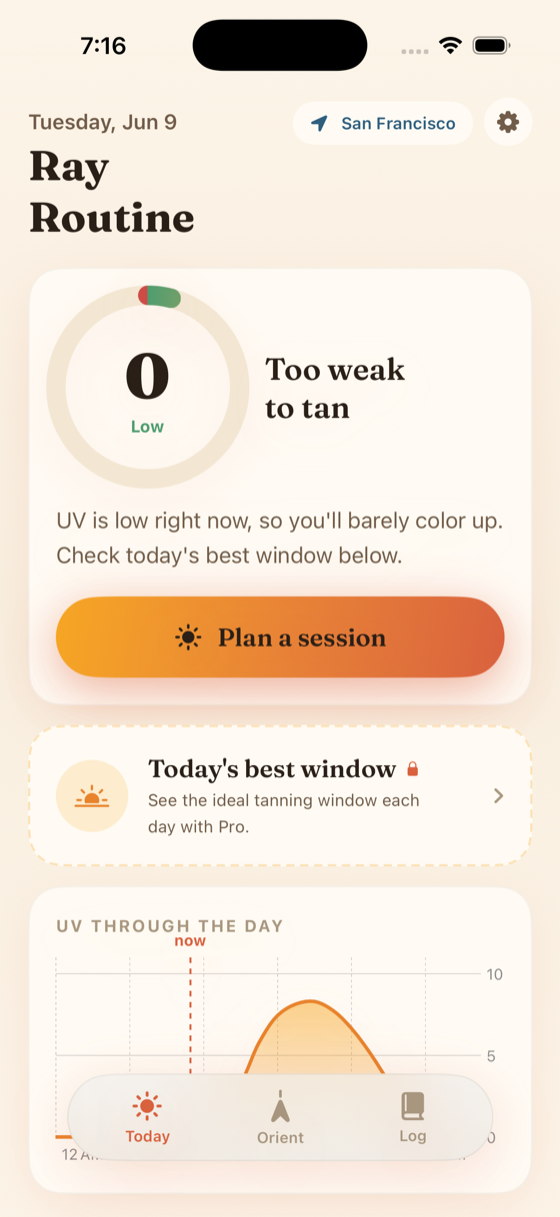
- Usually the UV is too low. Below a UV index of 3 there is little UVB to trigger melanin, so even bare skin barely changes. Skin type matters too: very fair skin makes little melanin and tends to burn instead of tan. Check the live UV and your skin type before assuming the sunscreen is to blame.
- How often should I reapply sunscreen while tanning?
- Every two hours, and immediately after swimming, toweling off or heavy sweating. Sunscreen breaks down and rubs off over time, so a single morning application leaves you exposed by midday. Setting a reminder for the two-hour mark keeps your protection steady through a longer session and prevents the surprise burn that ends a tan early.
UV, SPF & Tanning Research, BigBalli. We turn the UV index into a session you can follow, cross-checked against sources including the US FDA and the American Academy of Dermatology.
Ray Routine provides tanning and sun-exposure estimates to help you plan. It is not medical advice and does not diagnose or prevent any condition. People with a history of skin cancer or photosensitivity should follow their doctor's guidance.