What Happens After You Finish FODMAP Reintroduction?
Once reintroduction is finished, you enter personalization: a relaxed, lasting diet built from your results. You eat the FODMAP groups you tolerated freely, keep the failed ones to the portions you can handle, and stop following a strict elimination diet. The aim is the most varied diet your gut allows, with only your true triggers limited.
What is the personalization phase?
Personalization is the third and final phase of the low-FODMAP diet, sometimes called the modified or maintenance phase. You use your tolerance map to build a long-term way of eating: tolerated groups return fully, failed groups stay limited to your threshold portions. It is meant to be permanent and flexible, not another round of restriction.
Monash University describes this phase as relaxing the diet as much as your symptoms allow. The strict elimination diet was always temporary, a tool to find triggers. Personalization is where that work pays off, giving you a sustainable diet with maximum variety and the fewest possible limits, guided by what your own challenges revealed.
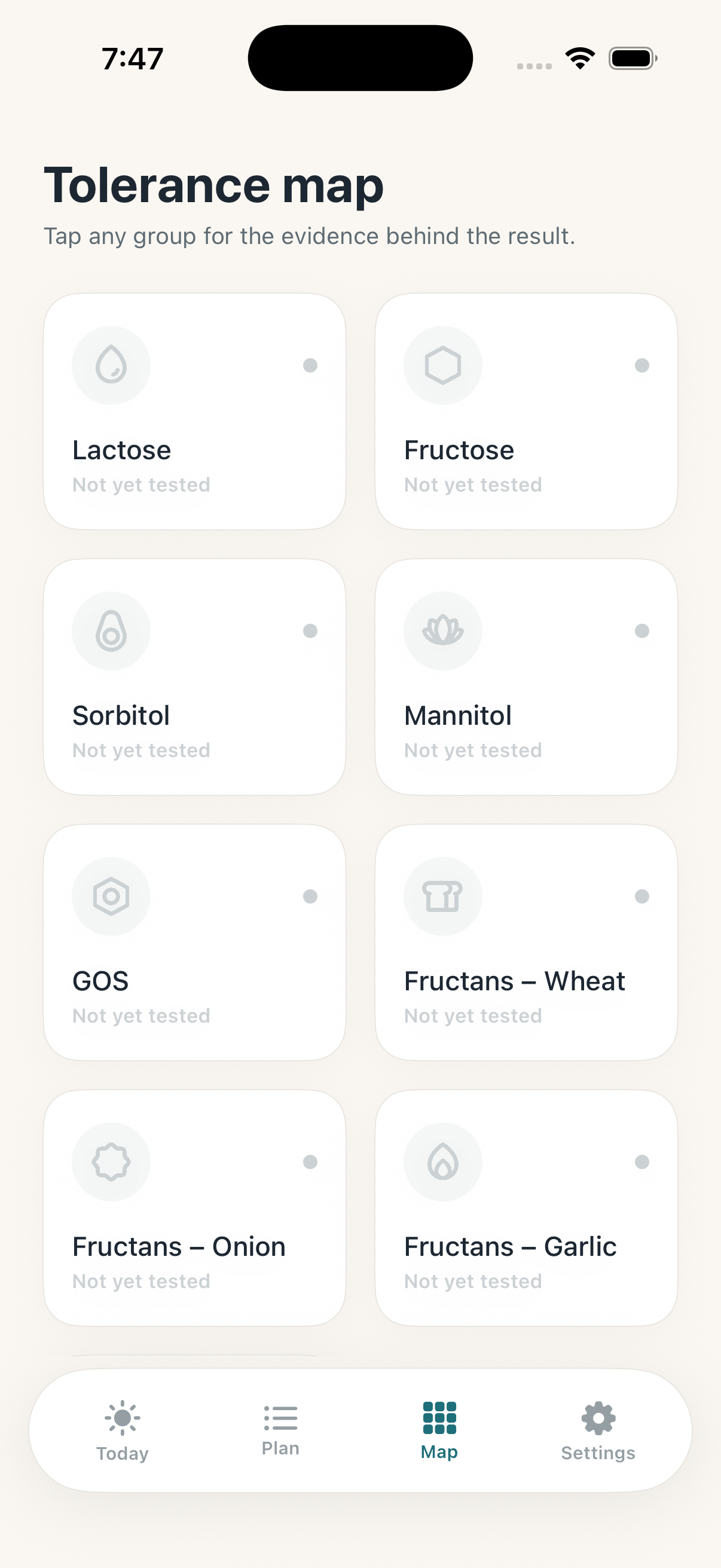
How do you use your tolerance map?
Your tolerance map lists each FODMAP group as pass, fail or a portion limit. Add the passes back without restriction. For fails, eat the threshold amount you found you could handle, or keep the group out if even small doses triggered you. The map turns weeks of testing into a simple set of rules for everyday eating.
Should you keep avoiding the groups you failed?
Limit them rather than ban them outright. Failing a large dose often still leaves room for a small one, so eat to your threshold instead of cutting the group entirely. Total avoidance is rarely needed and narrows your diet without cause. Reserve full avoidance for groups that triggered symptoms even at the smallest test dose.
Variety protects your gut bacteria and your sanity at the dinner table. A diet that keeps every failed group at zero is harder to follow and worse for the microbiome than one that respects sensible portion limits. The point of finding your threshold was to eat as much of each food as you comfortably can, not to extend the elimination diet forever.
Why retest your triggers every few months?
FODMAP tolerance is not fixed. As IBS settles and your gut adjusts, foods that failed once can become tolerable later. Retesting failed groups every three months or so can hand back foods you assumed were gone, widening your diet over time. Tolerance can also dip during stressful or symptomatic periods, so periodic checks keep your map current.
The gut you have today is not the gut you will have next year. Stress, healing and changes in your overall health all move the line on what you tolerate. Treating personalization as a living plan, with occasional retests, means your diet keeps expanding as you recover rather than staying frozen at the results of one set of challenges.
Key takeaways
- Personalization is the lasting third phase, built from your tolerance map.
- Add tolerated groups back fully; limit failed groups to your threshold portions.
- Full avoidance is only for groups that triggered you at the smallest dose.
- Variety supports gut bacteria and makes the diet sustainable long term.
- Retest failed groups every few months, since tolerance can improve over time.
Frequently asked questions
- Do you stay low-FODMAP forever?
- No. The strict low-FODMAP diet is a short diagnostic phase, not a long-term plan. After reintroduction you move to personalization, eating the widest diet your gut tolerates and limiting only your real triggers. Staying fully restricted long term is discouraged, because it narrows nutrition and starves beneficial gut bacteria without any added benefit once your triggers are known.
- Can you eat tolerated FODMAPs together?
- Usually, yes, but watch for stacking. Eating several tolerated FODMAPs in one meal can add up to a larger total load than any single group alone, which sometimes triggers symptoms even when each food passed on its own. If a mixed meal bothers you, spread tolerated FODMAPs across the day rather than concentrating them in one sitting.
- How often should you retest failed groups?
- About every three months is a common rhythm, though there is no fixed rule. Retest from a calm baseline using the same food and doses as before. If a group now passes, add it back. If it still fails, keep it limited and try again later. Tolerance tends to improve as IBS settles, so periodic retesting is worthwhile.
Low-FODMAP Diet Research, BigBalli. We turn the Monash reintroduction protocol into a day-by-day plan, cross-checked against sources including Monash University and the Academy of Nutrition and Dietetics.
Reintro provides educational information about the low-FODMAP diet, not medical advice. Talk to your doctor or a FODMAP-trained dietitian before starting, especially if you have a diagnosed condition or take medication.