How Do You Practice Stoicism Every Day?
Most people read Marcus Aurelius, nod along, and change nothing. Stoicism was never meant to be studied like that. The ancient Stoics treated it as askesis, a training routine for the mind, repeated every day. The daily version is small and unglamorous: a morning passage, a rule to apply during the day, and an honest accounting at night.
What does a daily Stoic practice actually look like?
A daily Stoic practice has three anchors. Morning: read one passage and set an intention for the day. Midday: when something frustrates you, sort it into what you control and what you do not. Evening: review the day with Seneca's three questions. Each anchor takes two to five minutes, so the whole practice fits a busy schedule.
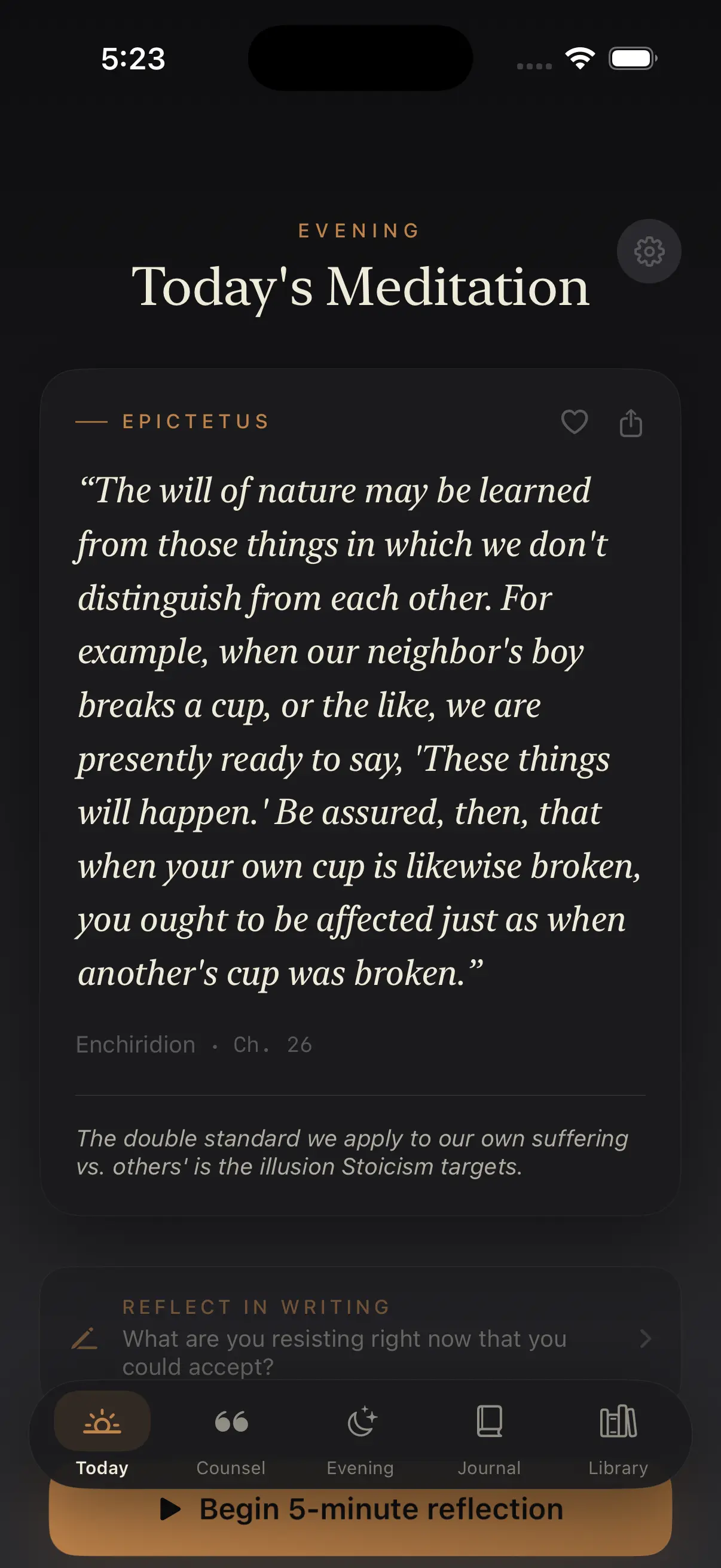
Epictetus told his students to rehearse principles until they became reflexes, the way a musician drills scales. The structure matters more than the duration. A reader who spends five honest minutes a day for a month internalizes more than one who reads for three hours and stops. Ataraxia builds this loop into one screen so the structure is already there when you open it.
How long should a daily Stoic practice take?
Ten minutes total is enough to start, split across the day. Spend two minutes on a morning passage, a few seconds applying the dichotomy of control whenever you are tested, and five minutes on the evening review. The goal is a streak you can keep for months, not a heroic session you abandon by Friday.
Long practices fail for the same reason crash diets do. They demand willpower you cannot sustain. The Stoics favored repetition over intensity because character is built by what you do most days, not what you do once. Start at ten minutes, hold it for two weeks, and let the habit deepen on its own rather than forcing it.
Which texts should guide a daily practice?
Three primary sources carry the practice. Marcus Aurelius wrote Meditations as private notes to himself, ideal for mornings. Seneca's Letters from a Stoic read like advice from a friend. Epictetus gives blunt rules in the Enchiridion and Discourses. Rotate short passages from all three rather than reading any one cover to cover.
Reading short and returning often beats marching through a whole book. The same line from Meditations lands differently on a calm Tuesday than during a hard week. A library you can browse by theme, author or work lets you pull the passage that fits the day. Bookmark the lines that hit and revisit them when the situation repeats.
How do you stay consistent with Stoic practice?
Attach the practice to things you already do. Read the morning passage with your first coffee, run the evening review when you set your alarm. Track a streak so a missed day is visible. Forgive a lapse quickly and resume the next morning. Guilt ends practices; quiet resumption keeps them alive.
Seneca admitted in his letters that he fell short and kept going anyway, which is the whole point. The practice is not a performance you pass or fail. It is a discipline you return to. Reminders set for the times you actually pause, plus a visible streak, do more for consistency than motivation ever will.
Key takeaways
- Build a three-part loop: morning passage, midday control check, evening review.
- Ten minutes a day held for weeks beats one long reading session.
- Rotate short passages from Marcus Aurelius, Seneca and Epictetus instead of reading one book straight through.
- Attach each anchor to an existing habit so it survives busy days.
- Track a streak, forgive lapses fast, and resume the next morning.
Frequently asked questions
- Do I need to read whole Stoic books to practice daily?
- No. The Stoics taught through short maxims meant to be rehearsed, not long arguments meant to be finished. A single passage you apply that day teaches more than a chapter you forget by evening. Reading short and returning often is the historically accurate way to practice, and it fits a busy schedule far better.
- What time of day is best for Stoic practice?
- Use two times. Morning is for setting an intention from a passage before the day pulls at you. Night is for the evening review, accounting honestly for how the day went. Marcus wrote in the morning and Seneca reviewed at night, so bracketing the day with both follows the original pattern closely.
- Is Stoicism a religion or therapy?
- Neither. Stoicism is a philosophy of life with practical exercises for handling emotion, adversity and judgment. It shares techniques with modern cognitive behavioral therapy, which drew on it directly, but it makes no medical claims and requires no belief. Treat it as mental training grounded in texts, not as treatment or worship.
- How soon will I notice a difference?
- Most people feel a small shift within two weeks of daily practice, usually a longer pause between a provocation and their reaction. Deeper change in temperament takes months. The Stoics expected slow progress and judged it by behavior under pressure, not by how calm you feel on an easy day.
Stoic Philosophy & Practice, BigBalli. We turn the primary Stoic texts into a daily discipline, citing Marcus Aurelius, Seneca and Epictetus from their own works.
Ataraxia offers philosophical and educational guidance, not medical or psychological treatment. If you are struggling with persistent anxiety, depression or distress, please consult a qualified clinician.