How Do You Do the Stoic Evening Review?
Seneca describes the practice in his essay On Anger. Every night he put the day on trial, summoning his own actions before himself and weighing them. He reports that after this accounting his sleep grew deep and untroubled, because nothing was left hidden or unsettled. The exercise is simple, ancient, and still the cleanest way to close a day.
What is the Stoic evening review?
The evening review is a structured nightly reflection borrowed from Seneca. You replay the day, name where you acted against your principles, credit where you acted well, and decide what to change tomorrow. It is not journaling about feelings. It is an audit of conduct measured against the values you hold, done calmly and without self-punishment.
Seneca borrowed the habit from the philosopher Sextius, who reviewed each day before sleeping. The tone matters: he conducted the review as a fair judge, not a prosecutor. The aim is accuracy, not guilt. You are gathering evidence about how you actually behave so tomorrow can be slightly better than today.
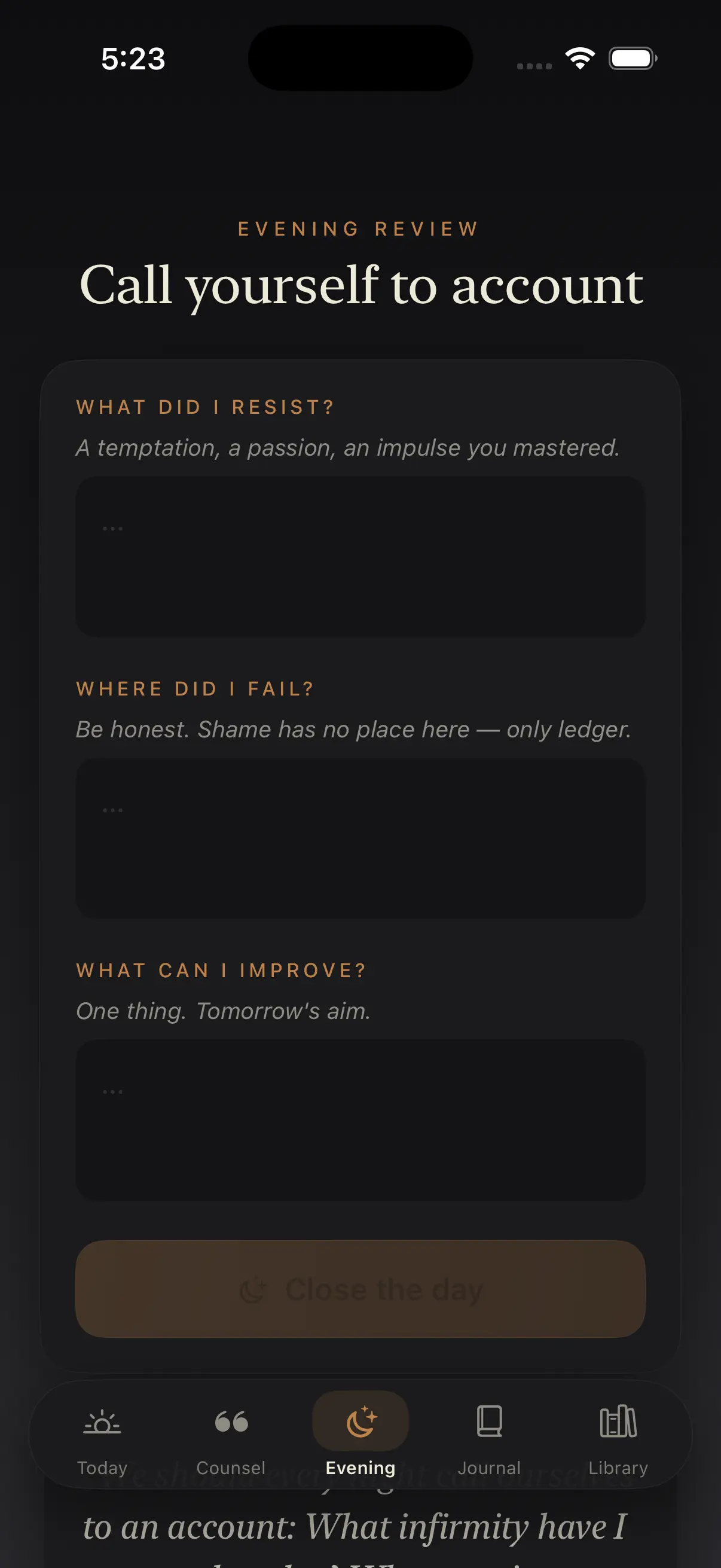
What three questions did Seneca ask each night?
Seneca's questions, drawn from On Anger III.36, are: What bad habit have I cured today? What fault did I resist? In what way am I better? In modern practice these become: where did I fail, what did I resist, and what can I improve. Three short answers are enough to close the day honestly.
The questions work because they balance the ledger. One forces you to admit a fault, one credits genuine restraint, and one points forward. Skipping the second turns the review into self-flagellation; skipping the third turns it into a diary. Answer all three and the day resolves into a lesson rather than a regret.
How do you actually run an evening review?
Sit quietly a few minutes before bed. Replay the day from morning forward. Note one moment you handled badly and why, one moment you handled well, and one concrete change for tomorrow. Write the answers down so patterns surface over weeks. Keep it to five minutes and end without dwelling.
Writing matters more than people expect. Spoken regrets evaporate; written ones accumulate into evidence. After two weeks of entries you start to see the same fault recurring, which is exactly the data you need to target it. A journal that gathers every review in one place turns scattered nights into a visible record of progress.
Why does the evening review improve sleep?
Seneca reported calmer sleep because the review closes open loops. Unexamined irritations and regrets circle the mind at night. Naming them, judging them fairly, and setting one intention for tomorrow signals to the mind that the day is settled. The accounting is done, so there is nothing left to rehearse in the dark.
This matches what modern psychologists call cognitive offloading: writing a worry down reduces its grip. Seneca arrived at the same result two thousand years earlier through structured reflection. The point is not to suppress what went wrong but to file it, assign the lesson, and let the rest of the night belong to rest.
Key takeaways
- The evening review is Seneca's nightly audit of conduct, described in On Anger III.36.
- Answer three questions: where did I fail, what did I resist, what can I improve.
- Judge yourself as a fair witness, not a prosecutor; the goal is accuracy, not guilt.
- Write the answers down so recurring faults become visible over weeks.
- Closing the day's open loops is why Seneca slept more soundly after the review.
Frequently asked questions
- Where does the Stoic evening review come from?
- Seneca describes it in his essay On Anger, book three, chapter thirty-six. He credits the habit to his teacher's teacher, the philosopher Sextius, who examined his soul each night. Seneca adopted it as a nightly trial of his own conduct and recommended it as a reliable way to improve character and sleep well.
- Should the evening review make me feel bad?
- No. Seneca was explicit that he reviewed his faults gently, as a fair judge rather than an angry one. The aim is honest accounting, not self-punishment. If the practice leaves you ashamed instead of clear-headed, you are prosecuting yourself. Name the fault, credit what went well, set one improvement, and stop.
- How is the evening review different from journaling?
- General journaling records thoughts and feelings freely. The evening review is a focused audit with a fixed structure: three questions about conduct against your principles. You can keep both, but the review's value is its discipline. The same three questions every night surface patterns that open-ended writing tends to bury.
- What if I forget to do it some nights?
- Resume the next night without guilt. Seneca treated the review as a lasting habit, not a perfect streak. A missed evening is not a failure of the practice. Set a reminder for the time you usually wind down, and let the habit reattach itself rather than abandoning it over one lapse.
Stoic Philosophy & Practice, BigBalli. We turn the primary Stoic texts into a daily discipline, citing Marcus Aurelius, Seneca and Epictetus from their own works.
Ataraxia offers philosophical and educational guidance, not medical or psychological treatment. If reflecting on the day brings up persistent distress, please consult a qualified clinician.