What Are the Four Phases of the Menstrual Cycle?
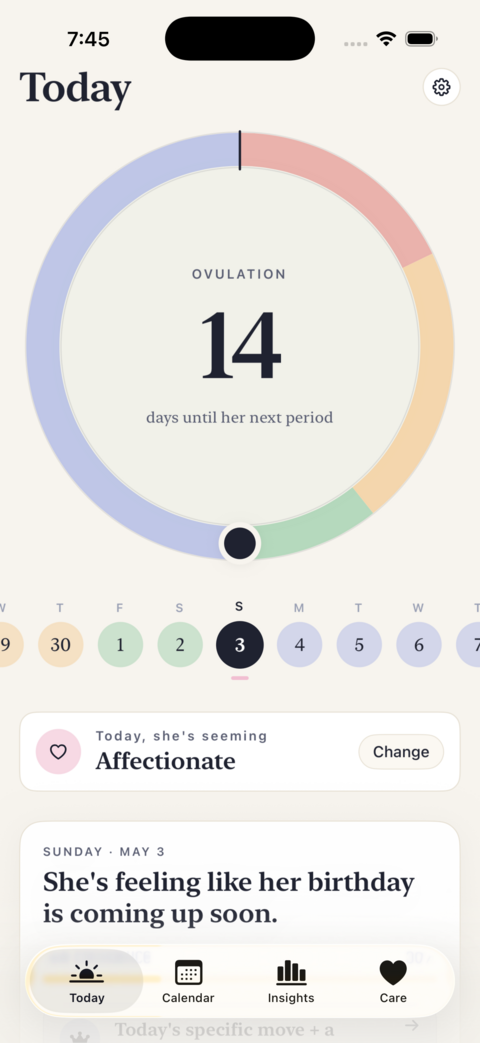
The cycle is not one event. It is four connected phases that loop roughly every month, each driven by a different mix of estrogen and progesterone. Once you know which phase she is likely in, the day stops feeling random. You can read energy, mood and comfort needs as part of a pattern, and Attune is built to surface that read in about ten seconds.
What are the four phases of the menstrual cycle?
The four phases are menstruation (the period, days 1 to 5), the follicular phase (the body prepares an egg, days 1 to 13), ovulation (an egg releases, around day 14), and the luteal phase (the body waits for pregnancy, days 15 to 28). The follicular phase overlaps with the period at the start of each cycle.
Day 1 is the first day of full flow, not spotting. Estrogen climbs through the follicular phase, peaks near ovulation, then progesterone takes over in the luteal phase. The Cleveland Clinic describes these as four distinct stages, each with its own hormone profile. The numbers above assume a 28-day cycle; for a 31-day cycle every later phase simply shifts a few days.
How long does each phase last?
Menstruation lasts 3 to 7 days. The follicular phase runs from day 1 until ovulation, usually 13 to 16 days, and is the part that varies most between people. Ovulation is a single day, though the fertile window around it spans roughly six days. The luteal phase is the steadiest, almost always 12 to 14 days.
The luteal phase rarely changes length, so when a whole cycle runs long or short, the follicular phase is usually the reason. Stress, travel, illness and poor sleep mostly stretch the follicular phase and push ovulation later. That is why a cycle can be 26 days one month and 31 the next without anything being wrong.
How do hormones change across the cycle?
Estrogen rises through the follicular phase and peaks just before ovulation, which often lifts energy, mood and sociability. After ovulation, progesterone rises to support a possible pregnancy, which can bring calm for some and tiredness or tension for others. Both hormones fall sharply before the period, the drop tied to many premenstrual symptoms.
This is the engine behind the mood shifts partners notice but cannot always place. The late-luteal hormone drop is when premenstrual symptoms cluster. Knowing the phase tells you whether low energy is likely temporary and hormonal or something worth a real conversation. It replaces "what did I do wrong" with "where is she in the cycle."
Why does knowing the phase help a partner?
Knowing the phase lets you time support instead of reacting after the fact. You can plan a heavier week when the luteal phase is likely, lean into social plans when estrogen is high, and offer comfort during the period without being asked. It turns vague observation into specific, well-timed follow-through.
None of this is about managing or labeling her. It is about paying attention with better information. The phase is a hypothesis, not a verdict, and her own words always outrank the model. Used that way, cycle awareness makes a partner more considerate and less likely to take a hard day personally.
Key takeaways
- The cycle has four phases: menstruation, follicular, ovulation and luteal.
- A normal cycle runs 21 to 35 days; 28 is just the textbook average.
- The luteal phase stays near 14 days, so length usually varies in the follicular phase.
- Estrogen peaks before ovulation; both hormones drop before the period.
- Knowing the phase lets you time comfort, plans and patience instead of reacting late.
Frequently asked questions
- Is a 28-day cycle normal?
- Yes, but it is an average rather than a rule. Cycles from 21 to 35 days are all considered normal in adults, and the same person can vary by a few days month to month. What matters more than the exact number is whether her cycles are roughly consistent for her, which Attune learns over time.
- Which phase causes mood changes?
- Most premenstrual mood changes happen in the late luteal phase, the days just before the period, when estrogen and progesterone both fall. Some people also notice an energy and mood lift around ovulation when estrogen peaks. Tracking which phase repeats with which mood is the fastest way to see her personal pattern.
- How do I know which phase she is in?
- Count from the first day of her last period. Roughly, days 1 to 5 are menstruation, days 6 to 13 are follicular, around day 14 is ovulation, and days 15 to 28 are luteal. Attune does this estimate for you from a single period start date and refines it as you log real observations.
- Can the cycle change month to month?
- Yes. Stress, travel, illness, poor sleep and big schedule changes can shift ovulation and make a cycle longer or shorter. The luteal phase usually holds steady, so the variation shows up before ovulation. Occasional swings are normal; a sudden, lasting change is worth a conversation with a clinician.
Cycle Literacy & Relationship Research, BigBalli. We translate cycle science into practical, respectful guidance for partners, cross-checked against sources including the Cleveland Clinic and ACOG.
Attune provides educational and relationship guidance, not medical advice or diagnosis. Cycle phase estimates are predictions, not clinical facts. For questions about irregular cycles, fertility or symptoms, talk to a qualified healthcare professional.