What Does RSSI Mean for Bluetooth Signal Strength?
Every advertising packet your phone hears comes with an RSSI reading. It is the radio telling you how loud that device sounded when the packet landed. Engineers use it to gauge proximity, find a device, diagnose a weak link, or map coverage. The number is always negative because it is measured in decibels relative to one milliwatt, and the signals are far below that reference.
What do RSSI numbers actually mean?
RSSI is reported in dBm, decibels relative to one milliwatt, as a negative value. A reading of minus 40 dBm means the device is very close, often within a meter. Minus 70 dBm is a typical room-distance signal. Below minus 90 dBm the link is weak and packets start dropping. The scale is logarithmic, so small number changes mean large power changes.
Because the scale is logarithmic, every 3 dBm drop roughly halves the received power. That is why moving a device a few feet can swing RSSI by 10 or more. Treat the number as a proximity hint, not a ruler. Walls, bodies, and metal all attenuate the signal, so two devices at the same distance can read very differently.
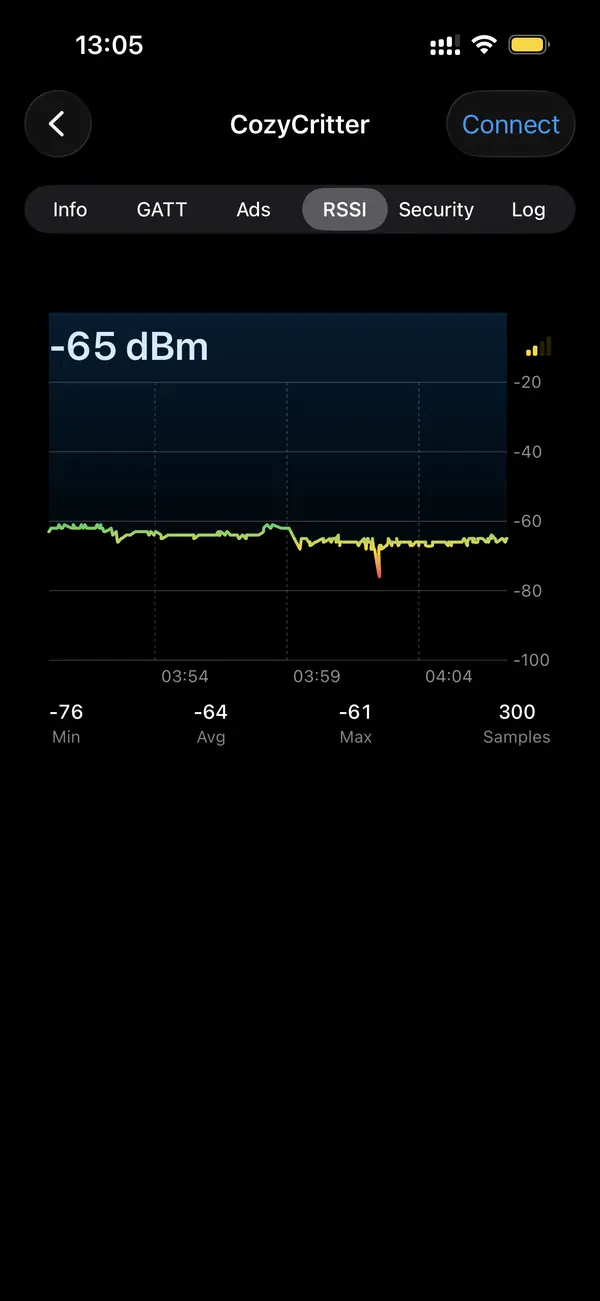
Can RSSI tell you exact distance?
No. RSSI estimates proximity but cannot give a precise distance. The relationship between signal strength and distance depends on transmit power, antenna design, orientation, and obstacles. You can build a rough distance model if you know a device's calibrated power at one meter, but in the real world reflections and absorption make any single reading approximate.
iBeacon includes a measured power field for exactly this reason: a one-meter reference that lets apps estimate near, immediate, and far zones. Even with that calibration, Apple buckets the result into coarse ranges rather than a number of meters. For reliable positioning you average many samples and accept that RSSI gives zones, not coordinates.
Why does RSSI jump around so much?
RSSI fluctuates because of multipath reflection, body blocking, antenna orientation, and interference from Wi-Fi and other 2.4 GHz radios. A device sitting still can swing 10 dBm between packets. This is normal radio behavior, which is why charts that show min, max, and a running average are far more useful than any single instantaneous reading.
BLE shares the crowded 2.4 GHz band with Wi-Fi, microwaves, and Zigbee. Your own hand near the phone's antenna can drop the signal noticeably. Averaging over a window smooths the noise so a real trend, like walking toward a device, stands out from the jitter. Watch the average line, not the spikes.
How do engineers use RSSI in practice?
Engineers use RSSI to locate devices with hot and cold proximity, run site surveys that map coverage as a heatmap, and diagnose flaky connections caused by weak signal. A steadily falling RSSI on a connected device often predicts a disconnect, so monitoring it helps catch range problems before they cause dropped links in production.
In a site survey you walk a floor plan, sample RSSI at marked points, and interpolate a heatmap that reveals dead zones. For finding a lost tag, you watch the average climb as you get warmer. For debugging, a connection that drops at minus 88 dBm tells you the device is at its range limit, not that the firmware is broken.
Key takeaways
- RSSI is received signal strength in dBm, always negative; closer to zero is stronger.
- Roughly: minus 40 is very close, minus 70 is a room away, minus 90 is the edge of range.
- The scale is logarithmic, so a 3 dBm change roughly halves or doubles power.
- RSSI estimates proximity zones, not exact distance, because obstacles distort it.
- Use min, max, and average charts; a single reading is too noisy to trust.
Frequently asked questions
- Is a higher RSSI better?
- RSSI is negative, so a number closer to zero is stronger and better. Minus 50 dBm is a stronger signal than minus 80 dBm. People sometimes say higher RSSI meaning a larger magnitude, which is actually weaker. Read it as: closer to zero means closer device and a more reliable link.
- What is a good RSSI for a stable BLE connection?
- Connections are generally reliable above roughly minus 80 dBm. Between minus 80 and minus 90 dBm you may see occasional packet loss and slower throughput. Below minus 90 dBm the link is fragile and prone to dropping. Moving closer or removing an obstruction usually restores a stable connection.
- Why is RSSI different on two phones for the same device?
- Antenna design, case material, and radio sensitivity vary between phone models, so absolute RSSI is not comparable across devices. What stays meaningful is the trend on a single phone: rising as you approach, falling as you move away. Use relative change, not absolute numbers, when comparing across hardware.
- Can I use RSSI to find a hidden device?
- Yes, with patience. Watch the averaged RSSI and move slowly; the value climbs toward zero as you near the device and falls as you move past it. This hot and cold method narrows a search area effectively, though reflections can create misleading peaks, so confirm by approaching from more than one direction.
Bluetooth & IoT Tooling, BigBalli. We build iOS tools for inspecting Bluetooth Low Energy and write guides cross-checked against the Bluetooth SIG specifications and Apple's Core Bluetooth documentation.
BLE Scanner is an engineering and diagnostic tool. RSSI readings are approximate and vary with hardware and environment. Use them as proximity estimates, not precise distance measurements, and inspect only devices you own or are authorized to test.