What Are the Conduit Bending Multipliers by Angle?
Every offset, saddle, and dogleg an electrician makes runs on a small set of numbers. Pick a bend angle, and its multiplier tells you how far apart to space your marks for a given rise. Memorize five of them and most field bends become arithmetic. The chart below is the one electricians keep in their head or on the bender.
What are the standard conduit bending multipliers?
The common multipliers are 6 at 10 degrees, 2.6 at 22.5 degrees, 2 at 30 degrees, 1.4 at 45 degrees, and 1.2 at 60 degrees. Each is one divided by the sine of the angle. Multiply your offset depth by the multiplier for the angle you choose to get the distance between the two bend marks for an offset.
| Bend angle | Multiplier | Shrink per inch of depth |
|---|---|---|
| 10 degrees | 6.0 | 1/16 in |
| 22.5 degrees | 2.6 | 3/16 in |
| 30 degrees | 2.0 | 1/4 in |
| 45 degrees | 1.4 | 3/8 in |
| 60 degrees | 1.2 | 1/2 in |
Read the chart left to right: the smaller the angle, the larger the multiplier and the longer, gentler the offset. Thirty degrees sits in the middle and earns its popularity from a clean multiplier of 2. The shrink column is the second number you need, covered below.
Where do the multipliers come from?
Each multiplier is the cosecant of the bend angle, which is one divided by the sine. For 30 degrees the sine is 0.5, so the multiplier is 2. For 45 degrees the sine is about 0.707, giving roughly 1.4. The values are rounded for field use, but they come straight from the trigonometry of a right triangle formed by the offset.
The offset depth is the vertical leg of that triangle and the mark spacing is the hypotenuse. Dividing depth by the sine of the angle gives the hypotenuse, which is the same as multiplying by the cosecant. You never have to run the trig on the job, but knowing the source explains why steeper angles need shorter mark spacing.
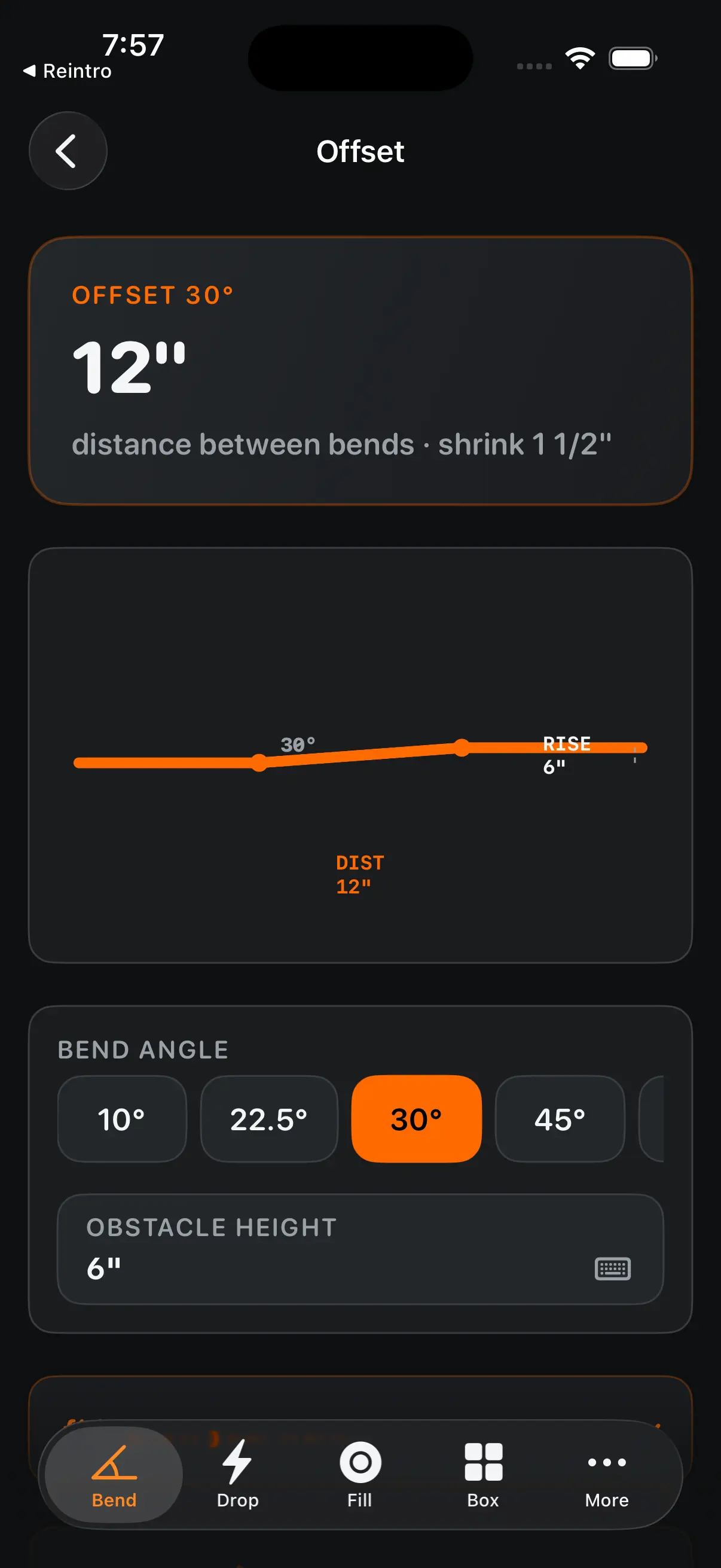
What is the shrink for each angle?
Shrink is how much the conduit shortens along the run as it climbs an offset, so you add it before measuring. Per inch of offset depth, shrink is about 1/16 inch at 10 degrees, 3/16 at 22.5, 1/4 at 30, 3/8 at 45, and 1/2 at 60 degrees. Steeper angles shrink more because the conduit rises over a shorter horizontal distance.
For a 4 inch offset at 30 degrees, shrink is 4 times 1/4, which is 1 inch. Add that inch to the distance from your reference to the first bend so the far end still reaches its box. Ignore shrink and the run lands short by exactly that amount. Multiplier sets the marks; shrink positions the whole offset.
Which angle should you choose?
Use 30 degrees for everyday offsets because the multiplier of 2 makes the math easy and the bend pulls wire smoothly. Choose 10 or 22.5 degrees for long, shallow offsets on a rack where you want a gentle sweep. Reach for 45 or 60 degrees only when an obstruction is close and the conduit has to rise sharply in a short space.
Shallow angles look cleaner on parallel runs and ease the pull, but they need more length to develop the offset. Steep angles fit tight quarters but shrink more and bind wire on a long pull. Matching the angle to the space and the run length is the judgment that separates a tidy rack from a fight at the box.
Key takeaways
- Multipliers: 6, 2.6, 2, 1.4 and 1.2 for 10, 22.5, 30, 45 and 60 degrees.
- Mark spacing equals offset depth times the multiplier for the chosen angle.
- Each multiplier is one divided by the sine of the angle.
- Shrink rises with angle: 1/16 to 1/2 inch per inch of depth across the chart.
- Thirty degrees is the everyday choice; steeper angles fit tight spaces.
Frequently asked questions
- What is the multiplier for a 30 degree bend?
- The multiplier for 30 degrees is 2, because the sine of 30 degrees is 0.5 and the multiplier is one divided by that. To space the marks for a 30 degree offset, multiply the offset depth by 2. A 5 inch offset needs marks 10 inches apart. This clean number is the main reason 30 degrees is the field default.
- Do multipliers change with conduit size?
- No. Multipliers depend only on the bend angle, so they are the same for half inch EMT and two inch rigid. What changes with size is the deduct for a 90, the minimum bend radius, and how much space the bend physically needs. The offset mark spacing from a multiplier stays constant across every conduit size.
- How accurate are the rounded multipliers?
- The rounded values are close enough for field bends. The true cosecant of 45 degrees is about 1.414, rounded to 1.4, a difference of a hundredth of an inch per inch of depth. On normal offsets that error is invisible. For long, precise runs, using the exact value from a calculator removes even that small gap.
- Can I use multipliers for saddles too?
- Saddles use their own mark-distance factors, not the simple offset multipliers. A three-point saddle with a 45 degree center uses a 2.5 center-to-outer factor, and the geometry differs from a two-bend offset. Use the offset multiplier chart for offsets and doglegs, and the saddle factors for saddles, since the bend layouts are not the same.
Conduit Bending & NEC Reference, BigBalli. We turn the formulas in Benfield and Ugly's Electrical References into quick, checkable field math.
BendMarks is a teaching and estimation tool, not a substitute for licensed professional judgment or the National Electrical Code. Verify bends against the job's specifications and the adopted code.