How Do You Bend a Conduit Offset?
An offset jogs a conduit up or over to clear an obstruction, then runs straight again. You make it with two equal bends in opposite directions. The whole job comes down to two numbers: how far apart your bend marks sit, and how much the conduit pulls back toward you as it rises, which benders call shrink.
What is the multiplier for a conduit offset?
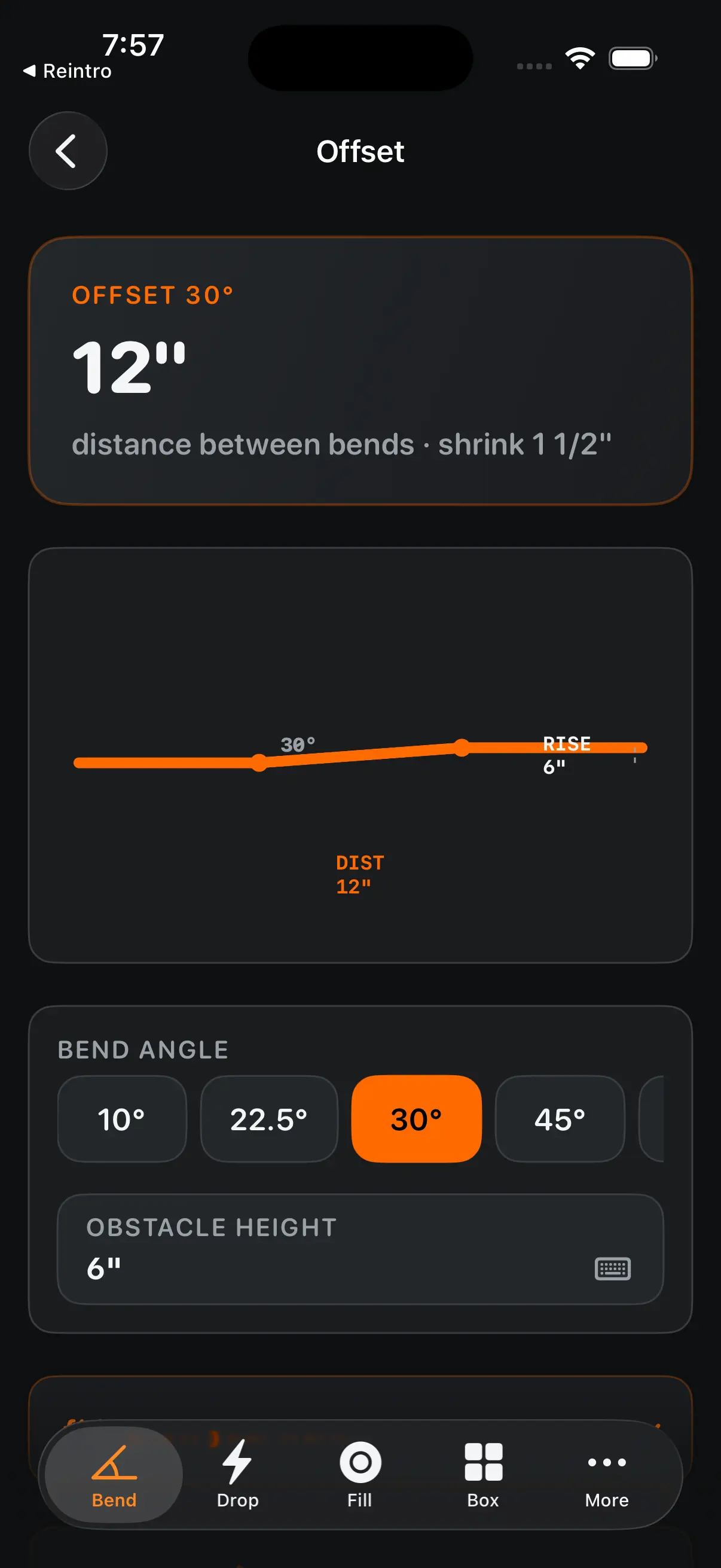
The offset multiplier converts the depth you need into the distance between your two bend marks. Multiply the offset depth by the multiplier for your chosen angle. Common values are 6 for 10 degrees, 2.6 for 22.5 degrees, 2 for 30 degrees, 1.4 for 45 degrees, and 1.2 for 60 degrees. Shallower angles give longer, gentler offsets.
Pick the angle first, then the multiplier follows. A 3 inch offset at 30 degrees needs marks 6 inches apart, because 3 times 2 is 6. The same 3 inch offset at 45 degrees needs marks only 4.2 inches apart. Shallow angles pull wire easier and look cleaner on a rack; steep angles fit tight spaces. Most field work lives at 30 degrees because the math is simple and the bend pulls smoothly.
How do you calculate offset shrink?
Shrink is how much shorter the conduit gets along its run as it climbs the offset, so your end mark moves toward the bender. Multiply the offset depth by the shrink constant for the angle: about 0.25 inch per inch at 30 degrees, 0.41 at 45 degrees, and 0.06 at 10 degrees. Add that shrink to your measurement before the first bend.
Ignore shrink and your box or coupling lands short. For a 6 inch offset at 30 degrees, shrink is roughly 1.5 inches, so a stub that needs to reach 48 inches gets measured and marked at 49.5 inches. Steeper angles shrink more because the conduit climbs faster over a shorter horizontal distance. This single correction separates a clean offset from one that fights the box.
How far apart should the two bend marks be?
Mark spacing equals the offset depth times the multiplier. Place the first mark where the offset should start, then measure along the conduit and make the second mark. Bend both at the same angle, in the same direction relative to the bender arrow, keeping the conduit flat so both bends sit in one plane and the run stays straight.
The order of operations matters. Bend the first mark, rotate the conduit 180 degrees in the same plane, line up the second mark, and bend again to the identical angle. If the second bend twists out of plane, the offset doglegs and the conduit will not lie flat against the wall. Sighting down the pipe after the first bend keeps the two legs honest.
Why does my offset come out crooked?
A crooked offset almost always means the second bend was made out of plane, the conduit rotated between bends, or the two angles do not match. Keep the bender arrow pointed the same way, bend both marks to the same degree stop, and sight down the conduit before you pull the second bend to confirm both legs share one flat plane.
The other common miss is a dogleg, where the offset twists like a corkscrew. It happens when the pipe rolls in the shoe between bends. Mark a reference line down the top of the conduit with a marker, keep that line up for both bends, and the offset stays planar. A wavy offset wastes pipe and looks rough on inspection.
Key takeaways
- Mark distance equals offset depth times the angle multiplier; 30 degrees uses 2.
- Add shrink before measuring; a 30 degree offset shrinks about 0.25 inch per inch of depth.
- Bend both marks to the same angle in the same plane to avoid a dogleg.
- Shallow angles pull wire easier; steep angles fit tight spaces but shrink more.
- Sight down the conduit after the first bend to keep the second one honest.
Frequently asked questions
- What angle is best for a conduit offset?
- Thirty degrees is the field default because its multiplier is a clean 2 and the bend pulls wire smoothly. Use shallower angles like 10 or 22.5 degrees for long, gentle offsets on a rack, and steeper angles like 45 or 60 degrees only when an obstruction sits close and you need the run to climb fast.
- How do I find the multiplier for an angle?
- The multiplier is one divided by the sine of the bend angle. For 30 degrees the sine is 0.5, so the multiplier is 2. You do not have to do the trig in the field. Most benders stamp common multipliers on the handle, and a calculator app stores the full set so you can pick any angle.
- Does conduit size change the offset math?
- The multiplier and shrink stay the same for any size, since they come from the bend angle, not the pipe. What changes is the minimum bend radius and the gain at the bend. Larger conduit needs more space to make the same angle, so confirm the offset depth still clears the obstruction once the bigger pipe is in place.
- What is the difference between offset and shrink?
- Offset is the depth the conduit rises or shifts to clear something. Shrink is the length the conduit loses along its straight run as it makes that climb. You set the offset by the marks you space; you compensate for shrink by adding length before the first bend so the far end still reaches its target.
Conduit Bending & NEC Reference, BigBalli. We turn the formulas in Benfield and Ugly's Electrical References into quick, checkable field math.
BendMarks is a teaching and estimation tool, not a substitute for licensed professional judgment or the National Electrical Code. Always verify bends and clearances against the adopted code and the job's specifications.