How Do You Calculate Box Fill?
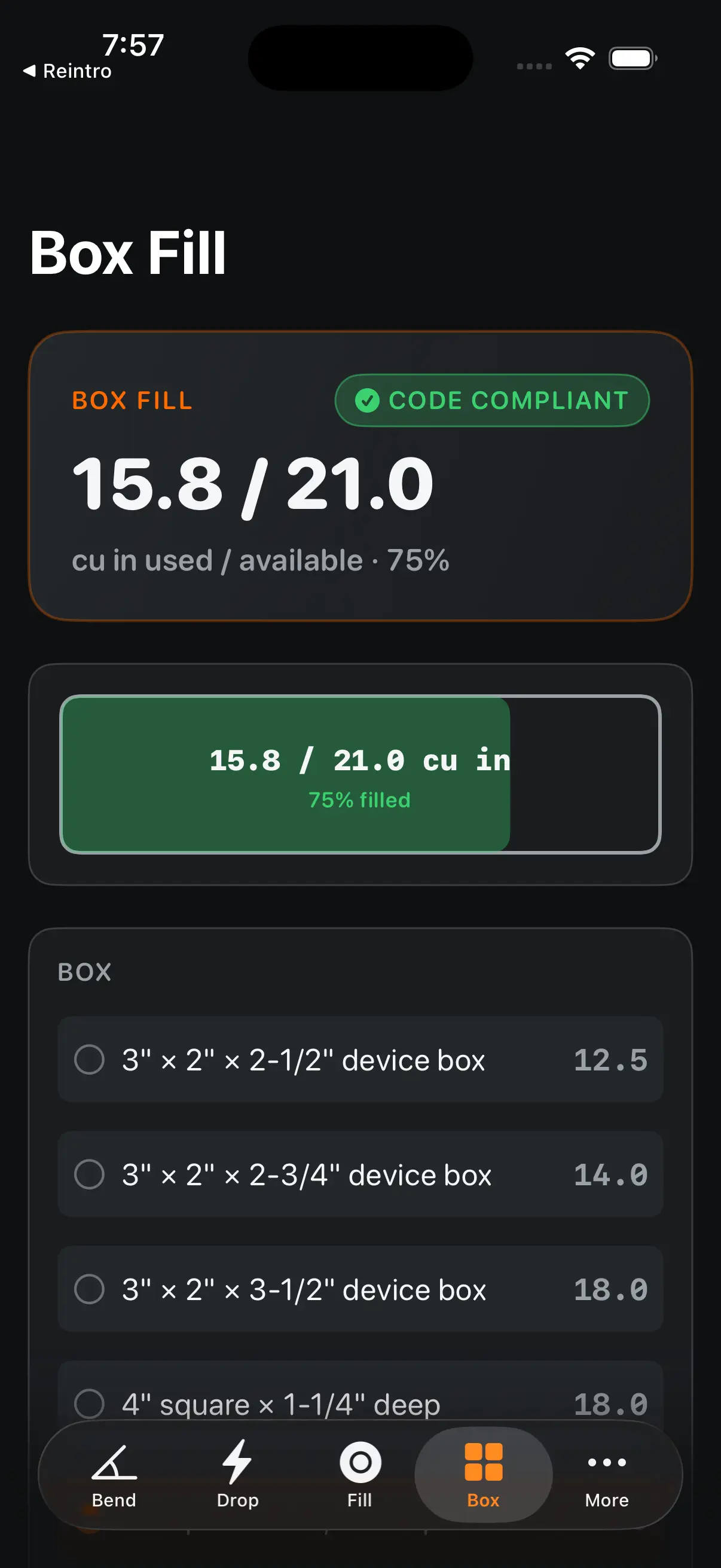
Cram too much into a box and you cannot fold the wires back, the device will not seat, and heat builds with no room to escape. Box fill is the NEC's way of keeping that from happening. It assigns a volume allowance to everything inside the box, sums them, and compares the total to the box's rated capacity in cubic inches.
How do you count conductors for box fill?
Each current-carrying conductor that enters the box and terminates or passes through counts as one. A conductor that runs in and out unbroken still counts once. Conductors that begin and end inside the box, like pigtails, do not count. Use NEC Table 314.16(B) to find the volume per conductor by its gauge: 2.0 cubic inches for 14 AWG, 2.25 for 12 AWG, and 2.5 for 10 AWG.
Count by the largest conductor present when sizes differ, applying that conductor's volume to the device and clamp allowances. A box with three 12 AWG and one 14 AWG conductor counts four conductor units, with the device and clamp allowances figured at the 12 AWG value of 2.25 cubic inches. Tally the conductor units first, then add the other items.
How do devices and clamps add to box fill?
A yoke or strap holding a device, like a switch or receptacle, counts as two conductor volumes based on the largest conductor connected to it. All internal cable clamps together count as one conductor volume, figured on the largest conductor in the box. A support fitting like a stud or hickey also counts as one. Add each allowance once, not per item.
So a single receptacle on 12 AWG adds 2 times 2.25, which is 4.5 cubic inches. If the box has internal clamps, add one more 2.25 for all of them combined. These allowances exist because the device body and the clamp hardware physically take up room that conductors would otherwise use, even though they are not conductors themselves.
How are grounding conductors counted in box fill?
All equipment grounding conductors in the box together count as a single conductor volume, based on the largest grounding conductor present. If an isolated grounding conductor is also present, it adds one more allowance. So a box with four bare grounds still adds just one ground unit, sized to the biggest of them, not four separate units.
This single-unit rule keeps the count realistic, since grounds bundle and twist together into little space. Use the largest ground's gauge for its allowance. A box with several 12 AWG grounds adds 2.25 cubic inches for all of them. Forgetting the ground allowance entirely is a frequent miss that makes a box look legal when it is actually over.
What happens if a box is over fill?
An overfilled box fails inspection and is a real hazard: conductors get nicked folding them in, devices will not seat flush, and trapped heat ages insulation. The fix is a larger or deeper box, a box extension ring that adds listed volume, or moving some conductors to a separate junction box. Never force an over-fill count to pass.
Plaster rings and extension rings carry their own marked volume that adds to the box, often enough to clear a tight count. When a metal box has no marked volume, use the value from Table 314.16(A) for its size. The cleanest fix on a remodel is usually a deeper box, since it adds capacity without changing the opening in the wall.
Key takeaways
- Each conductor through or into the box counts as one volume by its gauge.
- A device on a yoke counts as two; all clamps together count as one.
- All equipment grounds together count as a single allowance by the largest gauge.
- Per-conductor volumes are 2.0, 2.25 and 2.5 cubic inches for 14, 12 and 10 AWG.
- Over fill needs a deeper box, an extension ring, or a separate junction box.
Frequently asked questions
- Do pigtails count toward box fill?
- No. A conductor that both originates and ends inside the box, such as a short pigtail jumper, is not counted in box fill. Only conductors that enter the box from outside count, whether they terminate on a device or pass straight through. This keeps you from penalizing the small jumpers used to connect grounds and neutrals together.
- Which conductor size do I use for the device allowance?
- Use the largest conductor connected to that device. If a receptacle has both 12 and 14 AWG conductors landing on it, figure its two-unit allowance at the 12 AWG volume of 2.25 cubic inches each. The device allowance always follows the biggest conductor attached to the yoke, not the smallest or an average.
- Where do I find a box's volume?
- Standard metal boxes have their cubic-inch volume stamped inside or listed in NEC Table 314.16(A) by box type and size. Nonmetallic boxes are marked with their volume. Add any plaster ring or extension ring volume, which is marked on the ring, to the box's volume before comparing it to your total fill count.
- Does a single receptacle and ground always fit a standard box?
- Not always. A common single-gang box around 18 cubic inches fits a typical receptacle, two or three 12 AWG conductors, and a ground, but adding clamps, a second cable, or larger wire can push it over. Always run the count rather than assuming. The margin disappears fast once you add a second device or jump to 10 AWG.
Conduit Bending & NEC Reference, BigBalli. We turn the formulas in Benfield and Ugly's Electrical References into quick, checkable field math.
BendMarks is a teaching and estimation tool, not a substitute for licensed professional judgment or the National Electrical Code. Confirm box volumes and allowances against the adopted code edition and the box markings.