How Do You Calculate Conduit Fill?
Stuff too many wires in a pipe and you cannot pull them, the insulation overheats, and the inspector red-tags the job. Conduit fill is the rule that prevents it. It caps how much of the pipe's inside area the conductors can occupy, leaving room to pull and to shed heat. The math is just adding areas and comparing to a percentage.
What is the maximum conduit fill percentage?
NEC Chapter 9, Table 1 sets the limits by conductor count: 53 percent for a single conductor, 31 percent for exactly two conductors, and 40 percent for three or more. Three or more is the case on most real jobs, so 40 percent is the number you reach for most often. The limits leave room to pull wire and to dissipate heat.
The two-conductor case is the strictest at 31 percent because two round wires pack poorly and bind during a pull. Once you have three or more, they nest better, so the code allows 40 percent. A single conductor in a sleeve gets the most generous 53 percent. These percentages are of the conduit's total internal area, not its diameter.
How do you calculate conduit fill step by step?
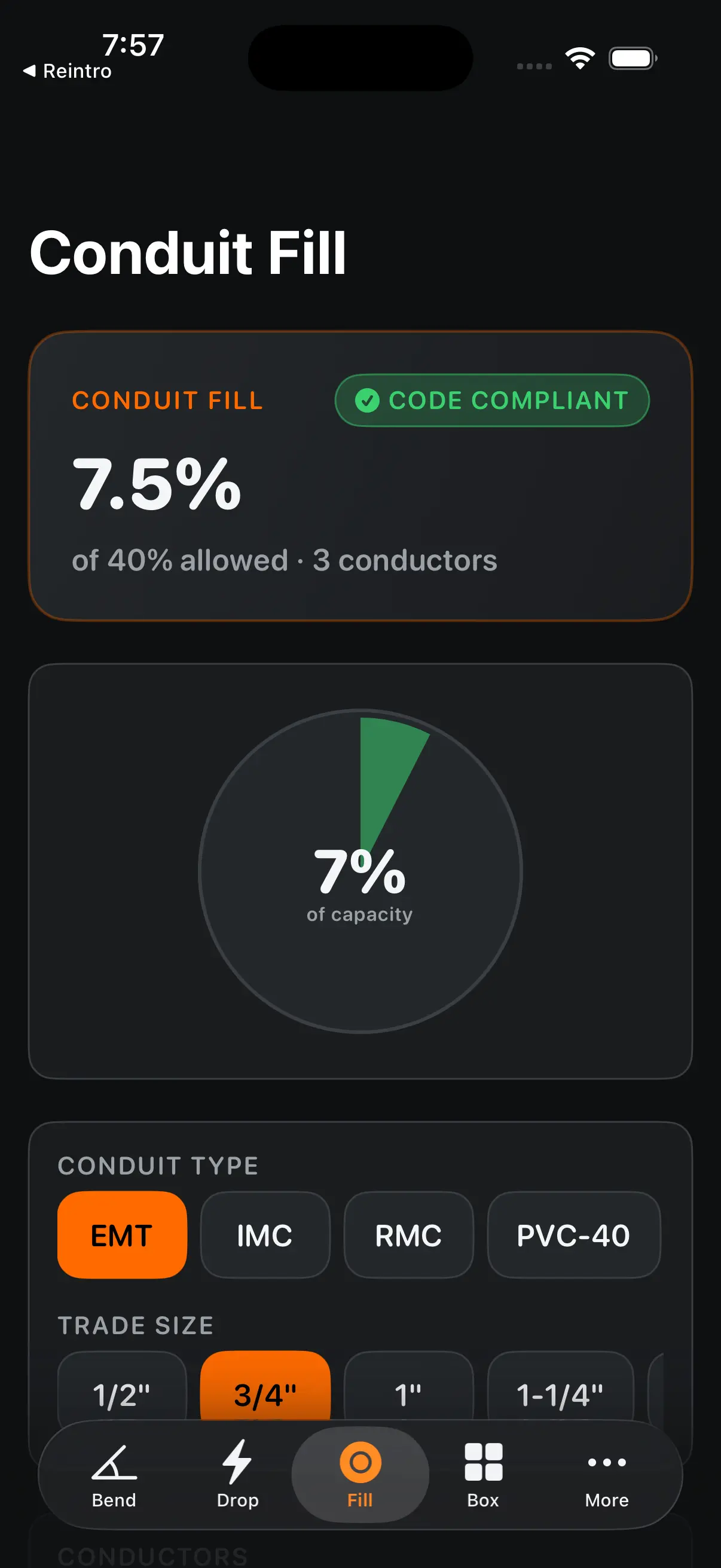
Look up each conductor's cross-sectional area in NEC Chapter 9 Table 5, add the areas for all conductors, and look up the conduit's total internal area in Table 4. Multiply the conduit area by the allowed percentage, usually 0.40, and confirm your conductor total is at or below that figure. If it is over, step up to the next conduit size.
For example, three 12 THHN conductors are 0.0133 square inch each, totaling 0.0399 square inch. Half inch EMT has an internal area of 0.304 square inch; 40 percent of that is 0.1216 square inch. Since 0.0399 is well under 0.1216, the fill passes easily. The same conductors in many more counts is where you start bumping pipe size.
Why does insulation type change the answer?
Conductor area depends on the insulation, not just the copper. THHN is thin-wall and packs tightly, while XHHW and RHH with their thicker jackets take more room for the same AWG. The same gauge can change conduit-size requirements depending on insulation, so always pull the area from the row in Table 5 that matches your exact conductor type.
A 12 AWG THHN conductor is 0.0133 square inch, but a 12 AWG XHHW is larger because of its jacket. Mixing the wrong row into your total understates the fill and can let you pull a pipe that is actually overstuffed. The insulation marking on the wire tells you which Table 5 row to use, so read it before you sum.
Do equipment grounds count toward conduit fill?
Yes. Every conductor in the conduit counts toward fill, including the equipment grounding conductor, even though it is not current-carrying for ampacity derating. Use its actual cross-sectional area from Table 5. The grounding conductor adds to the total area the same as any phase or neutral, so include it before comparing to the 40 percent limit.
People often leave the ground out of the fill math because it is excluded from the separate count used for ampacity adjustment. Those are two different calculations. For fill, physical space is what matters, and the ground occupies space. Forgetting it is a common way to size a conduit one notch too small on a tightly loaded run.
Key takeaways
- Fill limits are 53 percent for one conductor, 31 for two, and 40 for three or more.
- Sum conductor areas from Table 5, compare to the percentage of conduit area from Table 4.
- Insulation type changes conductor area; use the exact Table 5 row.
- Equipment grounds count toward fill even though they are excluded from ampacity derating.
- If you exceed the limit, step up to the next conduit size.
Frequently asked questions
- Why is the limit 40 percent and not higher?
- The 40 percent cap for three or more conductors leaves room to pull the wire without damaging insulation and lets heat escape so conductors stay within their temperature rating. Packing a pipe tighter makes pulls harder, risks scraped insulation, and traps heat. The percentage is a long-standing balance between using the pipe efficiently and keeping the install safe and pullable.
- Does conduit fill apply to all conduit types?
- Yes, the percentage limits in Chapter 9 Table 1 apply across EMT, IMC, rigid, PVC and others, but each type has its own internal area in Table 4. A half inch EMT and a half inch PVC do not have identical interior areas, so use the Table 4 row for the specific raceway you are filling before applying the 40 percent figure.
- What if all my conductors are the same size?
- When every conductor is the same size and insulation, you can use the quick tables in Annex C, which list the maximum number of that conductor allowed in each conduit size. They already apply the fill percentage for you. For mixed sizes or insulations, fall back to summing areas from Table 5 against Table 4.
- Do I count the neutral in conduit fill?
- Yes. The neutral is a conductor and occupies space, so it counts toward fill regardless of whether it is considered current-carrying for ampacity adjustment. Include the neutral's area from Table 5 in your total. The only conductors excluded from fill are those not present in the raceway, so every wire you pull gets added.
Conduit Bending & NEC Reference, BigBalli. We turn the formulas in Benfield and Ugly's Electrical References into quick, checkable field math.
BendMarks is a teaching and estimation tool, not a substitute for licensed professional judgment or the National Electrical Code. Confirm fill against the adopted code edition and the actual conductor markings.