What Is the Voltage Drop Calculation Formula?
Push current down a long wire and some of your voltage is lost as heat before it reaches the load. That loss is voltage drop. On a short run it is trivial; on a long pull to a far panel, pump, or sign, it can dim lights, trip motor protection, and waste energy. The fix is sizing the conductor before you pull it, not after.
What is the voltage drop formula?
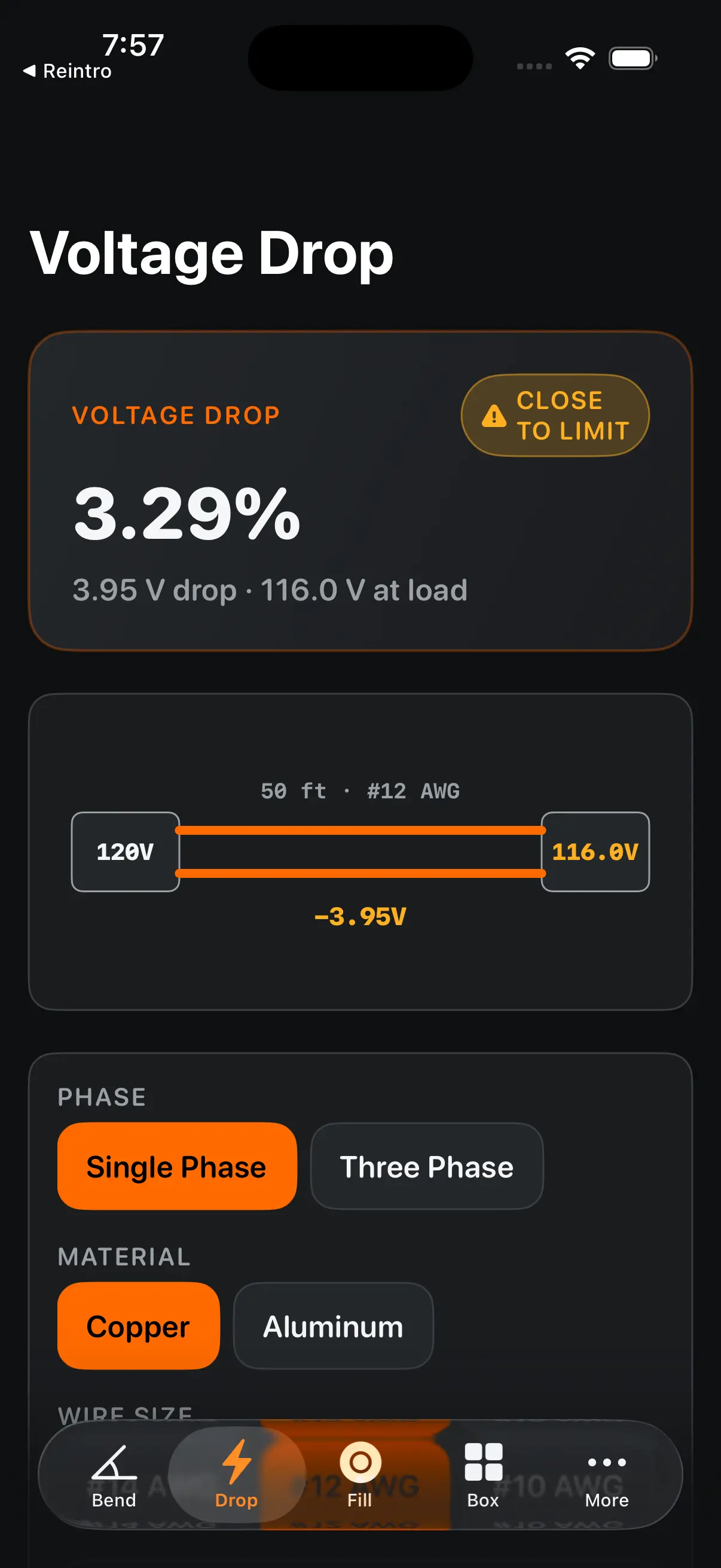
For single-phase, voltage drop equals 2 times K times I times L divided by circular mils, where K is the conductor resistivity constant, 12.9 for copper and 21.2 for aluminum, I is current in amps, and L is the one-way length in feet. The 2 accounts for the current traveling out and back. Divide the result by the supply voltage and multiply by 100 to get the percentage.
The circular mils figure comes from the conductor size. A 12 AWG copper conductor is 6,530 circular mils; 10 AWG is 10,380. Larger wire means more circular mils, which shrinks the drop. The formula is the field-friendly version of Ohm's law applied to the conductor's resistance over distance, and it matches the values in NEC Chapter 9, Table 8.
How is three-phase voltage drop different?
Three-phase voltage drop uses 1.732, the square root of 3, in place of the 2 used for single-phase. The formula becomes 1.732 times K times I times L divided by circular mils. The lower multiplier means a three-phase circuit drops less voltage than a single-phase one carrying the same current over the same distance, which is one reason long runs favor three-phase.
The change reflects how the phases share the return path. In single-phase, current runs out one conductor and back another, so you count both legs. In a balanced three-phase circuit, the phase relationship reduces the effective length factor to 1.732. Pick the right multiplier for the system or your result will be off by a fixed ratio every time.
What voltage drop does the NEC allow?
The NEC does not mandate a hard limit in most cases, but informational notes recommend no more than 3 percent drop on a branch circuit and no more than 5 percent combined for the feeder and branch circuit together. Sensitive loads, long motor runs, and some local amendments call for tighter limits, so check the spec and the adopted code.
| Run | Recommended max drop |
|---|---|
| Branch circuit only | 3 percent |
| Feeder only | 3 percent |
| Feeder plus branch (total) | 5 percent |
These percentages are guidance, found in notes to NEC 210.19 and 215.2, not enforceable rules in the base code. Many engineers write them into project specifications, which makes them binding for that job. When in doubt, size to 3 percent on the branch and you will almost always satisfy both the note and the spec.
How do you fix excessive voltage drop?
The direct fix is a larger conductor, since drop falls as circular mils rise. Going up one or two wire sizes on a long run usually pulls the drop back under 3 percent. Other options are raising the system voltage, shortening the run, balancing the load across phases, or splitting a heavy load onto separate circuits.
Upsizing is the most common move because it needs no design change beyond the wire and the conduit fill check. Bumping a 12 AWG branch to 10 AWG on a 150 foot run can cut the drop nearly in half. Confirm the bigger conductor still fits the conduit and that terminations are rated for the larger size before you commit to the pull.
Key takeaways
- Single-phase drop equals 2 times K times I times L over circular mils.
- Three-phase uses 1.732 instead of 2, giving a smaller drop for the same load.
- K is 12.9 for copper and 21.2 for aluminum; L is the one-way run in feet.
- Aim for under 3 percent on a branch and under 5 percent feeder plus branch.
- Upsizing the conductor is the simplest fix for a long run that fails.
Frequently asked questions
- Is voltage drop a code requirement?
- In the base NEC it is mostly guidance, given as informational notes recommending 3 percent on a branch and 5 percent total. A few sections, such as those for fire pumps and sensitive equipment, set firmer limits, and project specs often make the percentages binding. Always check the adopted code and the job specification for the run you are sizing.
- Do I use one-way or round-trip length?
- Use the one-way length in the formula and let the multiplier handle the return path. The 2 in the single-phase equation already doubles for the out-and-back trip, and the 1.732 does the equivalent for three-phase. If you plug in the round-trip distance and keep the 2, you double-count and overstate the drop.
- Does aluminum drop more voltage than copper?
- Yes, for the same size. Aluminum has higher resistivity, so its K value is 21.2 against copper's 12.9. An aluminum conductor drops more voltage over the same length and current, which is why aluminum feeders are often sized a step or two larger than the copper equivalent to land under the same percentage target.
- What current do I use, running or starting?
- For general circuits use the continuous load current. For motors, also check the drop at starting, since inrush can be several times the running current and a large momentary dip can prevent the motor from starting. Sizing for running current keeps steady-state drop in range; checking starting current protects against nuisance trips and stalls.
Conduit Bending & NEC Reference, BigBalli. We turn the formulas in Benfield and Ugly's Electrical References into quick, checkable field math.
BendMarks is a teaching and estimation tool, not a substitute for licensed professional judgment or the National Electrical Code. Size conductors against the adopted code, the equipment ratings, and the project specification.