Why isn't 99.9% coverage the same as a total solar eclipse?
Last updated 2026-08-02
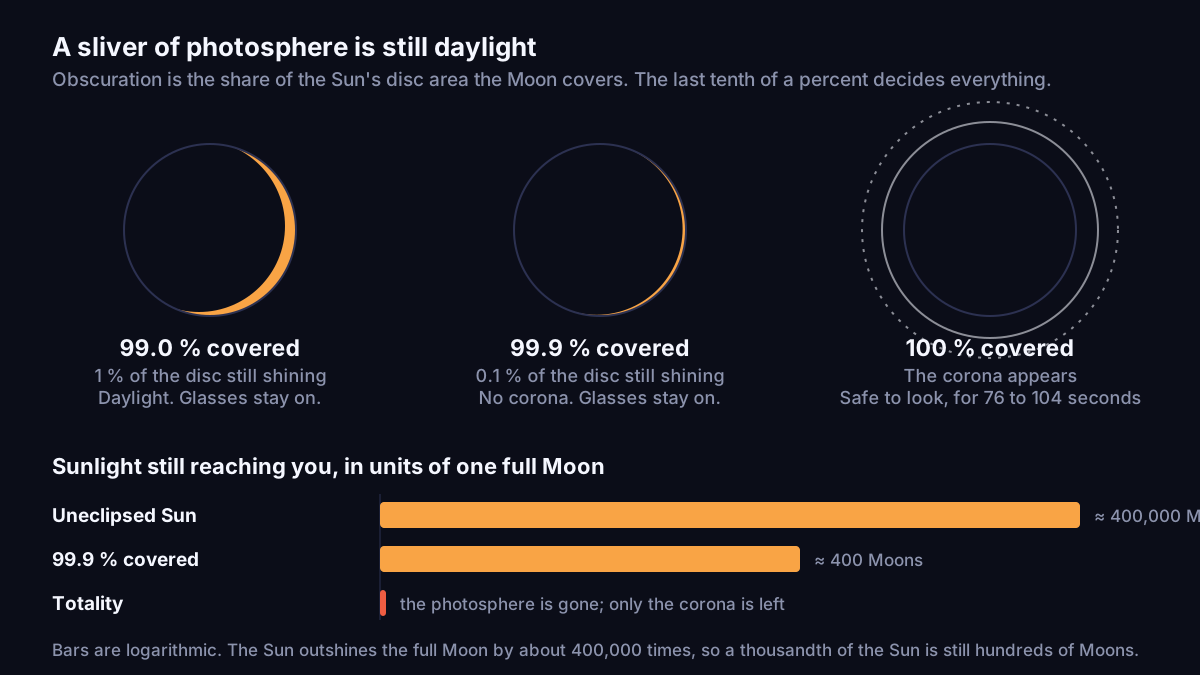
At 99.9 percent obscuration a thin arc of photosphere is still shining, and that arc is roughly 400 times brighter than a full Moon. The corona stays invisible, the sky stays blue, and certified filters stay on. Totality is a different phenomenon rather than a stronger version of the same one.
Obscuration measures how much of the Sun's visible disc the Moon covers, and the last tenth of a percent carries almost all the meaning. Madrid reaches about 99.90 percent on 12 August 2026 and sees no corona at all. Alcobendas, 15 kilometres north, reaches 100 percent and sees the full event. The gap between those two numbers looks trivial written down and is enormous in the sky.
How much light does 99.9 percent actually leave?
Enough to keep the sky bright. The Sun outshines a full Moon by around 400,000 times, so leaving one thousandth of the disc uncovered leaves something in the order of 400 full Moons overhead. Your eyes adapt, the light looks strange and metallic, and it remains unmistakably daylight.
Human vision makes this worse rather than better. The eye responds to brightness roughly logarithmically, so a hundredfold drop in light reads as a modest dimming. People at 99 percent frequently report that the eclipse looked underwhelming, then conclude eclipses are overrated. They watched a genuinely different event.
What do you actually miss without totality?
The corona, which is the reason people travel for these. Also the horizon glow in every direction, planets and bright stars in the daytime sky, the temperature drop, the shadow arriving across the landscape, and the diamond ring at each end. None of these appear at 99.9 percent.
The corona is the Sun's outer atmosphere, extending several solar radii into space. It is about as bright as a full Moon, which is precisely why the photosphere has to be gone completely before you can see it. Any remaining sliver overwhelms it, in the same way that a streetlight overwhelms the Milky Way.
On 12 August the Sun sits between 2 and 12 degrees above the horizon in Spain, so observers inside the band get an unusual version of this: a corona hanging just above the skyline with sunset colours wrapped around the whole horizon. Observers outside the band get a bright crescent low in the west.
Is it safe to remove glasses at 99.9 percent?
No. Any uncovered photosphere is direct sunlight and can damage the retina without pain, since the retina has no pain receptors. Certified ISO 12312-2 filters come off only during totality itself, and only if you are genuinely inside the umbral band. Outside it, they stay on throughout.
This is the specific reason a near miss is dangerous rather than merely disappointing. In a place like Madrid, the sky darkens enough that removing the glasses feels reasonable, and the remaining sliver is still bright enough to cause injury. Being told plainly that your location does not reach totality is a safety instruction, not a technicality.

How far do you need to travel to fix it?
Often less than 20 kilometres, which is the cruel part. From central Madrid the nearest municipality inside the band is Alcobendas, roughly 15 kilometres north. Distance is rarely the obstacle on 12 August 2026. Traffic, parking and a clear western horizon are the obstacles.
Where you start from decides how bad the problem is. From Madrid the nearest municipality inside the band is Alcobendas. From Barcelona the band lies west and south, through Lleida and Tarragona. From Seville, Málaga or the Canary Islands there is no short drive at all, because the umbra never touches Andalusia and the nearest inside-band territory sits in Segovia and Guadalajara, several hundred kilometres north.
Aim past the edge rather than at it. A site a few hundred metres inside the umbral limit gets a second or two of totality and no margin for an error in your position or in the published boundary. A site near the centre line gets the full duration and survives a wrong turn. Where the towns around you disagree with each other, treat that as a signal to keep driving north.
Eclipse answers one question: does totality reach you, or not. It reports the IGN verdict for 7,531 municipalities and names the nearest town inside the band when yours is outside.

Key takeaways
- Obscuration of 99.9 percent leaves roughly 400 full Moons worth of direct sunlight in the sky.
- The corona is about as bright as a full Moon, so any surviving sliver of photosphere hides it completely.
- Madrid reaches about 99.90 percent and sees no corona. Alcobendas, 15 kilometres north, reaches totality.
- Certified filters come off only during totality, and only inside the band. A deep partial eclipse is not an exception.
- Aim for the centre line rather than the edge, so a small positioning error does not cost the whole event.
Frequently asked questions
Is a 99 percent partial eclipse worth watching?
It is worth watching and it is not the same event. A deep partial eclipse dims the light, sharpens shadows and cools the air noticeably. It does not produce the corona, the horizon glow or the visible planets. Observers who have seen both rarely treat them as comparable.
How much brighter is 99.9 percent coverage than totality?
The Sun outshines a full Moon by roughly 400,000 times. Leaving 0.1 percent of the solar disc uncovered therefore leaves something around 400 full Moons of direct sunlight in the sky. During totality the photosphere is hidden completely and only the corona remains.
Can I take my eclipse glasses off at 99.9 percent?
No. Any exposed photosphere can damage your retina, and a sliver that thin is still direct sunlight. Certified filters come off only during totality itself, and only if you are genuinely inside the umbral band. Outside the band they stay on for the entire eclipse.
How far would I have to travel from Madrid to reach totality?
Alcobendas, about 15 kilometres north of central Madrid, falls inside the band according to the Instituto Geográfico Nacional. That is a short distance on paper. On 12 August 2026 the roads north out of the city will carry a large share of the metropolitan population.