Will clouds ruin the total solar eclipse in Spain?
Last updated 2026-08-02
AEMET gives the Cantabrian coast a 30 to 50 percent chance of clear sky during eclipse hours, against 50 to 70 percent for the interior plateau and the Ebro valley. That is climatology rather than a forecast. Wildfire smoke is the second risk, and a low Sun makes it worse.
Cloud is the one variable no calculation answers, and it is the variable most likely to decide whether 12 August 2026 works. The path of totality happens to run along the cloudiest strip of summer Spain, while the reliably clear southern half of the country sees no totality at all. AEMET published a study in May 2026 quantifying exactly that trade off, and it is the most useful planning document available for this eclipse.
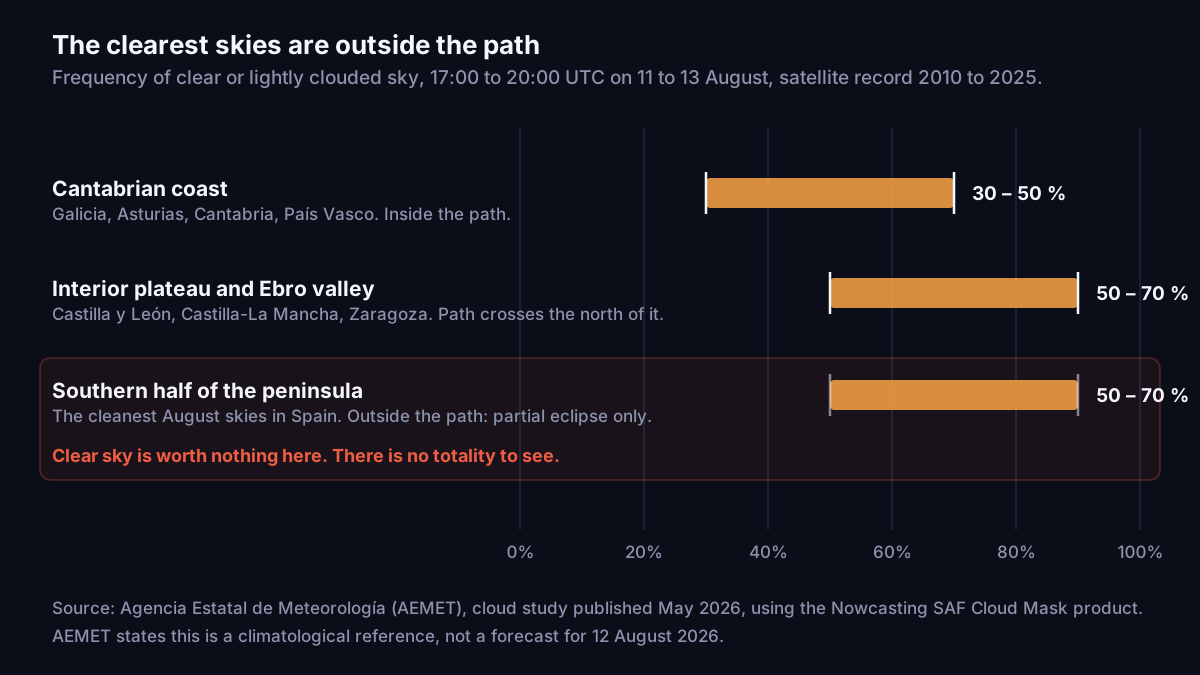
How often is the sky clear in mid August?
AEMET analysed satellite cloud records from 2010 to 2025 for 11, 12 and 13 August between 17:00 and 20:00 UTC, the eclipse window. The northern coastal strip returned a 30 to 50 percent frequency of clear sky. Much of Castilla y León, Castilla-La Mancha and the Ebro valley returned 50 to 70 percent.
The method used the Cloud Mask product from the Nowcasting Satellite Application Facility, which is a direct satellite measurement rather than a station observation. AEMET is explicit that the result is a climatological reference and does not predict what will happen on the day.
Eclipsophile's independent analysis of the same track agrees on the shape. It puts satellite measured August cloud cover near 60 percent along the Bay of Biscay, around 35 percent across the central plateau, and below 30 percent over the Ebro floodplain around Zaragoza and Huesca. Soria averages 73 percent of possible sunshine in August and Logroño 67 percent.
Which parts of the path have the best odds?
The Ebro valley around Zaragoza and Huesca has the best cloud statistics of anywhere inside the band, followed by the southern edge of the Castilla y León plateau. The Cantabrian coast through Oviedo, Santander and Bilbao has the worst, despite offering the highest Sun and a flat sea horizon.
That creates a genuine conflict. The coast gives you 10 to 12 degrees of Sun altitude and a guaranteed unobstructed horizon, both of which matter a great deal at this eclipse. It also carries roughly double the cloud risk of the Ebro valley, where the Sun sits lower and terrain has to be checked. There is no site that wins on every axis, and pretending otherwise makes for bad planning.
The compromise worth considering is the Burgos, Palencia and Soria corridor: about 8 degrees of altitude, roughly 104 seconds of totality, and interior cloud statistics rather than coastal ones.
Could wildfire smoke affect the view?
Yes, and 2026 is a bad year for it. More than a dozen major wildfires were burning in Spain in late July, including one in Guadalajara that has covered over 32,000 hectares since 24 July and one in Ávila exceeding 50,000 hectares since 22 July. Smoke degrades a low Sun disproportionately.
Becky Wagner, an air quality and climate researcher at the University of Sheffield, has pointed out the specific mechanism: because totality in Spain happens at 2 to 12 degrees altitude, sunlight travels through a much longer path of atmosphere than it would at midday. Haze that would be barely noticeable overhead can dim or wash out the corona and the diamond ring entirely. Smoke particles also persist for days to weeks and travel long distances, so a fire nowhere near your site can still cost you the view.
Nothing about this is predictable ten days out. It is a reason to keep the plan flexible rather than a reason to change it now.
A clear sky over the wrong place is worth nothing. The southern half of Spain has the best August skies in the country and sees a partial eclipse only. Optimising for weather at the cost of leaving the path of totality is the most common way to get this decision wrong.
When is the forecast worth acting on?
Treat anything past five days as background noise. Real signal for a specific location arrives around 48 to 72 hours out, and the hourly detail that separates two nearby sites firms up inside 24 hours. Plan a destination and a fallback within driving distance, then choose between them late.
Book accommodation that lets you drive somewhere else on the morning of the twelfth, and pick a fallback in a different meteorological regime rather than 20 kilometres down the same valley. Coast and interior fail for different reasons, which is what makes them a useful pair.
Eclipse shows the hourly cloud forecast at maximum eclipse for your location, and says plainly when the forecast is still too far out to be worth acting on.

Key takeaways
- AEMET gives the Cantabrian coast 30 to 50 percent clear sky at eclipse hour, and the interior 50 to 70 percent.
- The study covers 2010 to 2025 for 11 to 13 August, 17:00 to 20:00 UTC. AEMET states it is not a forecast.
- The Ebro valley around Zaragoza has the best cloud statistics inside the band, below 30 percent average August cover.
- Wildfire smoke hits a 2 to 12 degree Sun far harder than a midday one, and 2026 has been an active fire season.
- Pick a primary site and a fallback in a different weather regime, then decide between them 24 to 72 hours out.
Frequently asked questions
Where in Spain has the best chance of clear sky for the eclipse?
Inside the path, the interior plateau and the Ebro valley score best, with AEMET giving 50 to 70 percent clear or lightly clouded sky during eclipse hours. Eclipsophile puts average August cloud cover below 30 percent around Zaragoza. The Cantabrian coast is the weakest part of the track.
Is the AEMET cloud study a forecast for 12 August 2026?
No, and AEMET says so explicitly. The study analyses satellite cloud records from 2010 to 2025 for 11, 12 and 13 August between 17:00 and 20:00 UTC. It describes how often the sky has been clear at that hour historically. It predicts nothing about this particular day.
Could wildfire smoke affect the eclipse view?
Yes. Because totality happens with the Sun 2 to 12 degrees up, sunlight crosses far more atmosphere than at midday, so haze that would be invisible overhead can wash out the corona and the diamond ring. Smoke particles travel long distances and persist for days to weeks.
When does the weather forecast become reliable enough to act on?
Treat anything beyond about five days as background. Useful signal for a specific site arrives around 48 to 72 hours out, and the hourly detail that decides between two nearby locations firms up inside 24 hours. Build a plan that tolerates a late change of destination.