What time is totality in each Spanish city on 12 August 2026?
Last updated 2026-08-02
Totality falls between 20:27 and 20:33 CEST, moving west to east. First contact runs from 19:31 in A Coruña to 19:38 in Palma. In 6,060 of 7,531 Spanish municipalities the Sun sets before the eclipse finishes, so the closing partial phase never happens above the horizon.
Every useful time for this eclipse sits inside a two hour window on the evening of Wednesday 12 August 2026, and the part that matters is under two minutes long. Peninsular Spain and the Balearic Islands both run on CEST, so there is no time zone arithmetic to do. What there is instead is a sunset that arrives partway through the show and takes the ending with it.
When exactly does totality happen across Spain?
Totality reaches the Galician coast at about 20:28 CEST and the Balearics at about 20:32, a spread of roughly four minutes for observers, though the shadow needs six to clear the country. Maximum eclipse in Madrid falls at 20:32, but Madrid gets a deep partial phase rather than totality.
The narrowness of that window is the practical problem. If you are driving between two candidate sites, you are not choosing between an eight o'clock showing and a nine o'clock one. You are choosing between seeing it and not seeing it, and the decision has to be made well before you set off.
What are the contact times in the major cities?
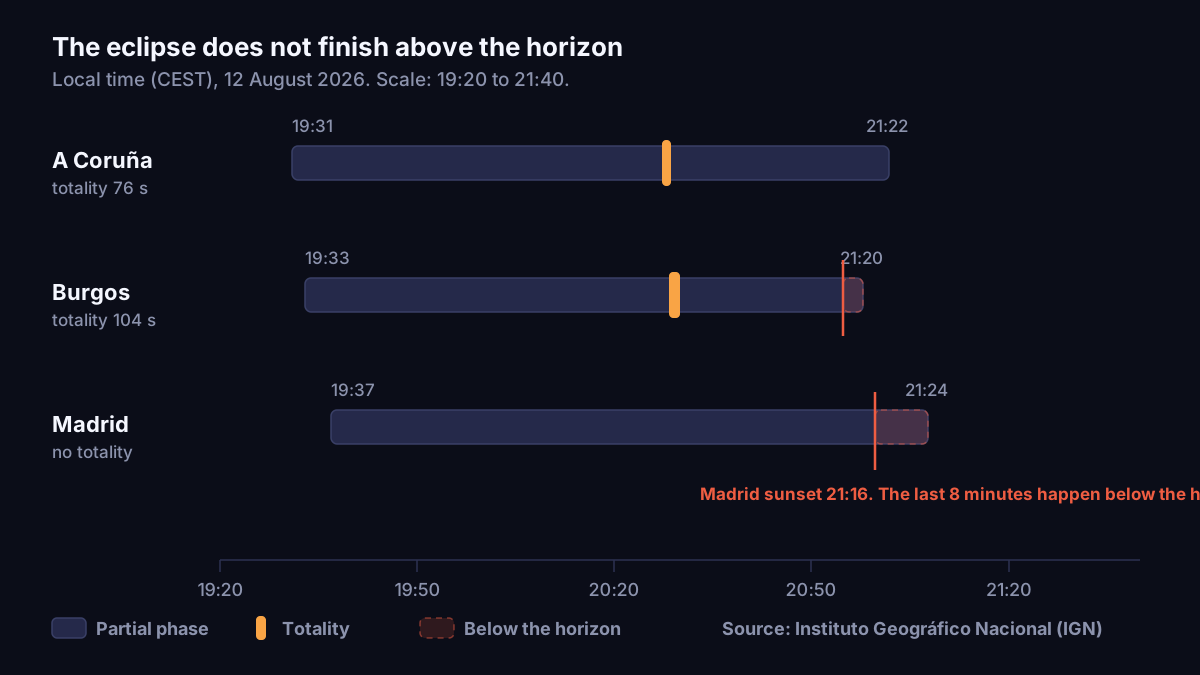
First contact runs from 19:31 CEST in A Coruña to 19:38 in Palma. Maximum falls between 20:28 and 20:32 everywhere. Last contact is calculated for around 21:20 to 21:24, though in most of the country that moment arrives after the Sun has already gone.
| City | First contact | Maximum | Totality | Sun altitude |
|---|---|---|---|---|
| A Coruña | 19:31 | 20:28 | 76 s | 12° |
| Burgos | 19:33 | 20:29 | 104 s | 8° |
| Madrid | 19:37 | 20:32 | None | 7.2° |
| Palma | 19:38 | 20:32 | Check municipality | 2° |
All times are CEST and come from the Instituto Geográfico Nacional. The corridor through Burgos, Palencia, León, Oviedo and Soria holds the longest totality on the mainland at roughly a minute and forty seconds. That corridor is also where the Sun sits highest, which makes it the strongest combination of duration and clear sightline in the country.
Why does the eclipse end below the horizon?
The Moon is still sliding off the solar disc when the Sun reaches the horizon. In Madrid the calculated last contact is 21:24 while sunset is 21:16, so eight minutes of eclipse happen out of sight. Across the Eclipse dataset this affects 6,060 of 7,531 municipalities, four in five.
Published contact times are astronomical events, not visibility promises. A table saying the eclipse ends at 21:24 is arithmetically correct and practically misleading if the Sun left at 21:16. The number worth having is whichever comes first: last contact or sunset.
For photographers and anyone planning a sequence of images, this changes the shot list. The symmetrical arc of partial phases before and after totality does not exist in most of Spain. What you get instead is a long approach, totality, and then a brief closing phase against an increasingly red and thick atmosphere before the Sun disappears entirely.

How early should you be in position?
Be at your chosen spot by 18:30 CEST, an hour before first contact. Roads inside the band will be busy, the good western horizons will fill first, and totality lasts between 76 and 104 seconds. There is no version of this event that tolerates arriving late.
Mobile networks are the other constraint. Several million people converging on a strip of northern Spain and all opening maps at once is a reliable way to saturate cell towers, so anything you need at 20:28 should already be on your phone before you leave. Screenshot your contact times if nothing else.
Eclipse shows contact times to the second in your own local time, clipped to sunset, for any of 7,531 Spanish municipalities. It ships every calculation offline.

Key takeaways
- Totality happens between 20:27 and 20:33 CEST, moving from Galicia to the Balearics in about six minutes.
- First contact runs from 19:31 in A Coruña to 19:38 in Palma, with roughly 55 minutes of partial phase before totality.
- In 6,060 of 7,531 municipalities the Sun sets before last contact, so the closing partial phase is never visible.
- Madrid's calculated last contact of 21:24 falls eight minutes after its 21:16 sunset.
- The Burgos, Palencia and Soria corridor combines the longest mainland totality with the highest Sun.
Frequently asked questions
What time does the eclipse start in Spain?
First contact runs from about 19:31 CEST in A Coruña to about 19:38 in Palma, with Burgos at 19:33 and Madrid at 19:37. The partial phase then builds for roughly 55 minutes before totality. The whole event spans 264 minutes across the country as a whole.
Is the eclipse time the same across Spain?
No, though the spread is small. Maximum eclipse moves from about 20:28 CEST on the Galician coast to about 20:32 in the Balearics, because the shadow crosses the country in roughly six minutes. Peninsular Spain and the Balearics share one clock, so no time zone conversion is needed.
Why does the eclipse end after sunset in most of Spain?
The Sun sets while the Moon is still moving off the disc. In Madrid the calculated last contact is 21:24 but the Sun sets at 21:16, so the final eight minutes happen below the horizon. In the Eclipse app dataset this affects 6,060 of 7,531 municipalities.
How long before totality should I be in position?
Be standing at your chosen spot at least an hour before first contact, so by 18:30 CEST. Roads inside the band will be congested, parking near good western horizons will be gone, and totality lasts under two minutes. Arriving late costs the entire event.