When is the next solar eclipse in Spain?
Last updated 2026-08-13
2 August 2027, a total eclipse crossing the Strait of Gibraltar at about 10:47 local time, with 4 minutes 49 seconds of totality in Ceuta. Then 26 January 2028, an annular eclipse that puts 3,078 Spanish municipalities under a ring of fire at sunset. After that, nothing until 2030.
Spain's total solar eclipse of 12 August 2026 has passed. Two more eclipses reach the country inside eighteen months, and they are not variations on the same event: one is a genuine totality confined to the far south, the other covers half the country and never gets dark at all. Confusing them leads to bad decisions, including one that can cost you your eyesight.
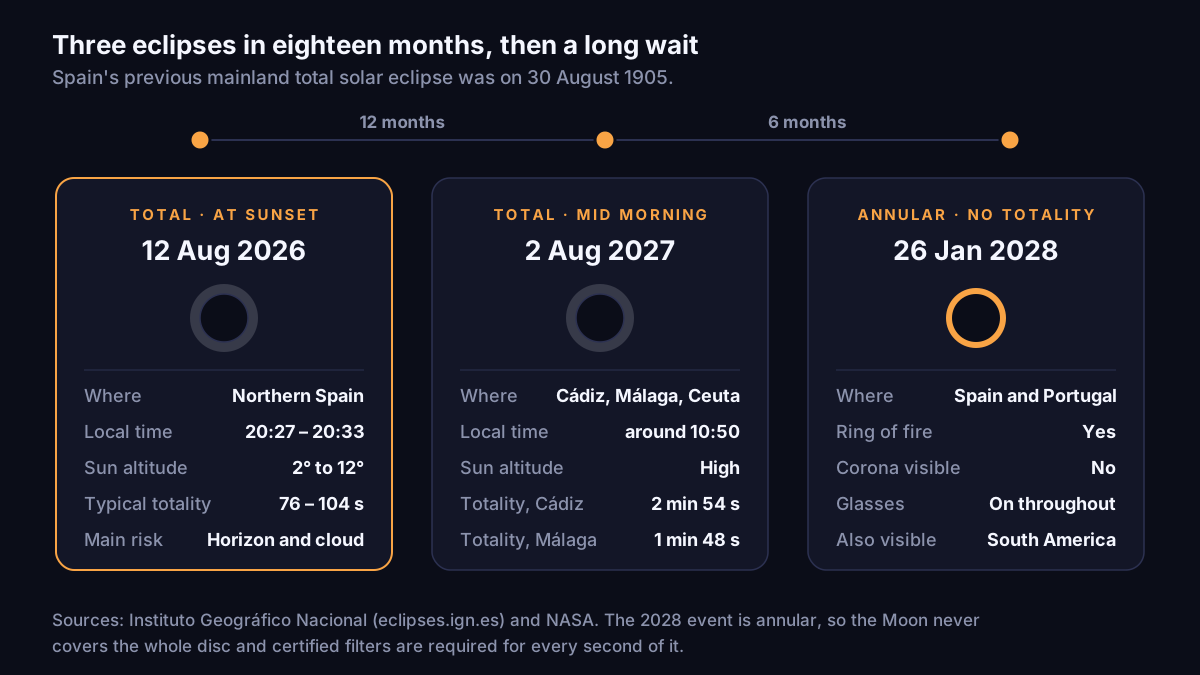
What happens on 2 August 2027?
A total solar eclipse crosses the Strait of Gibraltar from west to east at about 10:47 local time. Only 102 of Spain's 7,528 municipalities are inside the band, spread across Cádiz, Málaga, Granada and Almería plus Ceuta and Melilla. Ceuta records the longest Spanish totality at 4 minutes 49 seconds.
Tarifa follows with 4 minutes 38 seconds and Algeciras with 4 minutes 27 seconds. Cádiz city drops to 2 minutes 55 seconds and Málaga, near the northern limit, to 1 minute 49 seconds. Those are all far longer than the 2026 mainland maximum of about 104 seconds, so a shorter Spanish footprint buys a much longer event for anyone inside it.
The Sun also sits 37 to 41 degrees above the horizon rather than skimming it, which removes the obstruction problem that dominated 2026 planning. The track then leaves for Morocco and runs on to Egypt, where totality near Luxor passes six minutes — the longest over land in decades.

What is different about the 2028 annular eclipse?
On 26 January 2028 the Moon is too far from Earth to cover the solar disc, so a bright ring of photosphere stays visible at maximum. That ring is direct sunlight. Certified filters stay on for every second, the corona never appears, and there is no safe naked-eye moment at any point.
This is the single most dangerous thing to get wrong about the run of three, because an annular eclipse looks like the Sun has gone and it has not. Roughly 7 per cent of the disc is still burning at maximum. Any advice that tells you to remove filters "during the ring" is describing a total eclipse and does not apply here.
Geographically it is the mirror image of 2027. Spain stops being a sliver and becomes the story: 3,078 municipalities sit under the ring, about 23.9 million people, including Barcelona, València, Sevilla, Málaga, Murcia, Palma and Córdoba. The track reaches Spain after crossing the Pacific, Ecuador, Peru, Brazil and the Atlantic.
Why does the 2028 eclipse happen at sunset?
The ring reaches Spain as the Sun is going down, so 7,450 of the 7,528 municipalities lose the end of the eclipse below the horizon. The median Sun altitude under the ring is 3 degrees. Barcelona and Palma are at 0 degrees, and Sevilla, the highest, only reaches 7.
That makes 2028 harder to watch than either total eclipse, and it puts the horizon problem of 2026 back at the centre of planning, worse than before. A single building or ridge in the west-south-west removes the entire event. Scouting a genuinely clear sightline days ahead stops being optional.
In 309 municipalities the Sun actually sets while annularity is still in progress. Barcelona is one: the ring closes at 17:53:22 and the Sun sets at 17:59:12, so the city sees the ring form and then watches it disappear below the horizon rather than reopen.

Which eclipse should you plan around?
Both, because they answer different questions. 2027 is the one that delivers a corona, and it requires travelling to the Strait unless you already live there. 2028 requires no travel for most Spaniards but never becomes safe to view unfiltered, and its low Sun makes the sightline the deciding factor.
For anyone who saw 12 August 2026, the honest framing is that 2027 is the better version of the same experience: longer, higher and warmer, in exchange for a drive south. For anyone who missed it because the band did not reach them, 2028 is the one that comes to you, with the caveat that a ring is not a totality and never will be.
After January 2028 Spain goes quiet. The next event is the annular eclipse of 1 June 2030, which clips the north of the country. That is a long enough gap that these two are worth treating as the pair to get right.
Eclipse carries the 2027 and 2028 eclipses offline, rolls over to each on its own, and draws the ring as a ring — it cannot be made to say "take your glasses off" during an annular eclipse.

Key takeaways
- The next total solar eclipse in Spain is 2 August 2027, at about 10:47 local time.
- Only 102 municipalities are inside it; Ceuta gets 4 min 49 s and Tarifa 4 min 38 s.
- 26 January 2028 is annular, not total. The ring is direct sunlight and filters never come off.
- 3,078 municipalities and about 23.9 million people sit under the 2028 ring, Barcelona included.
- 2028 is a sunset event: 7,450 of 7,528 municipalities lose the end below the horizon.
- In Barcelona the ring closes at 17:53:22 and the Sun sets at 17:59:12, before it reopens.
- After 2028 the next Spanish eclipse is the annular of 1 June 2030.
Frequently asked questions
When is the next total solar eclipse in Spain?
2 August 2027, at about 10:47 local time. The band crosses the Strait of Gibraltar from west to east and covers 102 Spanish municipalities in Cádiz, Málaga, Granada and Almería, plus Ceuta and Melilla. Ceuta gets 4 minutes 49 seconds of totality.
Is the January 2028 eclipse a total eclipse?
No. It is annular, so the Moon is too far from Earth to cover the disc and a bright ring of photosphere remains. The corona never appears and certified filters stay on for every second. It reaches Spain at sunset on 26 January 2028.
Which eclipse is better for someone living in Spain?
It depends where you live, and the two are opposites. 2027 gives real totality to 102 municipalities in the far south. 2028 gives no totality anywhere, but puts 3,078 municipalities under the ring, including Barcelona, València, Sevilla, Málaga and Murcia.
When is the next Spanish solar eclipse after 2028?
1 June 2030, another annular eclipse, which clips northern Spain. After the run of three between August 2026 and January 2028 the country goes quiet for more than two years, so 2027 and 2028 are the two worth planning around now.