Where does the path of totality cross Spain on 12 August 2026?
Last updated 2026-08-02
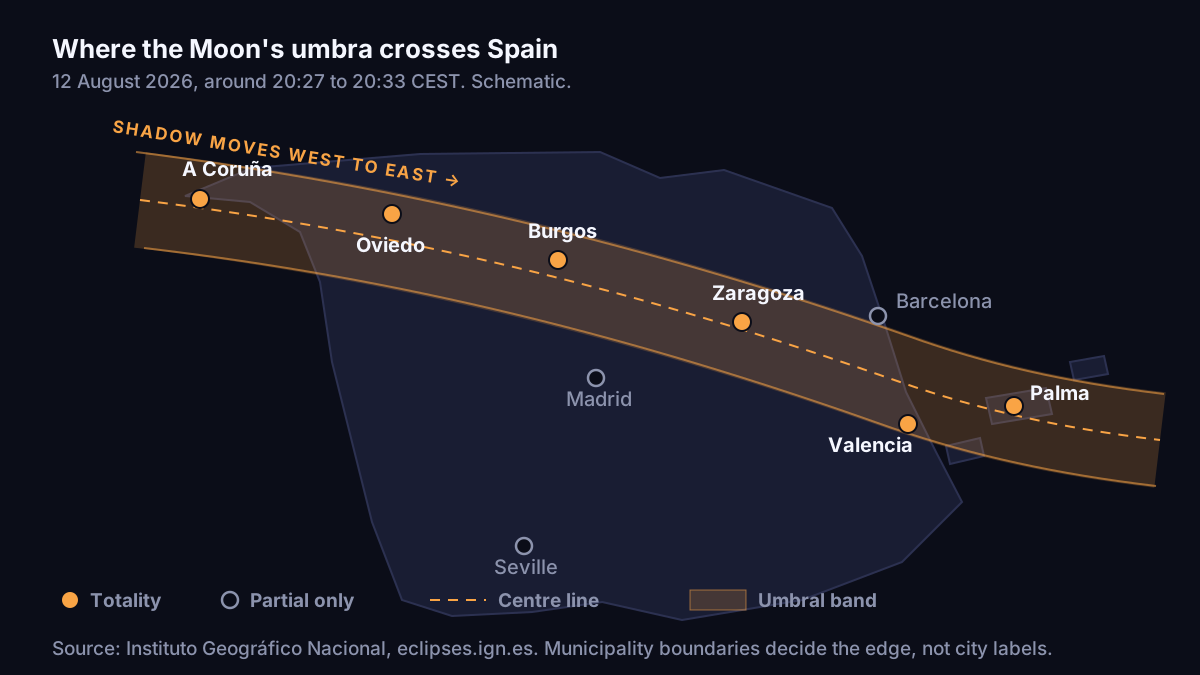
The umbral band enters Galicia at about 20:27 CEST on 12 August 2026 and leaves over the Balearic Islands six minutes later. It covers 22 provincial capitals, among them A Coruña, Oviedo, Burgos, Zaragoza and Valencia. Madrid, Barcelona and Seville sit outside it and see a partial eclipse only.
The path of totality is the strip of ground the Moon's darkest shadow actually touches, and on 12 August 2026 that strip crosses Spain from northwest to southeast. It comes ashore in Galicia, runs through Asturias, Cantabria, Castilla y León, País Vasco, La Rioja, Navarra and Aragón, clips northern Castilla-La Mancha and the Comunitat Valenciana, crosses Cataluña, and leaves Spanish territory over the Balearic Islands. Outside that strip there is no corona, no darkness, and nothing that resembles a total eclipse.
When does the Moon's shadow enter and leave Spain?
The umbra touches the Galician coast at about 20:27 CEST and leaves Spanish territory over the Balearics at about 20:33. Six minutes covers the entire crossing. Because the Sun is setting throughout, the partial phase that follows totality gets cut short almost everywhere along the track.
That six minute figure describes the shadow's own journey, not what any one observer experiences. Standing still, you get between about 76 seconds of totality on the Galician coast and roughly 104 seconds in the Castilla y León corridor through Burgos, Palencia and Soria. The Instituto Geográfico Nacional puts the full event, from first contact to last, at 264 minutes for the country as a whole.
Greatest eclipse for this event happens at 17:47 UTC over the North Atlantic near Iceland, where totality lasts 2 minutes and 18 seconds. Spain sits near the end of the track, which is why the Sun is so low and the durations are shorter.
Which provincial capitals are inside the path of totality?
Twenty-two provincial capitals fall inside the band: A Coruña, Lugo, Oviedo, León, Zamora, Valladolid, Palencia, Segovia, Burgos, Soria, Santander, Bilbao, Vitoria-Gasteiz, Logroño, Guadalajara, Cuenca, Zaragoza, Teruel, Lleida, Tarragona, Valencia and Castellón. The Instituto Geográfico Nacional publishes a separate verdict for each one of them.
A capital inside the band does not put its whole province inside. Guadalajara and Cuenca sit close to the southern limit, and large parts of both provinces are outside. The same holds in reverse further north, where a province may be almost entirely inside while its southernmost districts are not.
| City | Sun altitude at maximum | Totality |
|---|---|---|
| A Coruña | 12° | 76 seconds |
| Oviedo | 10° | Yes |
| Burgos | 8° | 104 seconds |
| Madrid | 7.2° | None |
| Barcelona | 3.5° | None |
| Palma | 2° | Check the municipality |
Why is Madrid outside the band by so little?
A textbook calculation from Besselian elements puts central Madrid inside the umbral limit by about three kilometres. The IGN, working with the national cartography, places it outside. The IGN is the authority here, and the practical result is that Madrid reaches roughly 99.90 percent obscuration and stops there.
The nearest municipality inside the band from the centre of Madrid is Alcobendas, about 15 kilometres north. That is a short drive on any ordinary evening and a long one on 12 August, when a few million people will have worked out the same thing. The southern limit of the band runs through the metropolitan area, which means neighbouring towns genuinely disagree with each other.

Why does your municipality decide it, not your province?
The umbral limit is a curve drawn by orbital geometry, and it pays no attention to administrative boundaries. It runs between towns rather than around them. Two municipalities twenty kilometres apart can return opposite verdicts, which is why the IGN publishes local circumstances municipality by municipality.
This matters most near the edges, where the honest answer is sometimes that the calculation is too close to call. A location a few hundred metres inside the limit technically sees totality, but for a second or two, with the corona barely emerging. Aiming for the centre line rather than the edge buys margin against both the arithmetic and the traffic.
The underlying figures come from the same places for everyone: Besselian elements computed by Fred Espenak at NASA Goddard Space Flight Center, national cartography from the IGN and CNIG, and municipality coordinates from GeoNames. What differs between sources is how carefully those inputs are combined at the boundary.
Eclipse carries the IGN verdict for 7,531 Spanish municipalities and works with no signal, which matters on a day when several million people crowd the same cell towers.

Key takeaways
- The umbra crosses Spain in about six minutes, entering Galicia near 20:27 CEST and leaving over the Balearics near 20:33.
- Twenty-two provincial capitals are inside the band, from A Coruña and Oviedo to Valencia, Castellón and Tarragona.
- Madrid, Barcelona and Seville are outside it. Madrid reaches about 99.90 percent obscuration and no more.
- Totality runs from roughly 76 seconds on the Galician coast to about 104 seconds through Burgos and Soria.
- The limit runs between municipalities, so check your town rather than your province or your region.
Frequently asked questions
How wide is the path of totality over Spain?
The band reaches its maximum width of 294 kilometres near the point of greatest eclipse, which falls in the North Atlantic close to Iceland. By the time the shadow reaches Spain it is arriving at a shallow angle, so the ground track is broad but strongly oblique. Municipality data beats any width figure.
Is Madrid inside the path of totality in 2026?
No. The Instituto Geográfico Nacional places the city of Madrid outside the umbral limit, so it sees a deep partial eclipse reaching about 99.90 percent obscuration. Alcobendas, roughly 15 kilometres north of the centre, does fall inside. The southern limit runs through the metropolitan area itself.
Which regions of Spain does the shadow cross?
Galicia, Asturias, Cantabria, Castilla y León, País Vasco, La Rioja, Navarra, Aragón, Cataluña, Castilla-La Mancha, the north of the Comunidad de Madrid, the Comunitat Valenciana and the Balearic Islands all have territory inside the band. Whether your own town is inside depends on the municipality, not the region.
Can I see totality from the Canary Islands?
No. The Canary Islands sit far south of the track and see a partial eclipse only. The same applies to Andalusia, Murcia, Extremadura and most of Castilla-La Mancha. Travelling north to the band is the only way to see the corona on 12 August 2026.