How do you watch the 2026 solar eclipse safely?
Last updated 2026-08-02
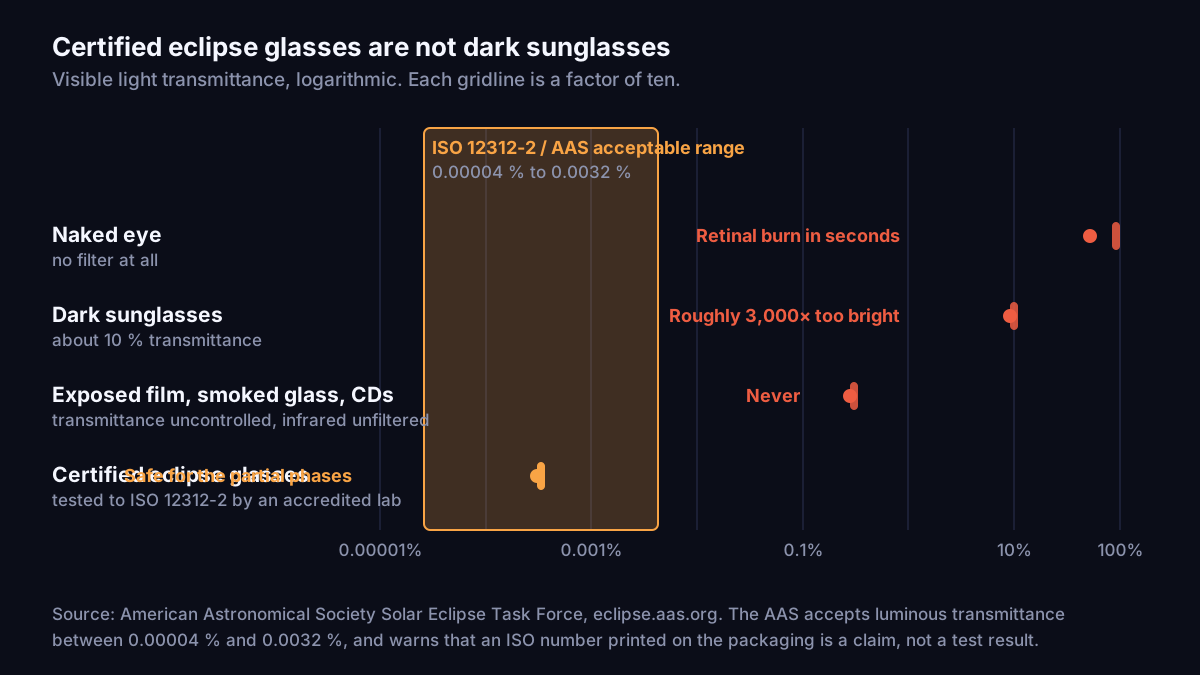
Wear filters certified to ISO 12312-2 for every moment the photosphere is visible. They pass between 0.00004 and 0.0032 percent of visible light, around a thousand times less than dark sunglasses. Remove them only during totality, and only if your location is genuinely inside the umbral band.
The one rule that matters on 12 August 2026. Most of Spain is outside the path of totality. If your municipality does not reach 100 percent obscuration, the filters never come off, at any point, for any duration.
Solar retinopathy is painless. The retina has no pain receptors, so damage from looking at an uncovered Sun registers as nothing at the time and shows up hours later as blurred central vision or a blind spot. That delay is why eclipse safety advice is written in absolutes rather than as guidance to weigh up.
What makes eclipse glasses safe to use?
ISO 12312-2:2015 sets maximum transmittance in visible, near infrared and near ultraviolet light, plus limits on uniformity, material quality and labelling. The American Astronomical Society accepts luminous transmittance between 0.00004 and 0.0032 percent. The standard also permits no more than 10 percent variation across the filter surface.
Infrared is the part people forget. A filter can look convincingly dark and still pass enough near infrared to cook the retina, which is why improvised options fail even when they dim the view impressively. Exposed photographic film, smoked glass, compact discs, polarising filters and stacked sunglasses all belong in the same category: uncontrolled transmittance, no infrared specification, no test data.
When is it safe to remove your glasses?
During totality only, from the moment the last point of photosphere vanishes and the corona appears, until the first point of light returns at the opposite edge. In Spain that window runs between roughly 76 and 104 seconds depending on where you stand inside the band.
The transitions are the risky moments. The diamond ring at second contact is genuinely spectacular and genuinely bright, so the safe practice is to keep filters on until the corona is unambiguously visible around the whole disc. At third contact, the light returns faster than most people expect. Put the glasses back on as soon as the corona starts to look asymmetric.
Anyone outside the band skips this section entirely. Madrid at 99.90 percent, Barcelona, Seville, Málaga and the Canary Islands never reach a safe viewing moment, however dark the sky becomes. Inside the band, which runs from Galicia through Asturias and Castilla y León into Aragón, Cataluña and the Balearic Islands, A Coruña gets about 76 seconds of it and Burgos about 104. The Instituto Geográfico Nacional publishes that verdict municipality by municipality, and it is the only input that determines whether the rule above applies to you.

How do you check your glasses are genuine?
The AAS warns that many sellers print the ISO number without ever having tested the product, so the marking alone proves nothing. Buy from a supplier on the AAS list of reputable vendors. Then test the glasses yourself before eclipse day, using an ordinary indoor light.
The field test takes ten seconds. Put them on indoors: you should see essentially nothing, apart from the very brightest lights, which appear as faint discs. Bright domestic lighting should be invisible through a genuine filter. Then check the material for scratches, punctures, creases or any separation from the frame, and discard the pair if you find any. Damaged filters are not repairable.
Glasses do not have a shelf life if they are undamaged. Older advice about a three year expiry applied to filters made before the current standard, and the AAS has since withdrawn it. Condition matters, age does not.
Can you watch without any filter at all?
Yes, by projection. A pinhole punched in card throws an image of the eclipsed Sun onto a second sheet held behind it, and a kitchen colander projects dozens of crescents simultaneously. You look at the projected image, never at the Sun. The gaps between leaves in a tree do this naturally.
Projection has one advantage over filters at this particular eclipse: it works for a group, and it works for children who cannot be relied on to keep glasses on. It has one disadvantage on 12 August, which is that the Sun will be very low. Projection needs a shaded surface positioned along a sightline that a 2 to 12 degree Sun can still reach.
Binoculars and telescopes need a filter mounted over the front aperture, ahead of all other optics. Holding eclipse glasses to your eyes behind an instrument concentrates sunlight onto the filter and destroys it within seconds. That failure mode has caused documented injuries.
Eclipse shows the eye safety rules on first launch and tells you plainly whether your municipality reaches totality, which is the fact those rules depend on.

Key takeaways
- ISO 12312-2 certified filters pass 0.00004 to 0.0032 percent of visible light. Sunglasses pass about 10 percent and are never adequate.
- Filters come off during totality only, and only inside the umbral band. Everywhere else in Spain they stay on throughout.
- An ISO number printed on packaging is a claim rather than a test result. Buy from a vendor listed by the AAS.
- Test glasses indoors first: bright household lighting should be invisible through them.
- Binoculars, telescopes and cameras need a filter over the front aperture. Eclipse glasses behind an eyepiece will fail.
Frequently asked questions
Are sunglasses safe for watching a solar eclipse?
No. Dark sunglasses transmit around 10 percent of visible light. Certified solar viewers transmit between 0.00004 and 0.0032 percent, which makes them roughly a thousand times darker than the darkest sunglasses. Stacking several pairs of sunglasses does not close that gap and does not filter infrared.
When exactly can I take my eclipse glasses off?
Only during totality, and only if your location is genuinely inside the umbral band. The moment the last sliver of photosphere disappears and the corona appears, the filters come off. They go back on the instant the first point of light returns at the far edge.
Can I use eclipse glasses with binoculars or a camera?
Never hold eclipse glasses to your eyes while looking through binoculars, a telescope or a camera viewfinder. The concentrated light melts the filter in moments. Optical instruments need a purpose built filter mounted over the front aperture, ahead of every other lens element.
What can I use if I have no eclipse glasses?
Use indirect projection. A pinhole in card projects an image of the eclipsed Sun onto a second surface, and a kitchen colander projects dozens at once. You watch the projected image and never the Sun. Leaf gaps in a tree do the same thing naturally.
Does eclipse eye damage hurt?
No, which is what makes it dangerous. The retina has no pain receptors, so solar retinopathy develops without any warning sensation. Symptoms such as blurred central vision or a blind spot typically appear hours later, and the damage may be permanent.