Which way do you look during the 12 August 2026 eclipse?
Last updated 2026-08-02
Look west-northwest, at an azimuth of about 283 degrees. The Sun will sit between 2 and 12 degrees above the horizon depending on where you are in Spain. At those altitudes a single building, ridge or line of trees several hundred metres away is enough to hide the entire eclipse.
Getting inside the path of totality is the first problem and finding a clear sightline is the second, and the second one ruins more attempts. Totality in Spain happens with the Sun almost on the horizon, so the geometry that decides whether you see it is local: the roofline opposite, the hill behind the village, the plane trees along the road. The Instituto Geográfico Nacional puts this plainly in its own guidance, recommending a western horizon free of mountains, buildings and trees.
Where in the sky will the Sun be?
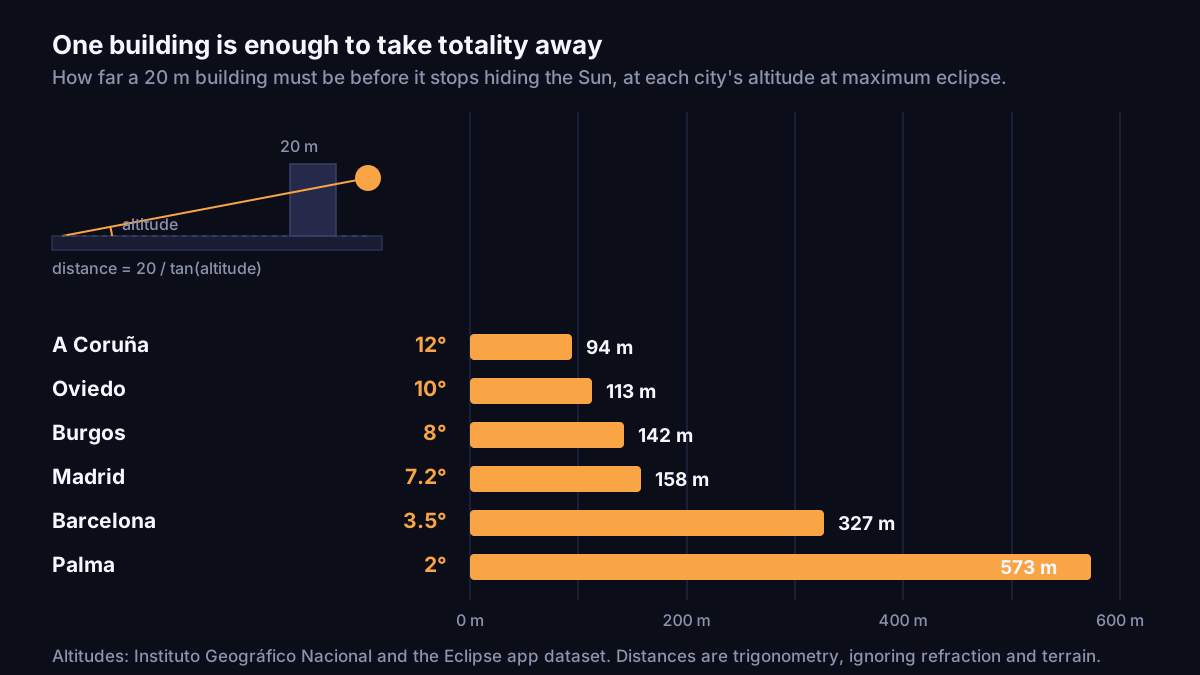
At azimuth 283 degrees, west-northwest, and low. A Coruña gets the Sun 12 degrees up at maximum, Oviedo 10, Burgos 8, Madrid 7.2, Barcelona 3.5 and Palma about 2. A closed fist at arm's length spans roughly 10 degrees of sky, which puts most of Spain inside one fist of the horizon.
Azimuth is measured clockwise from north, so 283 degrees sits just north of due west. It varies by a few degrees across the country, which is immaterial when you are scouting a site. What matters is that you can point in that direction and see sky, not masonry.
What will block your view at 3 degrees?
Almost anything. The blocking distance is the obstacle height divided by the tangent of the Sun's altitude, so a 20 metre building hides an 8 degree Sun from 142 metres away, a 3.5 degree Sun from 327 metres, and a 2 degree Sun from 573 metres. Hills do this at kilometres.
| City | Sun altitude | A 20 m building blocks it from |
|---|---|---|
| A Coruña | 12° | 94 m |
| Oviedo | 10° | 113 m |
| Burgos | 8° | 142 m |
| Madrid | 7.2° | 158 m |
| Barcelona | 3.5° | 327 m |
| Palma | 2° | 573 m |
Terrain scales the same way. A 200 metre ridge at 8 degrees blocks the Sun from 1.4 kilometres, and at 2 degrees from nearly 6 kilometres. In practice this rules out valley floors across much of northern Spain, and it makes any site with high ground to the west a bad bet regardless of how open it feels standing there at midday.
How do you scout a site in advance?
Go at the same time of evening on a clear day before the twelfth, face 283 degrees with a compass, and check that nothing intrudes below about 12 degrees of elevation. The Sun itself will be close to that bearing in the days around the eclipse, which makes the check direct rather than theoretical.
Scouting on the day does not work. You need to arrive an hour before first contact at the latest, and by then the good positions inside the band will be occupied. Anyone deciding between two sites should have walked both.
A rough elevation check without instruments: hold your arm straight out, make a fist, and rest the bottom of it on the horizon. The top of your fist marks roughly 10 degrees. If the obstruction reaches above your fist, that site is finished for everywhere except the Galician coast.

Does the coast or the interior work better?
The Cantabrian coast offers a guaranteed flat sea horizon, which suits a 10 degree Sun, but AEMET gives that strip only a 30 to 50 percent chance of clear sky during eclipse hours. The interior plateau and Ebro valley score 50 to 70 percent, at the cost of terrain you have to check yourself.
The compromise most likely to work is high ground in Castilla y León with an open westward aspect. That corridor through Burgos, Palencia and Soria also holds the longest mainland totality at roughly a minute and forty seconds, so it wins on duration as well as statistics. A west facing slope or plateau edge gives you elevation over the near obstacles without a ridge behind them.
Eclipse points a live compass at the eclipse bearing and reports the Sun's altitude for your exact position, so you can scout a horizon days in advance. It works with no signal.

Key takeaways
- Look west-northwest at about azimuth 283 degrees. The Sun sits between 2 and 12 degrees above the horizon.
- Blocking distance equals obstacle height divided by the tangent of the altitude. At 2 degrees, 20 metres blocks from 573 metres.
- A closed fist at arm's length covers roughly 10 degrees, which is enough to check a horizon without instruments.
- Valley floors and any site with high ground to the west are poor choices across most of the path.
- High ground in the Burgos, Palencia and Soria corridor combines the longest mainland totality with better cloud odds than the coast.
Frequently asked questions
What compass direction is the eclipse in Spain?
Roughly azimuth 283 degrees, which is west-northwest, varying by a few degrees with location. Set a compass to 283 and walk until nothing blocks that bearing down to the horizon. Phone compasses show magnetic north by default, and Spain's magnetic declination is small enough to ignore here.
How high will the Sun be during totality?
Between about 2 and 12 degrees above the horizon depending where you stand. A Coruña gets 12 degrees, Oviedo 10, Burgos 8, Madrid 7.2, Barcelona 3.5 and Palma about 2. For comparison, your closed fist held at arm's length covers roughly 10 degrees of sky.
How far away can a building still block the eclipse?
Further than most people expect. A 20 metre building hides a Sun at 8 degrees from 142 metres away, at 3.5 degrees from 327 metres, and at 2 degrees from 573 metres. The distance is simply the obstacle height divided by the tangent of the Sun's altitude.
Is the coast or the interior better for a clear horizon?
A west facing coast gives a guaranteed flat horizon, which suits the low Sun, but the Cantabrian coast also carries the highest cloud risk in the path. Inland ridges and plateaus in Castilla y León offer both elevation and better August statistics, at the cost of terrain that can block the view.