How Do You Settle a Toddler Without Screens?
Most bedtime screen habits started as solutions to a real problem: a child who would not settle, an exhausted parent, a device that worked. Removing it without a replacement recreates the original problem, which is why the swap fails more often than the intention does.
Why are screens hard to remove at bedtime?
They hold attention reliably, which is exactly what a tired parent needs and exactly what makes disengaging difficult. The visual stream captures attention passively, so stopping requires an external decision rather than a natural ending, and that decision produces the protest.
Light exposure close to bedtime is the second issue, associated with later sleep onset in young children. The combination means screens both delay sleep and make the transition to sleep a confrontation.
What replaces it effectively?
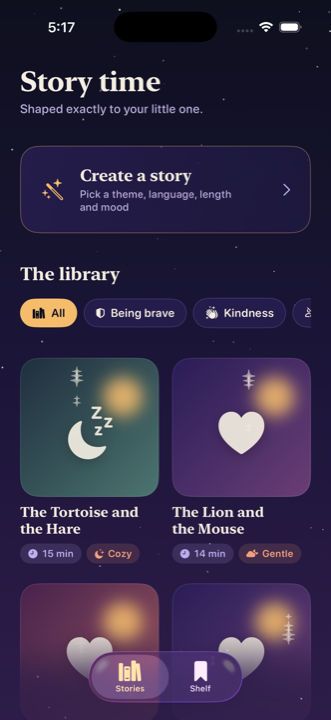
A story with a definite ending. Read aloud is best where possible; audio works when it is not. Both occupy the slot the screen filled, but a story finishes on its own, which removes the confrontation of taking something away mid-flow.
The natural ending is the mechanism. A child who has learned that the story ends and then it is sleep experiences bedtime as a sequence rather than an interruption. Nothing about a video provides that boundary unless an adult imposes it.
How should you make the switch?
Announce it once during the day rather than at bedtime, then apply it consistently. Introduce the replacement on the first night rather than after a gap. Expect three to five nights of resistance, which is the normal extinction curve for a changed expectation.
Consistency during those nights determines whether the change holds. Reintroducing the screen on night three because the protest peaked teaches that sufficient protest restores it, which makes the next attempt considerably harder.
What else helps the transition?
Dim lights for the final half hour, keep the bedroom dark and cool, and hold the rest of the routine steady while only the final step changes. Changing several things at once makes it impossible to tell what is working and increases total disruption.
If a child has been falling asleep to a device in the bedroom, removing the device from the room entirely tends to work better than leaving it present but unused. Visible availability keeps it in play as something to negotiate for.
Key takeaways
- Replace the screen rather than removing it and leaving the slot empty.
- A story ends naturally, which removes the confrontation of switching something off.
- Announce the change during the day, not at bedtime.
- Expect three to five nights of resistance and hold consistent through them.
- Remove the device from the bedroom rather than leaving it visible but unused.
Frequently asked questions
- How long before bed should screens stop?
- Common paediatric advice is to avoid screens for at least an hour before bedtime, with some sources suggesting longer for young children. The mechanism involves both light exposure and arousal, so a calm programme is better than an exciting one but still not neutral.
- What if the child only sleeps with a screen?
- That is a learned sleep association rather than a fixed requirement, and it can be changed the same way any association is: substitute something else, apply it consistently, and accept a period of protest. It is harder the longer it has been established, not impossible.
- Is a night light a problem?
- A dim, warm night light is generally considered fine and helps children who are afraid of the dark. The concern with screens is brighter, blue-weighted light plus cognitive stimulation. A low-level static light is a different thing from a tablet.
- Does this work for older children?
- The same principles apply, though older children negotiate more and may need to be part of the decision. Involving them in choosing the replacement, an audiobook or a book of their own, tends to work better than imposing it, since the protest is more verbal at that age.
Children’s Sleep & Story, BigBalli. We follow AAP and paediatric sleep guidance and turn it into practical routines. General information, not medical advice.