What Are the Screen Time Guidelines for Toddlers?
Screen time guidance is widely quoted and rarely quoted accurately. The numbers exist, but the emphasis in current paediatric advice has shifted away from a minute budget towards what the child is watching, whether an adult is watching with them, and what it displaces.
What are the actual age thresholds?
Under 18 months, the AAP recommends avoiding screen media other than video chatting with family. From 18 to 24 months, limited high-quality programming watched together with a caregiver. From two to five, up to roughly one hour per day of quality content, again co-viewed.
Video chat is carved out deliberately because it is interactive and social rather than passive consumption. A call with a grandparent involves turn-taking and response, which is closer to conversation than to watching a programme.
Why does co-viewing matter so much?
Young children learn considerably better from screens when an adult narrates, questions and connects what is on screen to the world. Watching alone, toddlers struggle to transfer what they see into real understanding, an effect researchers call the video deficit.
This is why the same programme can be educational or inert depending on whether anyone is watching with the child. The content matters, but the adult beside them matters more, which is inconvenient advice because it costs adult attention rather than money.
Where does audio fit?
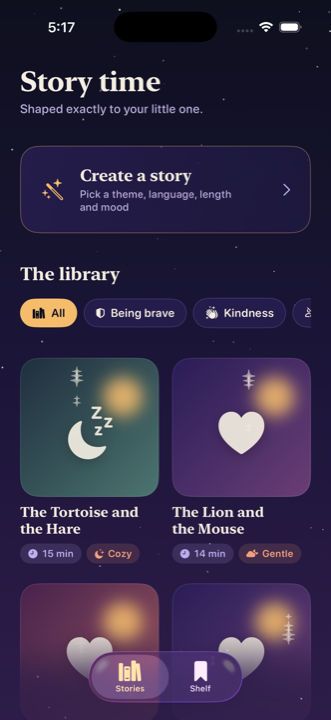
Audio is not screen media, and guidance on screens does not apply to it. Listening to stories engages language processing and imagination without the visual capture that makes screens hard to stop, which is why audio is a common substitution at bedtime and in cars.
This is not a claim that audio is unlimited or that it substitutes for interaction with a caregiver. It is a narrower point: the specific concerns driving screen guidance, visual displacement, sleep disruption from light, and difficulty disengaging, apply differently to listening.
What matters more than the minute count?
What the screen displaces. An hour that replaces sleep, physical play or conversation costs more than an hour that replaces sitting in a waiting room. Current guidance encourages families to protect sleep, meals and play first, then fit media around what remains.
Timing matters too. Screens close to bedtime are associated with poorer sleep onset in young children, which is one reason bedtime routines built around audio or reading rather than video are commonly recommended by paediatric sources.
Key takeaways
- No screen media before 18 months except video chatting with family.
- From 18 to 24 months, limited high-quality programming watched with a caregiver.
- Ages two to five, up to about an hour a day of quality co-viewed content.
- Co-viewing matters because young children learn poorly from screens alone.
- What the screen displaces, particularly sleep and play, matters more than the minutes.
Frequently asked questions
- Does video chatting count as screen time?
- The AAP explicitly carves it out, treating video chat with family as quality interaction rather than screen media. The reasoning is that it is genuinely two-way, involving turn-taking and response, which is developmentally different from watching a programme.
- Is educational content exempt from the limits?
- No, but quality changes what the time is worth. Well-designed programming co-viewed with an adult produces better outcomes than passive viewing of anything. The limits still apply; the guidance is that quality and company determine how much benefit the time delivers.
- What about screens on long journeys?
- Most paediatric sources take a pragmatic view that occasional exceptions in unusual circumstances are not the concern. The pattern across normal weeks matters more than any single journey. Audio is a common alternative precisely because it works in a car without a screen.
- Does audio affect sleep the way screens do?
- The light-exposure and difficulty-disengaging concerns that drive screen advice near bedtime do not apply the same way to listening. Calm audio is frequently used as part of a wind-down. Content still matters; an exciting story is not a settling one.
Children’s Sleep & Story, BigBalli. We follow AAP and paediatric sleep guidance and turn it into practical routines. General information, not medical advice.