What Can Children Do on Long Car Journeys?
Long journeys go wrong in a predictable pattern: everything works for the first hour, nothing works for the fourth. The fix is not a better single activity but a rotation, because any one thing loses its hold after about forty minutes regardless of how good it is.
How do you structure a long journey?
Divide it into segments with names and landmarks children can recognise, and tell them the plan before departure. Uncertainty is what produces the repeated question about arrival; a known structure with three stops answers it in advance.
Schedule stops roughly every two hours, and treat them as genuine breaks with movement rather than fuel stops. Children who have run around for ten minutes settle far better for the next stretch than children who stayed strapped in while an adult paid for petrol.
What activities actually hold up?
Audio stories, conversation games such as twenty questions or spotting games, sticker books and drawing on a lap tray, and deliberate quiet time. Rotate them roughly every forty minutes rather than waiting until the current one fails.
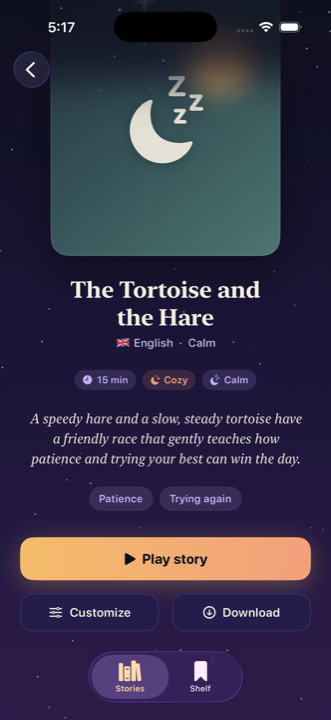
Audio does particularly well in cars because it works without hands, does not cause motion sickness the way reading or screens can for susceptible children, and can be shared by everyone including the driver.
Why does motion sickness affect what you choose?
It arises from a mismatch between what the eyes see and what the inner ear senses. Looking down at a book or screen while the car moves worsens it; looking at the horizon reduces it. Audio avoids the conflict entirely because it needs no visual focus.
For children prone to it, the practical set is audio, conversation and looking out of the window, with front-seat position where age and safety rules allow. Handing a susceptible child a tablet to keep them occupied frequently produces the outcome everyone wanted to avoid.
What should you prepare before leaving?
Download audio and anything else that needs a connection, since rural and motorway coverage is unreliable. Pack snacks and water within reach rather than in the boot. Keep a change of clothes and wipes accessible, and have one unopened new item in reserve.
The reserve item is the most useful trick in the list. A single new sticker book or story held back until the difficult final stretch is worth more than three familiar things offered at the start, because novelty is the resource that runs out.
Key takeaways
- Divide the journey into named segments and share the plan before leaving.
- Stop roughly every two hours for genuine movement, not just fuel.
- Rotate activities every forty minutes rather than waiting for one to fail.
- Audio avoids the visual conflict that triggers motion sickness.
- Download everything in advance and hold one new item in reserve.
Frequently asked questions
- Should you drive overnight so children sleep?
- It works for some families and carries a real trade-off: a tired driver is a considerably larger risk than an unsettled child. If you do it, share driving or plan a sleep beforehand. Driver fatigue is the factor that should decide this, not the children’s schedule.
- How do you handle the constant are-we-there-yet?
- Give a structure they can check themselves: three stops, and we are past the second. Young children have no sense of hours but can track countable milestones. A visual progress marker they tick off works better than any verbal answer.
- Are screens acceptable on a long drive?
- Most paediatric sources take a pragmatic view of occasional exceptions in unusual circumstances, and a long journey qualifies for many families. The pattern across normal weeks is what guidance addresses. Audio is worth trying first, particularly for children prone to motion sickness.
- What snacks work best in a car?
- Dry, non-sticky, low-mess items that do not need refrigeration, offered in small portions rather than open packets. Avoid anything that requires a lot of water afterwards, and keep drinks to water where possible to limit unscheduled stops.
Children’s Sleep & Story, BigBalli. We follow AAP and paediatric sleep guidance and turn it into practical routines. General information, not medical advice.