What Is the Best Time of Day to Tan?
There is no universal best hour, because the UV index shifts with the season, your latitude and the sky. As a rule, UV peaks around solar noon and tapers toward morning and evening. Midday tans fastest and burns fastest; the shoulders of the day tan more slowly and more safely. The right window is the one where the live UV matches your skin.
What time of day has the strongest sun for tanning?
UV is strongest around solar noon, which in summer falls near 1pm with daylight saving time. The window from about 11am to 3pm holds the highest UV index of the day, when the sun sits high and its rays travel the shortest path through the atmosphere. That is the fastest tanning window and also the easiest one to burn in.
Solar noon is when the sun reaches its highest point, not necessarily 12 on the clock. The higher the sun, the less atmosphere its UV passes through, so more reaches your skin. The EPA's guidance to seek shade between 10am and 4pm targets exactly this peak. If you tan in that window, keep sessions short and your SPF up.
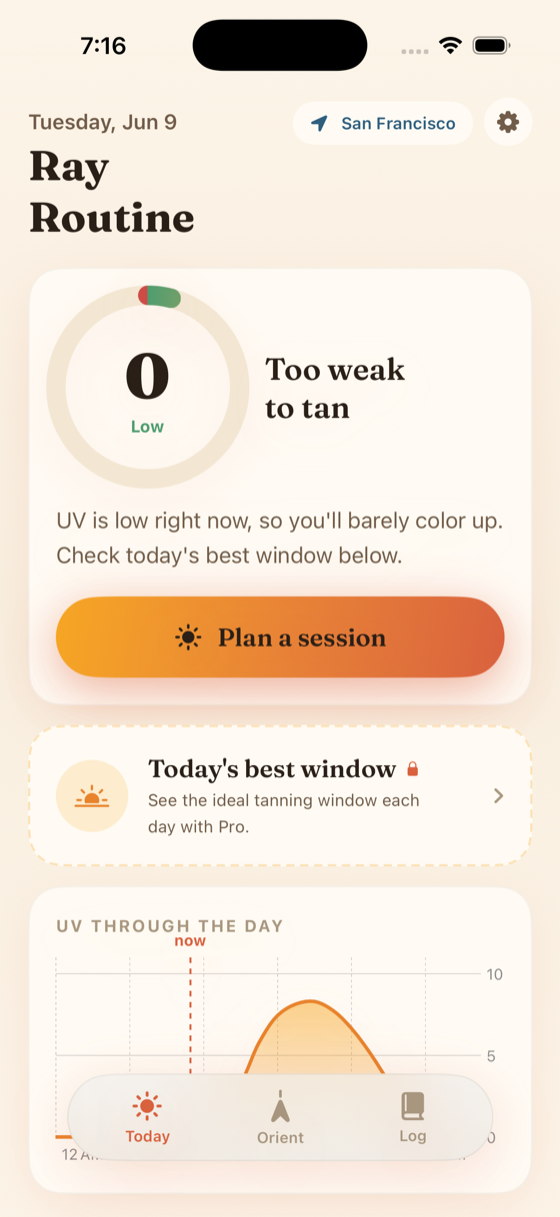
Is morning or afternoon better for a safe tan?
Both work, and the choice is about comfort and routine. Mid-morning, before 11am, offers a rising but still moderate UV and cooler air. Late afternoon, after 3pm, gives a falling UV and softer light. Either shoulder of the day tans more gently than noon, so you get an even base with a longer, more forgiving burn window.
The two shoulders are roughly symmetrical in UV, so pick whichever fits your day. Morning sessions suit people who want to be done early and avoid peak heat. Afternoon sessions suit a wind-down after work. The thing to watch is that late afternoon UV can still be high in midsummer, so the live index, not the hour, decides the session length.
Does the best tanning time change with the season?
Yes. In midsummer, UV can reach the high range for hours around noon, so the safe shoulders shrink and shift earlier and later. In spring and autumn, even noon may only hit a moderate UV, widening the comfortable window. Winter sun at many latitudes never crosses the tanning threshold of UV 3 at all.
Season changes the sun's angle, and angle drives UV. The same 2pm gives a punishing index in July and a mild one in October. This is why a fixed favorite hour fails across the year. Reading the day's UV curve tells you when the index sits in your target band, which moves week to week as the sun climbs higher or lower.
How do you pick a tanning time for your skin?
Match the hour to your Fitzpatrick skin type. Fair type 1 and 2 skin does best in the gentler morning or late afternoon UV, keeping sessions short. Deeper type 4 to 6 skin can use the midday window with reasonable protection. Set your skin type once and let the target UV band, rather than a fixed clock time, choose the hour.
Your skin type sets how much UV you can take before burning, so it should set your window too. A type 2 person tanning at noon is fighting the strongest sun with the lowest tolerance, a recipe for redness. The same person at 4pm, at a lower UV, builds color comfortably. Let tolerance and the live index meet, and the best time falls out of that match.
Key takeaways
- UV peaks around solar noon, roughly 11am to 3pm, the fastest and riskiest tanning window.
- Mid-morning before 11am or late afternoon after 3pm gives a gentler, safer tan.
- The best window shifts with season as the sun's angle changes.
- Fair skin suits the shoulders of the day; deeper skin can use midday with protection.
- Read the live UV curve, not the clock, to find your window.
Frequently asked questions
- Is it bad to tan at noon?
- Noon is not off-limits, but it carries the day's highest UV, so the burn risk is greatest. If you tan at noon, keep the session short, use broad-spectrum SPF 30 or higher, and take shade breaks. Many people get a safer, more even tan by shifting to the gentler UV of mid-morning or late afternoon instead.
- Can you tan in the early morning?
- You can once the UV index climbs to 3, which in summer often happens by mid-morning. Very early, just after sunrise, the UV is usually too low to tan much. Check the live index: if it has reached 3 or more, an early session works and comes with a long, forgiving burn window and cooler temperatures.
- What time is the UV index highest?
- The UV index peaks at solar noon, when the sun is highest in the sky. Depending on your time zone and daylight saving, that is usually between noon and 1pm, with the broad peak spanning roughly 11am to 3pm. Latitude and season shift the exact timing, so the day's UV curve is the reliable guide.
- Does late afternoon sun still tan you?
- Yes, as long as the UV index is still 3 or higher, which in midsummer can hold past 4pm. Late afternoon UV is falling, so it tans more gently than noon and gives a longer burn window. As the sun drops and the index slips below 3, tanning slows and effectively stops for the day.
UV, SPF & Tanning Research, BigBalli. We turn the UV index into a session you can follow, cross-checked against sources including the US EPA and the CDC.
Ray Routine provides tanning and sun-exposure estimates to help you plan. It is not medical advice and does not diagnose or prevent any condition. People with a history of skin cancer or photosensitivity should follow their doctor's guidance.