Can You Tan on a Cloudy Day?
Clouds block visible light and heat far more than they block ultraviolet, which is why an overcast day feels cool and dim yet still tans and burns. The UV index already accounts for cloud cover in the forecast, so a reading of 6 under clouds carries the same risk as a 6 under clear sky. The sky's appearance is the least reliable signal you have.
How much UV gets through clouds?
Thin or scattered cloud lets through up to about 80 percent of UV, and sometimes more at the edges where clouds scatter rays sideways. Only thick, dark storm cloud blocks a large share. This is why people burn on overcast beach days: the cooler air hides a UV level that is still high enough to tan and damage skin.
UV and visible light behave differently in the atmosphere. Water droplets in cloud absorb and scatter visible wavelengths strongly, dimming the day, but they let much of the shorter UV pass. The World Health Organization warns that cloud cover does not reliably reduce UV, and broken cloud can briefly raise it. Dim does not mean safe, and cool does not mean low UV.
Can you burn when it is overcast?
Yes, and it is a common way people get caught out. Because clouds cut the heat more than the UV, skin does not feel the warning warmth it would in direct sun, so people stay out far too long. If the UV index is 6 under cloud, the burn risk is the same as a clear-sky 6. Protection still applies on grey days.
The missing heat removes the natural cue to seek shade. On a sunny day, discomfort tells you to move; under cloud that signal is muted while the UV keeps working. Surfaces add to it: water, sand and pale concrete bounce UV upward regardless of the sky. The result is a sunburn that surprises people who assumed an overcast day could not cause one.
Does a cloudy day tan you more slowly?
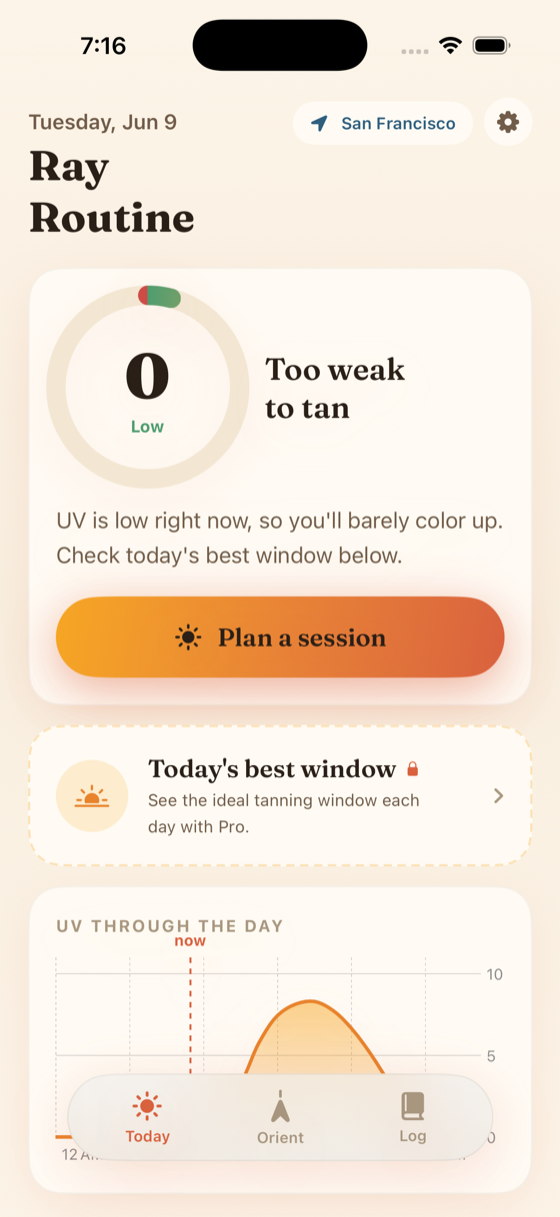
It depends on how thick the cloud is. Light haze barely slows a tan, since most UV still gets through. Heavy overcast lowers the UV index and so slows tanning in step with it. The honest answer is to read the live index: if it sits at 4 under cloud, you tan about as you would at a clear 4.
Tanning tracks the UV index, not the brightness of the sky. A thin overcast that holds the index at 5 builds color nearly as fast as clear sky at 5. A dark, rainy ceiling that drops the index below 3 effectively stops tanning. Since you cannot judge UV by eye through cloud, the index is the only number that tells you the real pace.
What should you do on a partly cloudy day?
Treat a partly cloudy day by the UV index, not the sky. Broken cloud can swing the UV up and down within minutes and even spike it above the clear-sky value as clouds scatter rays. Keep your SPF on, set a session timer to the forecast index, and do not extend your time just because the sun keeps ducking behind cloud.
Partly cloudy is the trickiest case because the UV is unstable. A passing cloud that lets you relax can be followed by a bright break that delivers a sharp dose, and the scattering effect at cloud edges sometimes pushes UV briefly higher than a fully clear sky would. Planning to the index, and keeping protection on throughout, smooths out those swings and prevents an accidental burn.
Key takeaways
- Up to 80 percent of UV passes through light cloud, so you can tan and burn on grey days.
- Clouds cut heat more than UV, removing the warmth that usually warns you to stop.
- Tanning speed tracks the UV index, not the brightness of the sky.
- Broken cloud can swing UV up and down and even spike it above clear-sky levels.
- Plan by the live UV index and keep SPF on, whatever the sky looks like.
Frequently asked questions
- Can you really tan through clouds?
- Yes. Light and moderate cloud lets through a large share of UV, so melanin still forms and you still tan, just at a pace set by the UV index rather than the brightness. Only thick storm cloud lowers UV enough to stop tanning. If the index reads 4 or higher under cloud, a tanning session is realistic.
- Do I need sunscreen on a cloudy day?
- If the UV index is 3 or higher, yes. Clouds do not reliably block UV, and the cooler air can fool you into staying out longer than you should. Applying broad-spectrum SPF 30 on overcast days prevents the surprise burns that catch people off guard precisely because the sky looked harmless and the day felt cool.
- Why do people burn more on cloudy days?
- Because the warning signs are missing. Clouds block heat and glare more than UV, so skin does not feel hot and eyes are not squinting, which removes the natural cues to seek shade. People then stay out far longer while the UV keeps working, and the burn appears hours later once they are already indoors.
- Can broken clouds increase UV?
- Yes, briefly. When the sun shines through gaps between bright cumulus clouds, the cloud edges can scatter additional UV downward, pushing the index above what a fully clear sky would give for a few minutes. This cloud-enhancement effect is one more reason to plan by the live UV index and keep protection on through changing skies.
UV, SPF & Tanning Research, BigBalli. We turn the UV index into a session you can follow, cross-checked against sources including the WHO and the US National Weather Service.
Ray Routine provides tanning and sun-exposure estimates to help you plan. It is not medical advice and does not diagnose or prevent any condition. People with a history of skin cancer or photosensitivity should follow their doctor's guidance.