What UV Index Is Safe to Tan In?
The UV index runs from 0 to 11 and higher, and it is the single number that decides whether tanning is even possible right now. Below 3, there is too little UVB to darken skin much. From 3 to 5, you tan steadily with manageable risk. From 6 upward the sun tans you faster but burns you faster too, so the safe move is less time, not more.
What UV index do you need to tan at all?
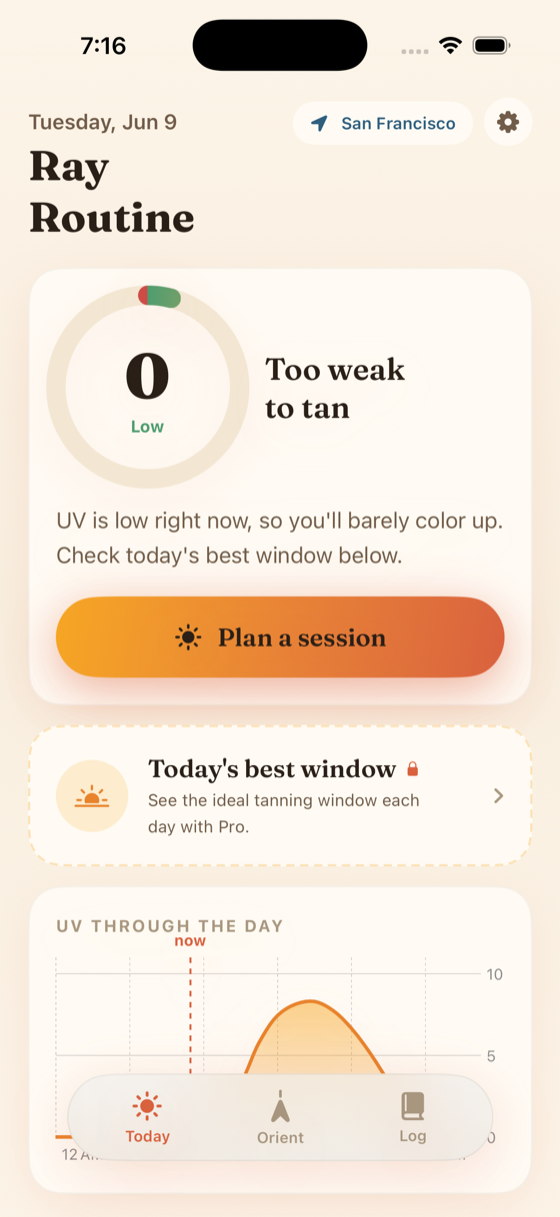
Tanning needs a UV index of at least 3. Melanin production is driven mainly by UVB, and below an index of 3 there is not enough UVB at ground level to stimulate it. At 0 to 2 you can sit out for an hour and see almost no color change, which is why early morning and winter sun rarely tan northern latitudes.
The World Health Organization, which co-developed the UV index scale, treats 3 as the threshold where sun protection starts to matter. That same threshold is where useful tanning begins. If your local index is stuck at 1 or 2, you are spending time outside for very little melanin, and you are better off waiting for a stronger window.
Is a UV index of 6 too high to tan?
A UV index of 6 is high but workable if you cut your time and raise your SPF. At this level unprotected fair skin can start to burn in roughly 15 to 25 minutes. You still tan, only the margin for error shrinks. Treat 6 and above as a signal to set a timer, use SPF 30 or more, and take breaks in shade.
The risk at higher UV is not the tan itself, it is the burn that overshoots it. A burn is inflammation and DNA damage, and it does not deepen a tan, it peels it away. The EPA recommends seeking shade and reapplying sunscreen every two hours once the index reaches the high range. A timed session keeps you inside the window where color builds without the skin going red.
What is the safest UV index for a slow, even tan?
A UV index of 3 to 5 is the comfortable zone for most skin. There is enough UVB to build melanin, but burn times are long enough that a 20 to 40 minute session rarely overshoots. This is the range you find in mid morning or late afternoon in summer, and it suits a gradual tan that lasts.
Slow is what makes a tan stick. Melanin laid down gradually sits in a base layer that holds for weeks, while a rushed tan over a burn flakes off as the skin repairs. Picking a moderate UV window and repeating short sessions beats one long session under a punishing midday sun. Consistency, not intensity, is what deepens color safely.
How does skin type change the safe UV for tanning?
Your Fitzpatrick skin type sets your personal burn clock. Type 1 and 2 skin burns fast and should treat any index above 5 with caution and high SPF. Type 4 to 6 tolerates higher UV and longer sessions. The same UV index of 7 is a short, protected session for fair skin and a relaxed one for deeper skin.
The Fitzpatrick scale, developed at Harvard in 1975, ranks skin from type 1, which always burns and never tans, to type 6, which rarely burns. It is the reason a single UV number cannot give everyone the same advice. Set your skin type once, and a session that is safe for you stops being a guess pulled from someone else's tolerance.
Key takeaways
- You need a UV index of at least 3 to tan, the same level where sun protection starts to matter.
- A UV index of 3 to 5 is the comfortable zone for a slow, even tan.
- At 6 and above you still tan, but cut your time, raise SPF, and use shade breaks.
- Your Fitzpatrick skin type sets your personal burn clock, so the same UV means different sessions.
- Slow, repeated sessions build a tan that lasts; a burn peels color off.
Frequently asked questions
- Can you tan with a UV index of 2?
- Barely. At a UV index of 1 or 2 there is too little UVB reaching the ground to push melanin production, so you might sit out for an hour and see almost no change. You will not burn easily either. If a tan is the goal, wait for the index to climb to 3 or higher before spending the time.
- What UV index causes sunburn fastest?
- Burn speed rises with the index. At a UV index of 8 to 10, unprotected fair skin can redden in 10 to 15 minutes, while at 3 to 5 it may take 45 minutes or more. The higher the number, the shorter your safe window, which is why a timer and SPF matter most on very high UV days.
- Is the UV index the same everywhere at noon?
- No. The midday UV index depends on latitude, altitude, season, cloud cover and surface reflection. The same clock time gives a UV of 4 in spring and 10 in midsummer at the same spot. Snow, sand and water bounce extra UV upward, raising your effective exposure even when the forecast number looks moderate.
- Does a higher UV index give a darker tan?
- It tans you faster, not necessarily darker or better. A higher index speeds melanin production but also speeds burning, and a burn strips color as it peels. A moderate index over several short sessions usually produces a deeper, longer lasting tan than one rushed session under extreme UV that ends in red skin.
UV, SPF & Tanning Research, BigBalli. We turn the UV index into a session you can follow, cross-checked against sources including the WHO and the US EPA.
Ray Routine provides tanning and sun-exposure estimates to help you plan. It is not medical advice and does not diagnose or prevent any condition. People with a history of skin cancer or photosensitivity should follow their doctor's guidance.