Which Way Should You Face the Sun to Tan?
Which way you face changes how fast and how evenly you tan, because UV intensity on skin depends on the angle of the light. Skin pointed straight at the sun catches the full dose; skin turned away catches a glancing one. The practical rule is to square up to the sun for the part you want tanned, then flip on a timer so nothing cooks while the rest stays pale.
Which direction should you face to tan?
Face the part of your body you want to tan toward the sun, squared up rather than slanted. The sun moves from east through south to west over the day in the northern hemisphere, so a south-facing position catches the strongest midday rays. Reposition as it moves, and flip front to back on a schedule for even color.
There is no single compass direction that works all day, because the sun travels. Early on it sits in the east, at noon it is highest to the south, and it sets in the west. Following that arc, or simply re-squaring to the sun every so often, keeps you in direct rays. The aim is to stay facing the sun, not a fixed point on the horizon.
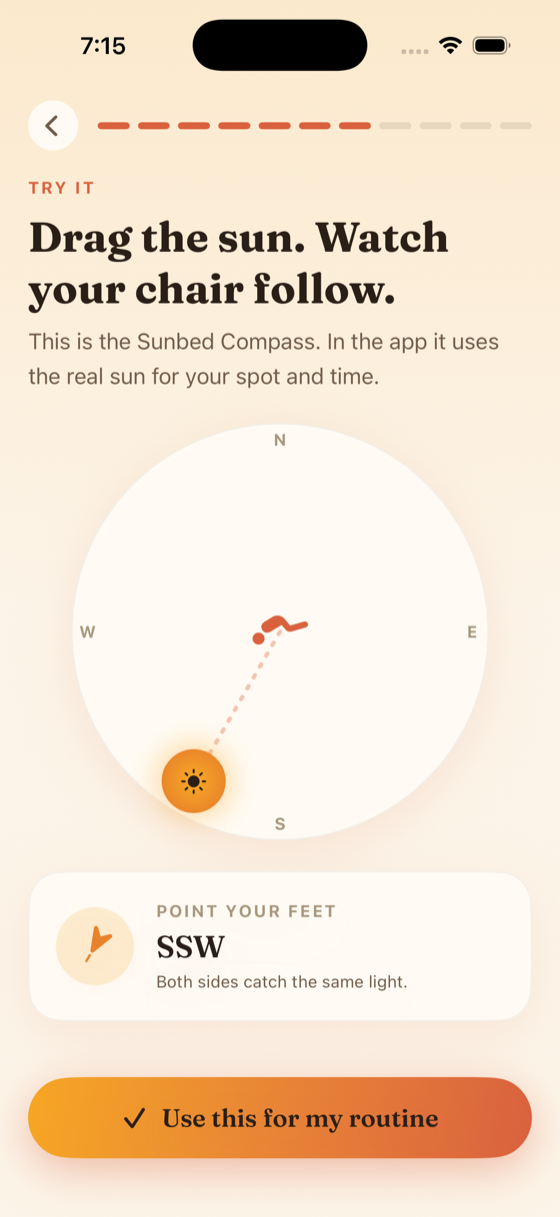
Why does facing the sun matter for an even tan?
Skin square to the sun absorbs far more UV than skin at a steep angle, the same reason midday sun is stronger than evening sun. If you lie at a slant, the side toward the sun tans while the shaded side stays pale. Squaring up and flipping on a timer spreads exposure so color builds evenly across your whole body.
UV that strikes skin head-on delivers its full intensity, while UV arriving at a shallow angle spreads over more area and weakens. A body angled away from the sun is mostly catching that weaker, glancing light on one side. Orientation is therefore a free lever on your tan: get it right and you raise your effective UV without adding a single minute or lowering your SPF.
How often should you flip while tanning?
Flip every 10 to 15 minutes, or split your planned session in half and turn at the midpoint. Regular flipping keeps any one area from overheating and gives front, back and sides a fair share of the sun. A timer is the simple fix, since it is easy to lose track and let one side run long while you relax.
Even tanning is about distributing the same total dose, not adding more. Turning on a fixed interval means each surface gets a controlled share rather than one side absorbing everything. It also breaks exposure into smaller chunks, which lowers the peak dose any patch takes at once. Set an interval that matches your session length, and let the prompt to flip do the remembering.
How do you set up a chair or sunbed for the sun?
Place the chair so the sun hits the front of your body squarely, check that no buildings, trees or umbrellas cast a creeping shadow over the session, and plan to nudge the chair as the sun arcs west. For a balanced tan, alternate squaring your front and back to the sun rather than leaving one side facing it the whole time.
Shadows are the hidden spoiler. A spot that is in full sun at noon can fall into shade by 2pm as the sun drops and nearby objects throw longer shadows. Picking a position with a clear path of sun for your whole session, and orienting the chair so the strongest rays land where you want color, gives you an even tan without constant fiddling. A quick check of the sun path before you settle in saves a lopsided result.
Key takeaways
- Face the part you want tanned toward the sun, squared up rather than slanted.
- Skin square to the sun absorbs far more UV than skin at a steep angle.
- The sun moves east to south to west, so reposition through the day.
- Flip every 10 to 15 minutes so front, back and sides tan evenly.
- Watch for creeping shadows and pick a spot with clear sun for the whole session.
Frequently asked questions
- Which way should my chair face to tan?
- Point the front of the chair toward the sun so its rays hit you squarely. Around midday in the northern hemisphere that means facing roughly south, where the sun sits highest. As the sun arcs toward the west through the afternoon, nudge the chair to keep facing it, and flip front to back on a timer for even color.
- Does the sun direction change how fast I tan?
- Yes. Skin squared to the sun absorbs the full UV intensity, while skin at a shallow angle catches a weaker, spread-out dose. Facing the sun directly therefore tans you faster than lying at a slant, without raising your burn risk or shortening the safe window. Orientation is a free way to make every minute of sun count more.
- How do I tan my back evenly?
- Flip onto your front and square your back to the sun for the same time your front received. Splitting the session in half and turning at the midpoint, or flipping every 10 to 15 minutes, gives your back an equal share. Using a timer prevents the common mistake of leaving one side facing the sun far longer than the other.
- Why does one side of my body tan more?
- Usually because it faced the sun longer or more directly. If you lie at an angle or forget to flip, the side toward the sun absorbs most of the UV while the other stays pale. Squaring up to the sun and flipping on a regular schedule evens out the exposure so both sides build matching color.
UV, SPF & Tanning Research, BigBalli. We turn the UV index into a session you can follow, cross-checked against sources including the US National Weather Service and the US EPA.
Ray Routine provides tanning and sun-exposure estimates to help you plan. It is not medical advice and does not diagnose or prevent any condition. People with a history of skin cancer or photosensitivity should follow their doctor's guidance.