How Do You Journal Like Marcus Aurelius?
Meditations was Marcus's private notebook, titled in Greek "to himself." He was the most powerful man in the world and used writing as a discipline, talking himself back into Stoic principles morning after morning. His journal is not a diary of imperial life. It is a tool for shaping his own mind, and that is exactly what makes it copyable.
What did Marcus Aurelius write in his journal?
Marcus wrote reminders, not records. He restated Stoic doctrines in his own words, prepared himself for difficult people, reflected on death and impermanence, and corrected his own behavior. Entries are short, often a single thought, repeated across the book in slightly different forms because he was drilling the ideas into himself, not informing a reader.
Book two opens with a famous example: "Begin each day by telling yourself, today I shall meet people who are meddling, ungrateful, arrogant." He is not complaining. He is rehearsing, so the encounter does not catch him off guard. The journal is a rehearsal space for the mind, written before the day rather than after it.
How is Stoic journaling different from a diary?
A diary records what happened; Stoic journaling reshapes how you judge what happened. Instead of "today was stressful," you write the principle that meets the stress: this is outside my control, my response is not. The entry argues you toward a better view. The aim is training your judgment, not preserving a memory of the day.
This is why Marcus repeats himself. He returns to impermanence, control and duty dozens of times, the way an athlete repeats a drill. A diary that said the same thing every week would be useless. A practice journal that does so is working as intended, because the goal is to make the principle reflexive.
When should you write, morning or evening?
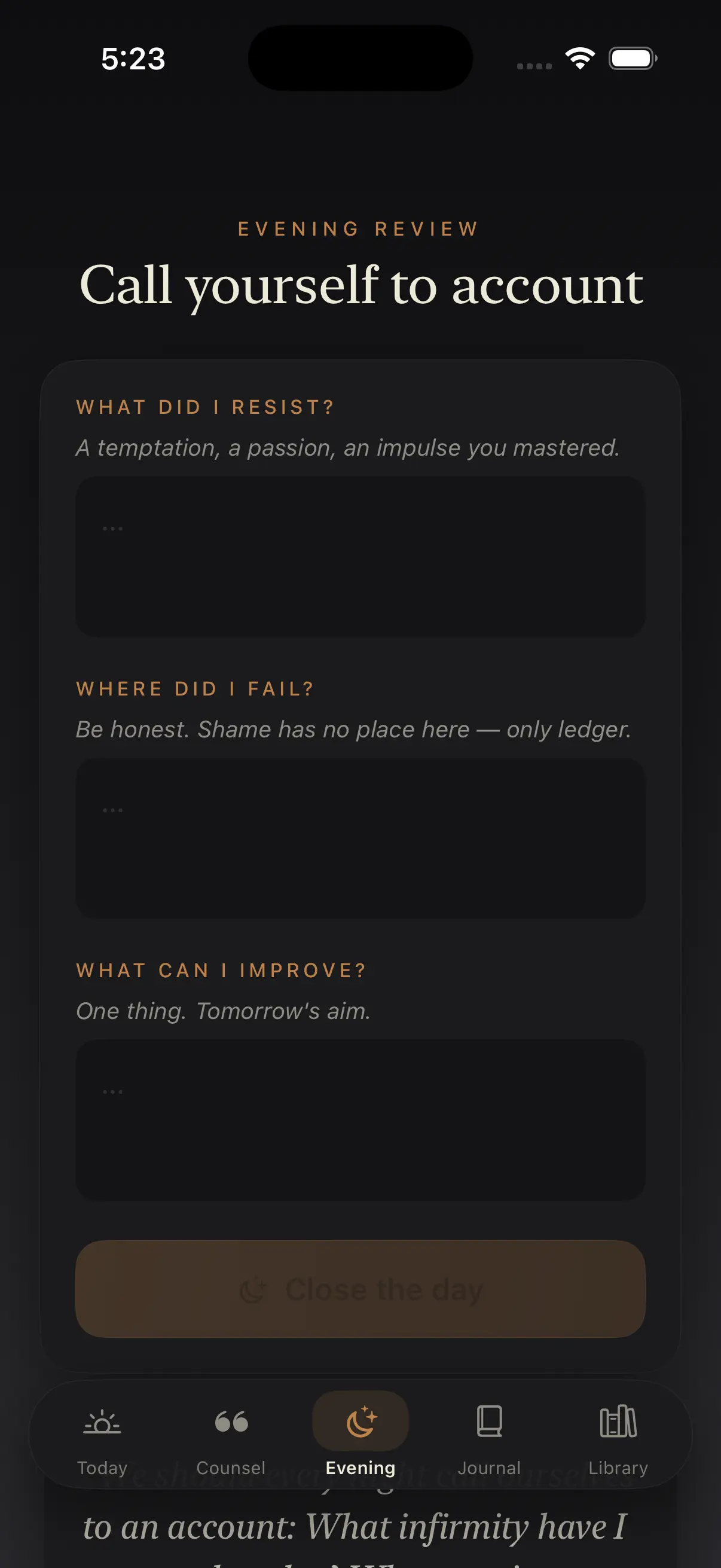
Both serve different ends. Morning entries prepare you: state an intention and rehearse the day's likely tests, as Marcus did. Evening entries review: account for how you actually behaved, in the manner of Seneca. Many practitioners do a short morning preparation and a longer evening review, bracketing the day with writing.
If you only have time for one, choose the evening review, since reflection on real events teaches faster than anticipation. But the morning note is cheap insurance. A single line setting your intention costs thirty seconds and changes how you meet the first hard moment. Marcus clearly valued the morning rehearsal; book two reads like one.
What prompts help you journal like Marcus?
Use prompts that turn writing into training. What is in my control here, and what is not? Who will test me today, and how will I respond? What did I do well, where did I fall short, what will I improve? What am I taking for granted that will not last? Short answers beat long essays.
The best prompts force a judgment rather than a description. "How do I feel?" invites a diary entry. "What false belief is making me anxious?" invites the Stoic work. Keep entries brief; Marcus rarely wrote more than a paragraph. Consistency and honesty matter far more than length or polish in this kind of journal.
Key takeaways
- Marcus journaled to train his mind, addressing himself, not recording events.
- Stoic journaling reshapes judgment; a diary just preserves what happened.
- Morning entries rehearse the day; evening entries review it honestly.
- Use prompts that force a judgment, such as what is in my control here.
- Keep entries short and honest; repetition is the point, not a flaw.
Frequently asked questions
- Did Marcus Aurelius intend Meditations to be published?
- Almost certainly not. The work has no title from him, no clear structure, and reads as private notes addressed to himself. The Greek heading means roughly "to himself." That privacy is what gives the book its honesty: he was not performing for readers but talking himself into living by his principles, day after day.
- How long should my journal entries be?
- Short. Many of Marcus's entries are a sentence or two. The value is in the judgment you reach, not the word count. A brief entry you write every day teaches more than a long one you produce once a week. If you only manage three honest lines, that is a complete entry.
- Do I need to be religious or spiritual to do this?
- No. Stoic journaling is a reasoning exercise, not a devotional one. Marcus mentions the gods and nature, but the core technique, examining your judgments and rehearsing better responses, works on its own terms. Modern cognitive behavioral therapy uses the same method without any spiritual framing, which shows how portable it is.
- What if I do not know what to write?
- Use a fixed prompt to remove the blank-page problem. Ask what is in your control in a current situation, or run Seneca's three evening questions. Structured prompts mean you never have to invent a topic. Over time the recurring questions surface the patterns worth writing about without you having to search for them.
Stoic Philosophy & Practice, BigBalli. We turn the primary Stoic texts into a daily discipline, citing Marcus Aurelius, Seneca and Epictetus from their own works.
Ataraxia offers philosophical and educational guidance, not medical or psychological treatment. If journaling surfaces persistent distress, please consult a qualified clinician.