What Is the Difference Between a Hue and a Genuine Pigment?
"Cadmium Yellow Hue" and "Cadmium Yellow" sit side by side on the shelf at very different prices, and the word "Hue" is the whole reason. One is a stand-in built from modern organic pigments; the other is genuine cadmium. Both can be fine paints. The difference shows up in your wallet, your safety and the way the color behaves when you mix it.
What does "Hue" on a paint label mean?
"Hue" signals an imitation of a traditional color made with substitute pigments. Cadmium Red Hue might be built from PR254 pyrrole red and PO73 instead of genuine cadmium PR108. The maker is matching the look of the classic color while avoiding its cost, toxicity or scarcity. The named mineral is not actually inside the tube.
Manufacturers use hues for good reasons: cadmium and cobalt are expensive and heavy-metal based, and some historic pigments are simply unavailable. A well-formulated hue can look almost indistinguishable from the original in mass tone. The trade-off appears in mixing and in subtle handling, which is where genuine pigments still earn their price for some painters.
How can you tell a hue from the genuine pigment?
Read the Color Index code, not the name. Genuine Cadmium Red lists PR108. A hue lists something else, often PR254, PR255 or a small mix. The front-of-tube name can say almost anything, so the ingredient line is the only reliable tell. If the code matches the classic pigment, it is genuine; if it does not, it is an imitation.
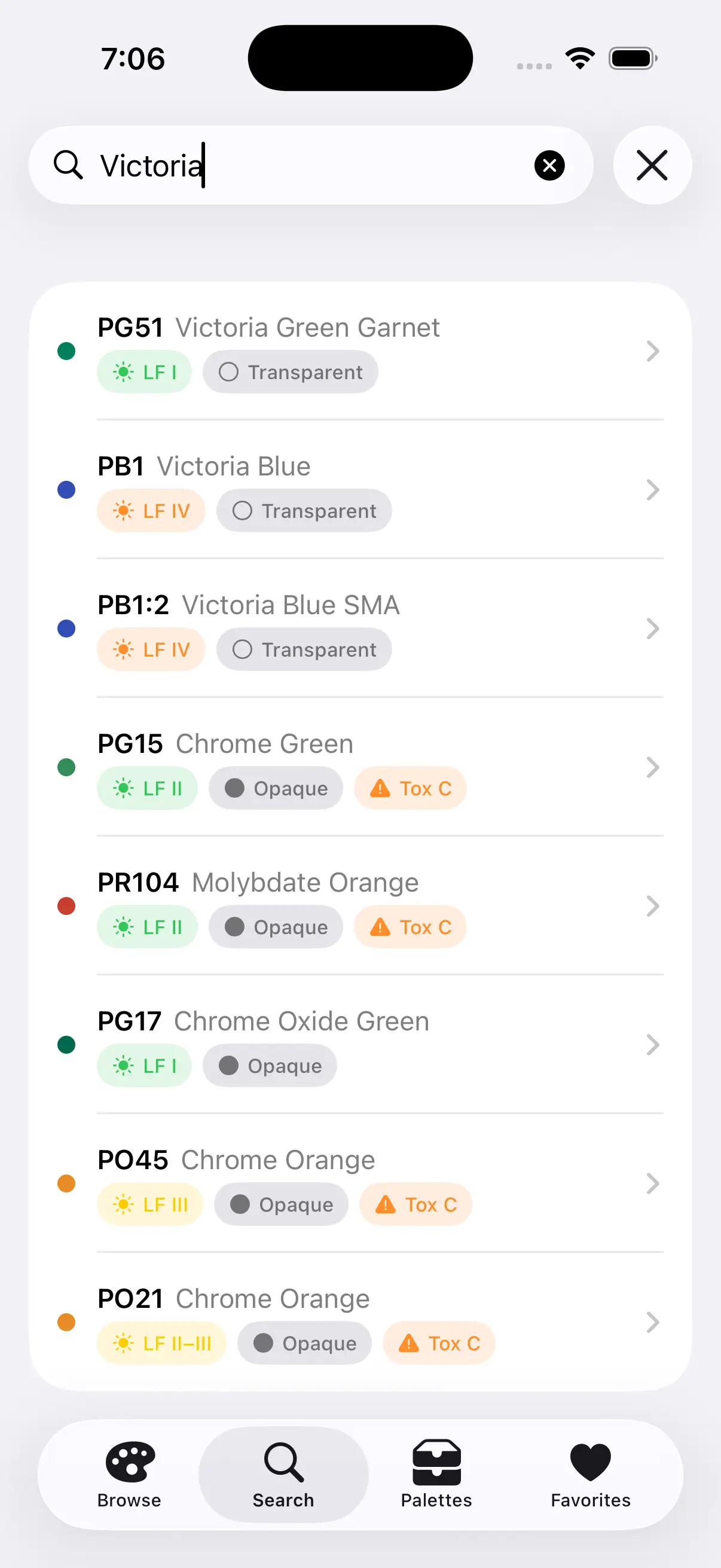
This is the same skill that decodes any tube. The word "Hue" is a courtesy that good brands print, but the code is the proof. Some makers omit the word and still substitute pigments, so checking the CI code protects you from both honest hues and quietly reformulated colors. Pigments shows the code and the genuine-versus-hue status together.
Do hues mix as well as genuine pigments?
Often close, sometimes not. A genuine single pigment mixes predictably because one colorant drives the result. A hue may blend two or three pigments to fake the target, so mixing it introduces those extra colorants and can muddy a clean blend. For straight application a hue is fine; for careful mixing, single-pigment genuines give more control.
The clearest example is opacity and tinting strength. Genuine cadmium is famously opaque with strong, warm tints, and some hues feel weaker or shift cooler when extended. If your work leans on glazing or precise mixes, test the hue before committing. If you paint largely from the tube, the savings often outweigh the small differences.
When is a hue the smarter choice?
Choose a hue when you want to avoid heavy metals, paint with students or children, work at scale on a budget, or simply do not need the genuine pigment's exact mixing behavior. Choose the genuine pigment when opacity, tinting strength and predictable mixing matter, or when matching a historic palette. Both are legitimate; the job decides.
A teacher stocking a classroom has every reason to buy cadmium-free hues. A portrait painter who relies on genuine cadmium's warmth and opacity has every reason to pay for the real thing. The label war between them is marketing; the practical answer is to match the tube to the work and the constraints in front of you.
Key takeaways
- "Hue" means an imitation built from substitute pigments, not the named mineral.
- The Color Index code, not the name, tells you whether a tube is genuine or a hue.
- Hues are cheaper and often heavy-metal free, useful for students and budgets.
- Genuine single pigments mix more predictably and often have stronger opacity and tinting.
- Match the choice to the job: hues for application, genuines for precise mixing.
Frequently asked questions
- Are hue paints lower quality?
- Not inherently. A hue can be a high-quality artist-grade paint using excellent modern pigments; it simply imitates a traditional color rather than containing it. Quality depends on the specific pigments and pigment load, which you read from the code and the brand's grade, not from the word "Hue" on the label.
- Why is genuine cadmium so much more expensive?
- Cadmium is a heavy metal with rising raw-material and regulatory costs, and genuine cadmium pigments carry strong tinting strength and opacity that painters pay for. Hues built on cheaper organic pigments deliver a similar look at a fraction of the price, which is exactly why so many ranges now offer a hue alongside the genuine color.
- Can I mix a hue and a genuine pigment together?
- Yes, with no chemical problem. The only caution is that a hue may already contain two or three pigments, so combining it with others can quickly muddy a mix. If you want clean, controlled blends, build them from single-pigment paints and treat multi-pigment hues as finishing colors rather than mixing bases.
- Does "Hue" affect lightfastness?
- It can go either way. Some hues use very lightfast modern pigments and outlast the historic color they imitate, while a few cheap hues use weaker pigments. Do not assume; check the lightfastness rating for the actual pigments listed in the code. The word "Hue" says nothing about permanence on its own.
Color Chemistry & Materials Research, BigBalli. We decode manufacturer formulations and the Colour Index so painters can compare genuine pigments and hues with confidence.
Pigments provides reference and educational information about art materials. Formulations vary between brands and over time; confirm the current pigment code on the tube and the manufacturer data sheet before relying on it.