What Do Color Index Codes Like PB29 Mean?
The name on a paint tube sells the tube. The Color Index code tells the truth about what is inside it. "Royal Blue" from one maker and "Ultramarine" from another can both be the single pigment PB29, the same synthetic ultramarine, milled and bound a little differently. Once you learn to read the code, two tubes with different names and different prices stop being a mystery.
What does a code like PB29 actually stand for?
A Color Index Generic Name has two parts. The letters mark the category and hue, so PB means Pigment Blue, PR means Pigment Red, PY means Pigment Yellow, PBk means Pigment Black. The number after the letters identifies one specific chemical compound. PB29 is synthetic ultramarine; PB15 is copper phthalocyanine blue.
The system comes from the Colour Index International, a reference maintained by the Society of Dyers and Colourists and the AATCC. Every recognized pigment gets one generic name. Because the code points at chemistry, it carries the properties that matter to a painter: how lightfast the compound is, whether it is transparent, and whether it contains a heavy metal. The label name carries none of that.
Why do two brands use the same code?
The Color Index code is brand independent. PR108 is cadmium red whether it comes from Winsor and Newton, Old Holland or a student line. The binder, pigment load and grind differ, so handling and price vary, but the colorant molecule is identical. The code is how you cross-reference one brand against another and find the cheaper or in-stock tube.
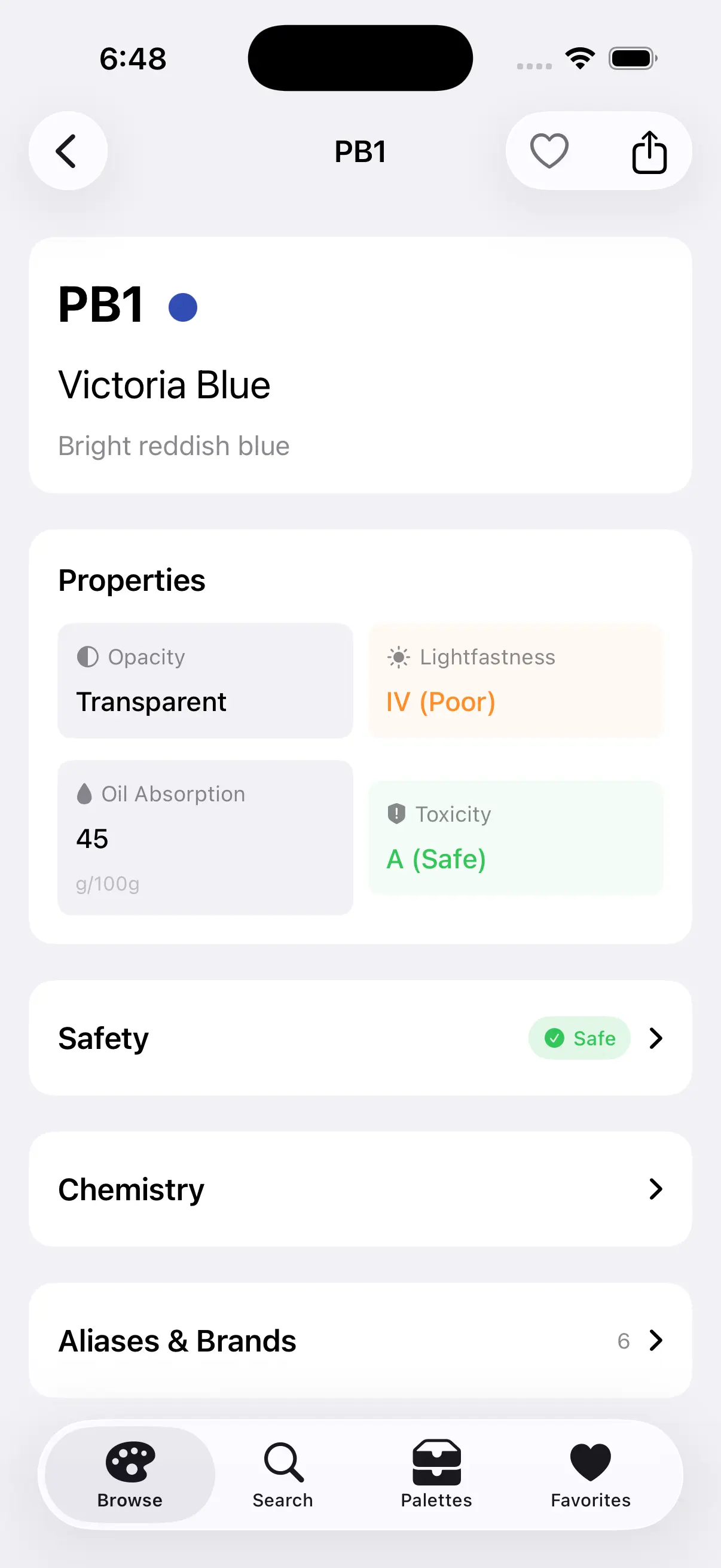
This is the single most useful trick in pigment shopping. A discontinued favorite is rarely gone for good; another maker almost always sells the same PR or PB number. When you read a code instead of a name, you stop paying for the label and start buying the chemistry. Pigments lists the brand aliases for each code so the cross-reference takes seconds instead of an afternoon of tab juggling.
What does more than one code on a tube tell you?
Several codes in the ingredient line mean the paint is a mixture, often called a convenience color. "Sap Green" might list PG7 plus PY83. Mixes are fine to use, but they muddy further mixing and can fade unevenly if one component is fugitive. A single code signals a single-pigment paint, which behaves more predictably on the palette.
Convenience colors save a step when you want that exact green out of the tube. The cost shows up when you try to mix from them, because you are already starting with two colorants and lose control over chroma. Painters who care about clean mixing read the ingredient line first and lean on single-pigment tubes wherever they can.
Where do you find the code on a tube?
Look on the back label or the crimped end of the tube for a line that reads "Pigment" or "Series," followed by codes like PB29 or PR108. Reputable makers print it. If a tube hides its pigments or lists only a romantic name, treat that as a warning sign about quality and consistency.
Student grades and craft paints often omit the codes, which is part of why they behave inconsistently from batch to batch. Artist-grade lines almost always print them. Photographing the label and reading the codes back in Pigments turns the scanner into a shelf assistant: point, recognize the CI code, and see the matched pigment with full details before the tube leaves your hand.
Key takeaways
- A Color Index code names the chemical in the tube, not the marketing name on the front.
- Letters give the hue and category (PB, PR, PY); the number identifies the exact compound.
- The same code means the same colorant across every brand, so codes are how you cross-reference.
- Multiple codes mean a mixed convenience color that mixes less cleanly than a single pigment.
- Artist-grade tubes print the codes; hidden pigments are a quality warning.
Frequently asked questions
- What does the P at the start of every code mean?
- The P stands for Pigment, distinguishing these colorants from dyes, which carry different prefixes in the same index. The letter or letters after it give the hue family: B for blue, R for red, Y for yellow, G for green, O for orange, V for violet, Br for brown, Bk for black and W for white.
- Is PB15 the same as PB15:3?
- Almost. The colon and number mark a crystal form of the same base pigment. PB15:3 is the greener, more stable form of phthalocyanine blue, while PB15:1 leans slightly redder. They share a molecule but differ in hue and lightfastness, so the suffix is worth reading when you want a precise blue.
- Do Color Index codes tell me if a paint is toxic?
- Indirectly, yes. The code identifies the compound, and once you know the compound you know whether it contains cadmium, cobalt, lead or another heavy metal. The code itself is neutral, but it is the key that unlocks the safety data. Pigments pairs each code with a plain toxicity rating.
- Why do some tubes list no code at all?
- Usually because the paint is a student or craft grade where the maker reserves the right to change the recipe between batches. Without a fixed code, the color you buy next year may not match the one you bought today. Consistent, code-printed tubes are the mark of an artist-grade line.
Color Chemistry & Materials Research, BigBalli. We turn the Colour Index and manufacturer data sheets into plain guidance for working painters, cross-checked against primary sources.
Pigments provides reference and educational information about art materials, not safety certification. Always read the manufacturer safety data sheet and follow local regulations when handling pigments that contain heavy metals.