What Do Lightfastness Ratings Mean on Paint Tubes?
Lightfastness is the one pigment property that decides whether your painting survives. A brilliant color that fades in a sunlit room was never permanent, only pretty for a while. Two systems describe it, and once you can read either, you can sort a shelf of tubes into keep and avoid in a few seconds.
What do the ASTM lightfastness ratings mean?
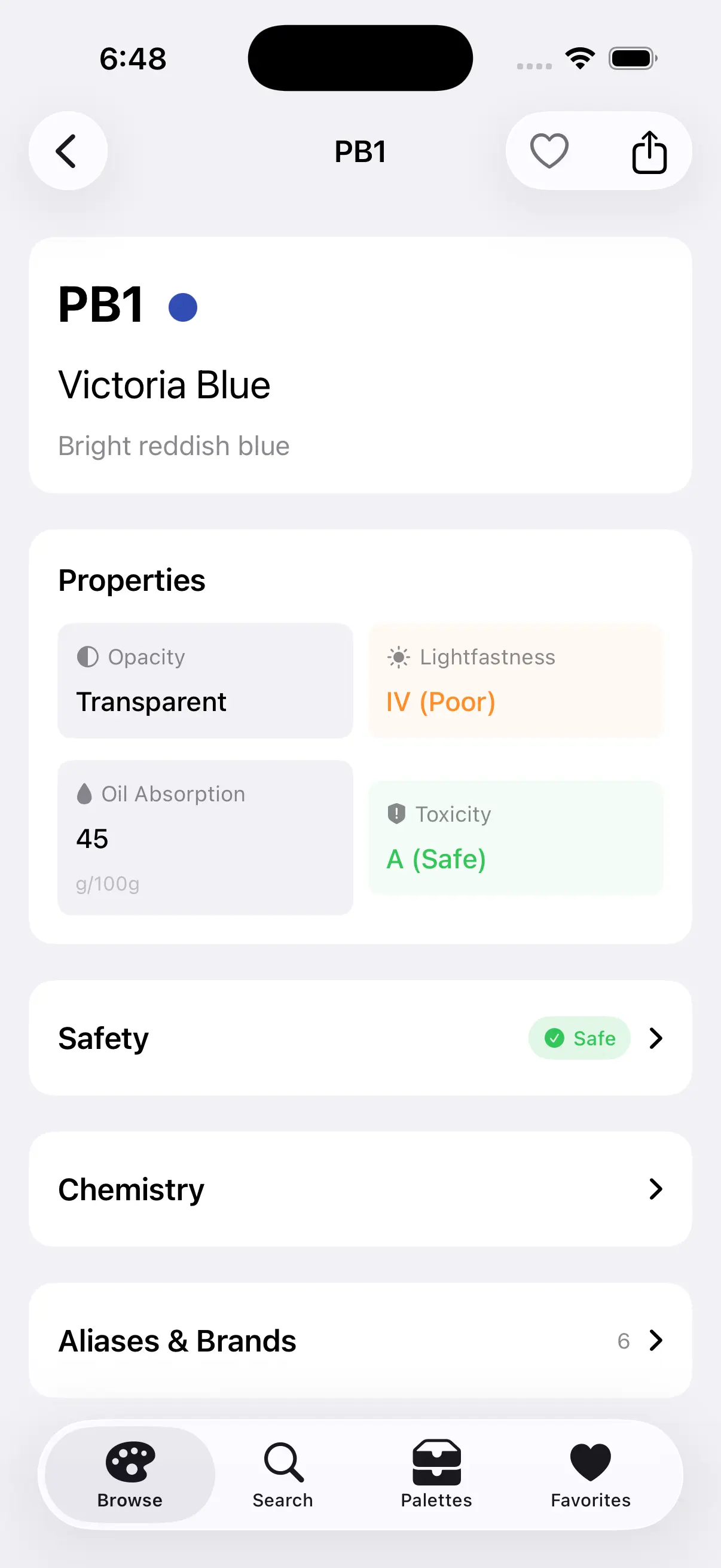
The ASTM D4303 standard rates pigments from I to V after accelerated and natural light exposure. ASTM I is excellent and ASTM II is very good; both are permanent enough for fine art. ASTM III is fair and shifts over decades, while IV and V are fugitive and fade noticeably. Serious work sticks to I and II.
ASTM International tests a pigment at a standard tint, exposes it to controlled light, and measures the color change. The rating reflects that measured shift, which is why it carries more weight than a maker's own star system. When a tube prints "ASTM I," an independent method backs the claim. When it prints only stars, you are trusting the brand.
How does the Blue Wool scale compare?
The Blue Wool scale, common in Europe, runs from 8 down to 1, where 8 is the most lightfast and 1 fades fastest. Roughly, Blue Wool 7 to 8 maps to ASTM I, and 6 maps to ASTM II. The two scales run in opposite directions, which trips people up, so always check which system a tube is using.
Blue Wool gets its name from dyed wool standards that fade at known rates beside the test sample. It is the older method and still appears on many watercolor and printmaking labels. The practical takeaway is the same as with ASTM: aim for the top of whichever scale is printed, and be suspicious of any color that sits in the lower third.
Which pigments are most often fugitive?
Alizarin crimson (PR83), many fluorescent and neon colors, some violets and certain bright pinks built on rhodamine or organic lakes are common offenders. They look gorgeous fresh and dull within years of light exposure. Modern quinacridones and pyrroles deliver similar hues with far better ratings, so substitutes exist for almost every fugitive favorite.
Alizarin crimson is the classic example: a beloved deep red that the Smithsonian and conservation literature flag as poorly lightfast. Quinacridone reds such as PR202 or PV19 reach a close hue at ASTM I or II. Knowing the fugitive list lets you enjoy a color in sketchbooks while keeping it out of work you expect to hang.
Does lightfastness depend on how thick you paint?
Yes. A pigment is most vulnerable in thin washes and pale tints, where each particle catches more light per unit of color. The same pigment painted in mass tone, thick and dark, often holds up better. Watercolorists and anyone glazing should weight lightfastness more heavily, because their layers are exactly where fading shows first.
This is why a watercolor rated ASTM II can outlast an oil washed thin to a tint. Medium matters too: an oil or acrylic binder shields particles that a transparent watercolor leaves exposed. When the work depends on delicate washes, treat the rating as a floor, not a target, and lean toward ASTM I.
Key takeaways
- Lightfastness measures fade resistance; it is the property that decides whether a painting lasts.
- ASTM runs I (best) to V (worst); aim for I or II for permanent work.
- Blue Wool runs 8 (best) to 1 (worst), the opposite direction, so check the scale.
- Alizarin crimson and most neons are fugitive; modern quinacridones and pyrroles replace them.
- Thin washes and tints fade first, so glazers and watercolorists should favor ASTM I.
Frequently asked questions
- What does "fugitive" mean on a paint review?
- Fugitive describes a pigment that fades, darkens or shifts color when exposed to light over time. It is the opposite of lightfast. A fugitive color may look vivid for a few years, then noticeably dull. Fugitive paints suit sketchbooks and studies but not finished work you expect to keep or sell.
- Can a varnish make a fugitive paint permanent?
- No. A UV-filtering varnish slows fading a little, but it cannot rescue a genuinely fugitive pigment. The instability is in the molecule, not the surface. The reliable fix is to choose a lightfast pigment in the first place, then varnish to protect an already stable surface from dirt and abrasion.
- Is student-grade paint always less lightfast?
- Not always, but more often. Student lines stretch cost with fillers and sometimes substitute cheaper, less stable pigments while keeping a familiar name. Many student colors are perfectly lightfast, yet the only way to be sure is to read the pigment code and its rating rather than trusting the tier name.
- How is lightfastness tested?
- Labs paint a standardized tint, then expose it to intense filtered light or measured daylight for a set period while an identical sample stays in the dark. They compare the two with a colorimeter and grade the color change. ASTM D4303 and Blue Wool both rest on this controlled exposure and measurement.
Color Chemistry & Materials Research, BigBalli. We translate ASTM standards and manufacturer data into clear permanence guidance, cross-checked against conservation sources.
Pigments provides reference and educational information about art materials, not conservation certification. Lightfastness varies with binder, tint and exposure; consult manufacturer data and a conservator for archival work.