What Is the Difference Between a Chromatic and an Instrument Tuner?
The difference comes down to how many notes the tuner can recognize. A chromatic tuner hears all twelve pitches of the musical scale and names whichever one you play. An instrument tuner is preset to a short list, usually the open strings of a guitar, bass, violin, or ukulele. One is a general tool, the other is a convenience built around a single instrument's standard tuning.
What is a chromatic tuner?
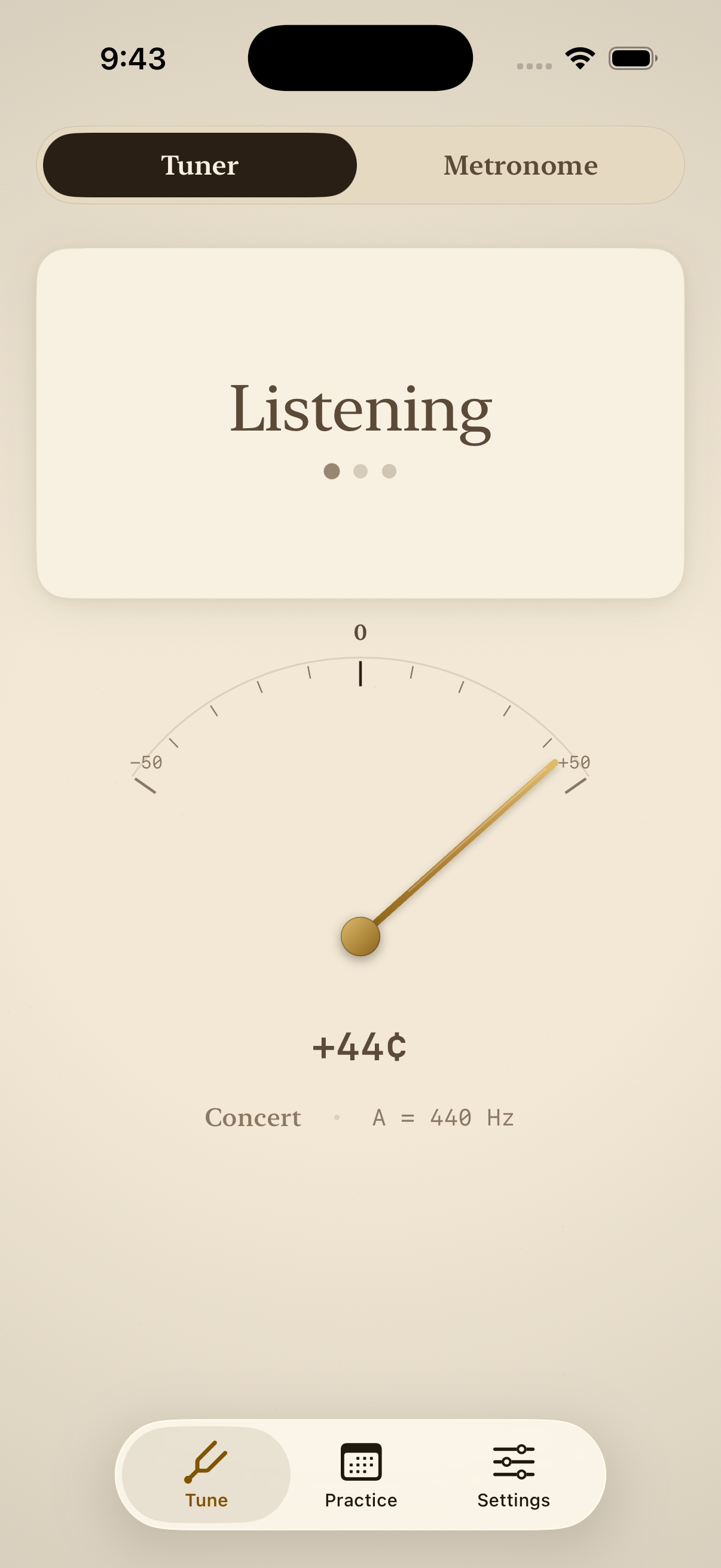
A chromatic tuner recognizes all twelve notes of the equal tempered scale and shows the nearest one to whatever pitch you play, along with the cents offset. Because it is not tied to any instrument, it tunes brass, woodwinds, strings, and voice equally well. It is the standard choice for band, orchestra, and any musician who needs to check arbitrary notes.
This flexibility is why most teachers recommend a chromatic tuner. You can check a single note in the middle of a phrase, tune an alternate string setup, or hand it to a friend on a different instrument. The tuner simply reports the closest note and how far off you are, with no assumptions about what you are playing.
When is an instrument specific tuner useful?
An instrument tuner shines for absolute beginners on a single instrument. A guitar tuner that only knows E, A, D, G, B, and E removes the chance of tuning to the wrong octave or note. The narrow focus is forgiving for a first timer. The tradeoff is that it cannot help with capos, alternate tunings, or any other instrument you pick up.
For a child's first guitar or a casual player who never changes tuning, the simplicity is a genuine benefit. There are fewer ways to make a mistake. But the moment you want a dropped D, a transposed note, or to tune a friend's clarinet, the instrument tuner runs out of room. Most players outgrow it within a year.
Which tuner should a student choose?
| Need | Chromatic tuner | Instrument tuner |
|---|---|---|
| Plays one instrument only | Works well | Works well |
| Plays multiple instruments | Best choice | Limited |
| Band or orchestra | Best choice | Not suitable |
| Alternate or dropped tunings | Handles any note | Cannot help |
| Absolute first timer | Slightly more to learn | Very simple |
For nearly every student past the first few weeks, a chromatic tuner is the better long term tool. It covers the one instrument you start on and every situation you grow into. An instrument tuner is fine as a stepping stone, but a chromatic tuner is the one you keep. When in doubt, choose chromatic.
Do chromatic tuners work for transposing instruments?
Yes. A chromatic tuner reads the actual sounding pitch, so a B flat trumpet playing its written C produces a concert B flat, and the tuner shows B flat. Many tuner apps add a transposition setting so the display matches your written note instead. Either way, a chromatic tuner handles transposing instruments that a fixed string tuner cannot.
This matters in band, where clarinets, trumpets, and saxophones all transpose differently. A chromatic tuner gives every player a true reading of their sounding pitch, and a transposition option lets each one see their own written note. An instrument tuner built for guitar strings has no concept of this, which is another reason ensembles rely on chromatic tuners.
Key takeaways
- A chromatic tuner recognizes all twelve notes and works for any instrument.
- An instrument tuner only knows its preset open strings, like a guitar's six.
- Chromatic is the standard for band, orchestra, and multi instrument players.
- Instrument tuners suit absolute beginners on one instrument, but most outgrow them.
- Chromatic tuners handle transposing instruments and alternate tunings that string tuners cannot.
Frequently asked questions
- Can a chromatic tuner tune a guitar?
- Yes, easily. A chromatic tuner recognizes the guitar's open string notes along with every other note, so it tunes a guitar just as well as a dedicated guitar tuner. The only difference is that it will not stop you from tuning to a wrong octave, since it accepts any note. Watch the note name as well as the meter.
- Is a chromatic tuner harder to use?
- Only slightly, and only at the very start. Because it accepts any note, you confirm the note name as well as the cents, where an instrument tuner picks the note for you. For a complete beginner that extra step is a small learning curve, but it is quickly mastered and pays off in flexibility forever after.
- Do professionals use chromatic tuners?
- Almost always. Professional and student ensembles rely on chromatic tuners because they read any note on any instrument, handle transposition, and work for tuning arbitrary pitches within a piece. Instrument specific tuners are mostly a beginner convenience for a single instrument. Serious players choose chromatic for the range of situations it covers.
- What about clip on versus app tuners?
- Both can be chromatic. A clip on tuner senses vibration through the instrument body, useful in noisy rooms, while an app uses the device microphone and adds features like a metronome and practice logging. For practice at home, an app chromatic tuner gives you tuning, tempo, and tracking in one place without extra hardware.
Music Education & Practice Research, BigBalli. We turn everyday tuning, tempo, and practice questions into clear guidance for students, parents, and private teachers.
PitchLab is a practice and tuning tool for musicians. Tuner choice depends on your instruments and goals; ask your teacher what suits your setup.