What Is A440 Tuning and Why Does It Matter?
A440 is a reference frequency. It fixes one note, the A above middle C, at 440 vibrations per second, and the rest of the scale is calculated from there. Standardizing this single pitch lets musicians, instrument makers, and tuners around the world agree on what in tune means. When your app or tuner says A=440, it is anchoring its whole scale to that one number.
Why is 440 hertz the standard?
A440 became the international standard in 1939 and was confirmed by the International Organization for Standardization as ISO 16 in 1955. Before that, concert pitch varied widely between cities and eras, which made instruments and scores hard to share. Fixing A at 440 gave everyone a common reference, so a clarinet made in one country matches an orchestra in another.
The choice was partly practical compromise. Pitch had been creeping upward for centuries because higher tuning sounds brighter and more brilliant, which tempted ensembles to keep nudging it up. A440 settled the drift at a workable middle ground. It is now built into tuning forks, electronic tuners, and reference tones worldwide, which is why it is the safe default for any student.
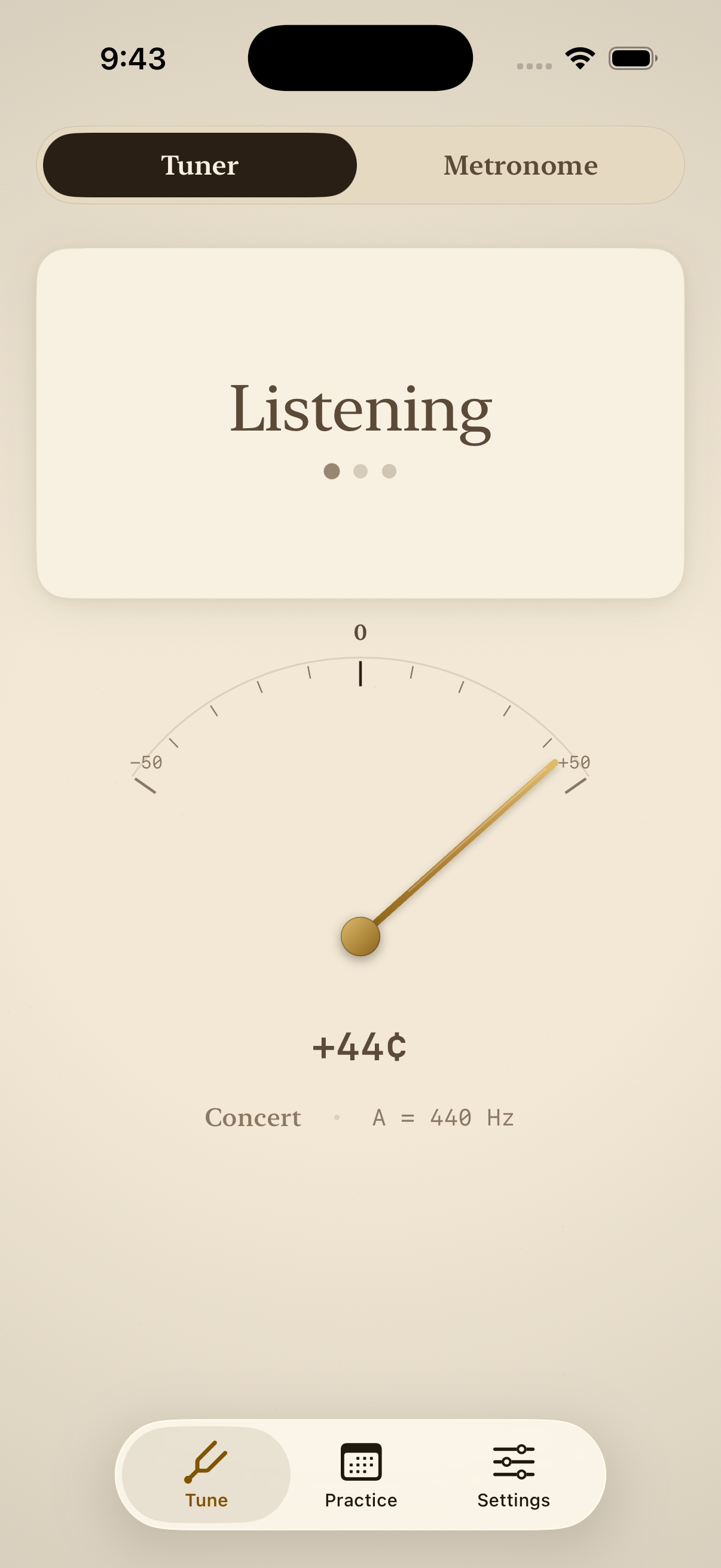
Why do some orchestras tune to 442 or 443?
Many European orchestras tune to A=442 or A=443 because a slightly higher pitch sounds brighter and more brilliant, which can help an ensemble project. The Berlin and Vienna Philharmonics are known for higher tuning. American orchestras more often sit at 440 or 441. The difference is small, a few hertz, but it is a deliberate artistic and acoustic choice.
A few hertz is only a handful of cents, far too small for a casual listener to name, yet it changes the overall sheen of the sound. The risk is mismatch. A soloist tuned to 440 against an orchestra at 442 will sound flat. That is why touring players ask the local pitch in advance and set their tuner to match before the first rehearsal.
What is baroque pitch and why is it lower?
Baroque ensembles often tune to A=415, roughly a semitone below modern pitch, to reflect the lower tuning common in the seventeenth and eighteenth centuries. Period instruments are built for it, and gut strings and historical winds sound best there. A=415 is a convention for historically informed performance, not a fixed rule, and some groups choose other low pitches.
The drop to 415 is close to one equal tempered semitone below 440, which conveniently lets harpsichords transpose by simply shifting the keyboard on some instruments. Players of baroque violin, traverso, and viol expect it. If you join an early music group, set your tuner to 415 rather than 440, because the entire ensemble is built around that lower reference.
Does A440 matter for solo practice?
For solo practice, A440 keeps you consistent with recordings, backing tracks, piano apps, and most published reference tones. Unless you are preparing for an ensemble that uses a different pitch, 440 is the right default. The important habit is picking one reference and staying on it for the whole session, so your ear learns a stable target.
Switching references mid practice teaches your ear conflicting targets and undermines intonation work. Pick 440, match it every day, and your sense of pitch grows around a fixed point. Only change when a real ensemble requires it. Consistency, not the specific number, is what builds reliable intonation over weeks and months of practice.
Key takeaways
- A440 fixes the A above middle C at 440 hertz, the modern concert pitch standard.
- It became the international standard in 1939 and was set as ISO 16 in 1955.
- Many orchestras tune higher, to 442 or 443, for a brighter sound.
- Baroque ensembles tune lower, around 415, for period instruments.
- For solo practice, 440 is the right default; consistency matters more than the exact number.
Frequently asked questions
- What does A=440 actually mean?
- It means the note A above middle C vibrates 440 times per second, measured in hertz. That single pitch becomes the anchor for the whole scale, since every other note is tuned in fixed ratios from it. When a tuner is set to 440, it judges every note you play against a scale built on that reference A.
- Is 432 hertz better than 440?
- There is no scientific evidence that 432 hertz is healthier or more natural, despite popular claims online. It is simply a lower reference some people prefer for its slightly warmer feel. If you enjoy it for solo playing, nothing is wrong with that, but 440 remains the standard for ensembles, recordings, and almost all published music.
- Will tuning to 442 make me sound sharp?
- Only relative to players at 440. If your whole ensemble tunes to 442, you will sound in tune together. The problem arises when references mismatch, such as a soloist at 440 over an orchestra at 442, where the soloist sounds flat. Always set your tuner to whatever reference your group has agreed on.
- How do I change the reference pitch on a tuner?
- Most tuners have a calibration setting, often labeled A4 or Hz, that lets you shift the reference from 440 to another value like 442 or 415. Set it once before you play and the whole scale recalculates from the new anchor. For solo practice, leaving it at 440 is the simplest and most compatible choice.
Music Education & Practice Research, BigBalli. We turn everyday tuning, tempo, and practice questions into clear guidance for students, parents, and private teachers.
PitchLab is a practice and tuning tool for musicians. Always follow the reference pitch set by your conductor, section leader, or teacher for ensemble playing.