What Does Cents Mean on a Tuner?
A cent is one hundredth of a semitone, the small step between two adjacent keys on a piano. Tuners use cents because hertz alone is hard to read across the range of an instrument. When your tuner says plus 12, you are 12 cents sharp of the note. When it says zero, you have matched the pitch. The sign and the number together tell you which way to adjust and how far.
How many cents are in a semitone and an octave?
A semitone equals 100 cents and an octave equals 1200 cents, by definition. The system was built so every half step is exactly 100 cents in equal temperament, the tuning used by pianos and most modern instruments. That even spacing is why a tuner can show your error as a simple number from one note to the next, regardless of how high or low you play.
Because the scale is even, 50 cents is a quarter tone, the midpoint between two notes. If your tuner cannot decide between two note names, you are probably near that 50 cent line. Twelve hundred cents per octave keeps the math consistent. The same plus 10 reading means the same proportional error whether you are tuning a low brass note or a high violin string.
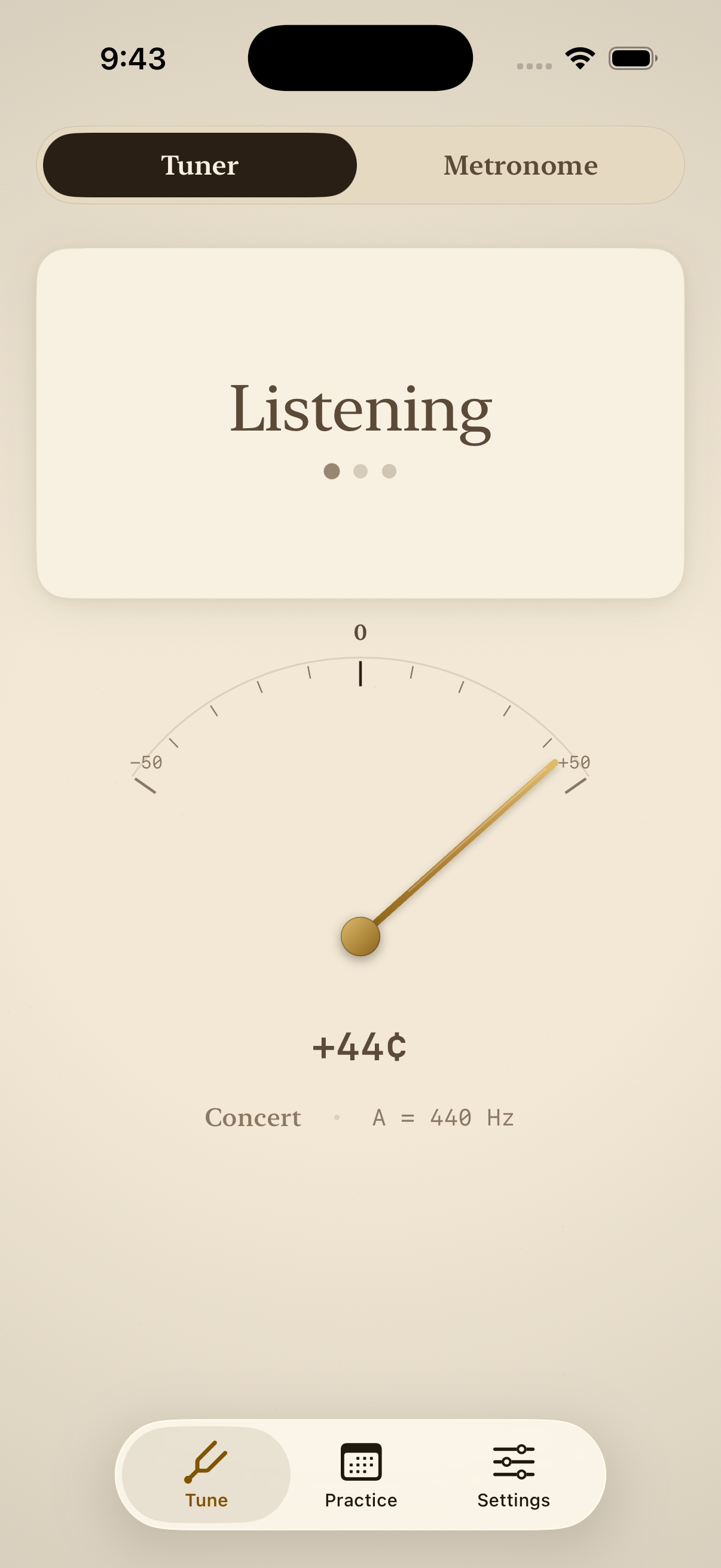
How many cents off is still in tune?
For most playing, within about 5 cents reads as in tune, and many ensembles accept up to 10. The just noticeable difference, the smallest pitch change a trained ear hears, sits near 5 to 6 cents in the middle range. Chasing zero on every note wastes time, since the audience cannot hear a 3 cent error.
Context matters. A solo held note exposes small errors more than a fast passage. Two instruments sounding the same pitch reveal beats that a single line hides. Aim for the center, accept a few cents of drift, and spend your attention on the notes that ring out and sustain. Perfection on the meter is not the same as sounding in tune to a listener.
Why does my tuner read sharp when I play louder?
Many instruments rise in pitch as you play louder and sink as you play softer, sometimes by 10 to 20 cents. Brass and woodwind players especially push sharp on loud, high notes. Air support, embouchure, and reed pressure all shift the pitch, so a tuner reading taken at one volume will not hold at another.
This is why you tune at a normal playing volume, not a whisper. If you tune softly and then play out, you will land sharp. The fix is partly mechanical and partly you, learning to adjust embouchure and air so loud notes stay centered. Watch the cents move as you change dynamics, and you will see exactly where your instrument needs help.
Do strings and frets use cents too?
Yes. Guitarists check each open string in cents and use the meter to set intonation at the bridge, comparing an open string to its twelfth fret harmonic. Violinists and cellists watch cents to train finger placement, since they have no frets. Cents give every string player a common language for how far a note sits from true.
On a guitar, if the fretted twelfth fret reads sharp against the harmonic, the string length needs adjusting at the saddle. On bowed strings, the meter shows whether your first finger lands a few cents high week after week, a pattern worth fixing in slow practice. Cents turn a vague sense of out of tune into a precise, repeatable target.
Key takeaways
- A cent is one hundredth of a semitone; a semitone is 100 cents and an octave is 1200.
- The plus or minus number on a tuner tells you how far and which way to adjust.
- Within about 5 cents reads as in tune for most playing; do not chase a perfect zero.
- Many instruments go sharp when loud and flat when soft, so tune at playing volume.
- String players use cents to set intonation and to fix finger placement in slow practice.
Frequently asked questions
- What does plus or minus cents mean on a tuner?
- Plus cents means you are sharp, above the target pitch, and minus cents means you are flat, below it. The number is how far. Plus 8 means lower the pitch a little; minus 8 means raise it. When the meter rests at zero with no sign, you have matched the note within the tuner's resolution.
- Is 5 cents noticeable?
- Barely, for most listeners. The smallest pitch change a trained ear reliably hears is around 5 to 6 cents in the middle of the range, and casual listeners need more. A 5 cent error on a single line passes unnoticed, though two instruments 5 cents apart create faint beating that careful ears can catch.
- How precise does a tuner need to be?
- A resolution of about 1 cent is plenty for any musical purpose, since you cannot hear or control pitch finer than a few cents. Tuners that claim sub-cent accuracy help with instrument setup, like guitar intonation, more than with everyday playing. For practice, any tuner that reads cents clearly will serve you well.
- Why is an octave 1200 cents?
- An octave spans twelve semitones, and each semitone is defined as 100 cents, so twelve times one hundred gives 1200. The cent was created to divide the octave evenly on a logarithmic scale, so equal musical steps get equal cent values whether the pitches are low or high. It makes tuning math simple and consistent.
Music Education & Practice Research, BigBalli. We turn everyday tuning, tempo, and practice questions into clear guidance for students, parents, and private teachers.
PitchLab is a practice and tuning tool for musicians. Intonation targets vary by instrument and ensemble; follow the guidance of your teacher or section leader.