
AI's biggest payoff is the work you never did
Most companies ask AI one question: how do we do what we already do, faster?
Fair question, small answer.
I've published 100+ iOS apps since 2010. For fifteen years, porting them to Android never made sense: a different language, a different toolkit, and no app big enough to pay for a second developer. This year I ported more than 40 of them with coding agents.
Zero hours saved, because nobody was ever going to spend those hours. 40 apps now exist that otherwise wouldn't.
Every business has a list like that: work nobody had the time, money, people or know-how to try. I wrote up the seven constraints AI is loosening, the costs that aren't falling nearly as fast, and the question I'd ask instead of "how do we save time?"
What's on your list?
Most AI conversations inside a company start with the same question: how do we do what we already do, faster? It's a fair question with a small answer. A report that took a day now takes ten minutes. Nice, and your competitors get the same ten minutes.
The bigger payoff sits on a different list: everything you never did because there wasn't the time, the money, the people or the know-how. That list is long in every business I've seen, and AI is quietly making a lot of it affordable.
Forty apps that were never going to exist
I've published more than 100 iOS apps since 2010. For fifteen years, porting them to Android never made sense: a different language, a different toolkit, and none of the apps big enough to pay for a second developer.
This year I ported more than 40 of them with coding agents.
No hours were saved, because nobody was ever going to spend those hours. Forty apps now exist on Android that otherwise wouldn't, and that's a completely different kind of value from "doing the same work faster."
Same story with data. The pipeline I built for Cruiseable.co, a cruise search startup that wound down, collects sailings, itineraries and weekly fares. For years it was an asset with no product around it. It now powers cruise-itinerary.com and GetPortDay.com with MCP/connectors that let Claude and ChatGPT answer cruise questions from it. That project sat at the bottom of the list for years because the economics never added up for a one-person effort. Now they do.
Four levels of AI value
I think it helps to separate what AI does for a business into four levels: efficiency, expansion, enablement and creation.
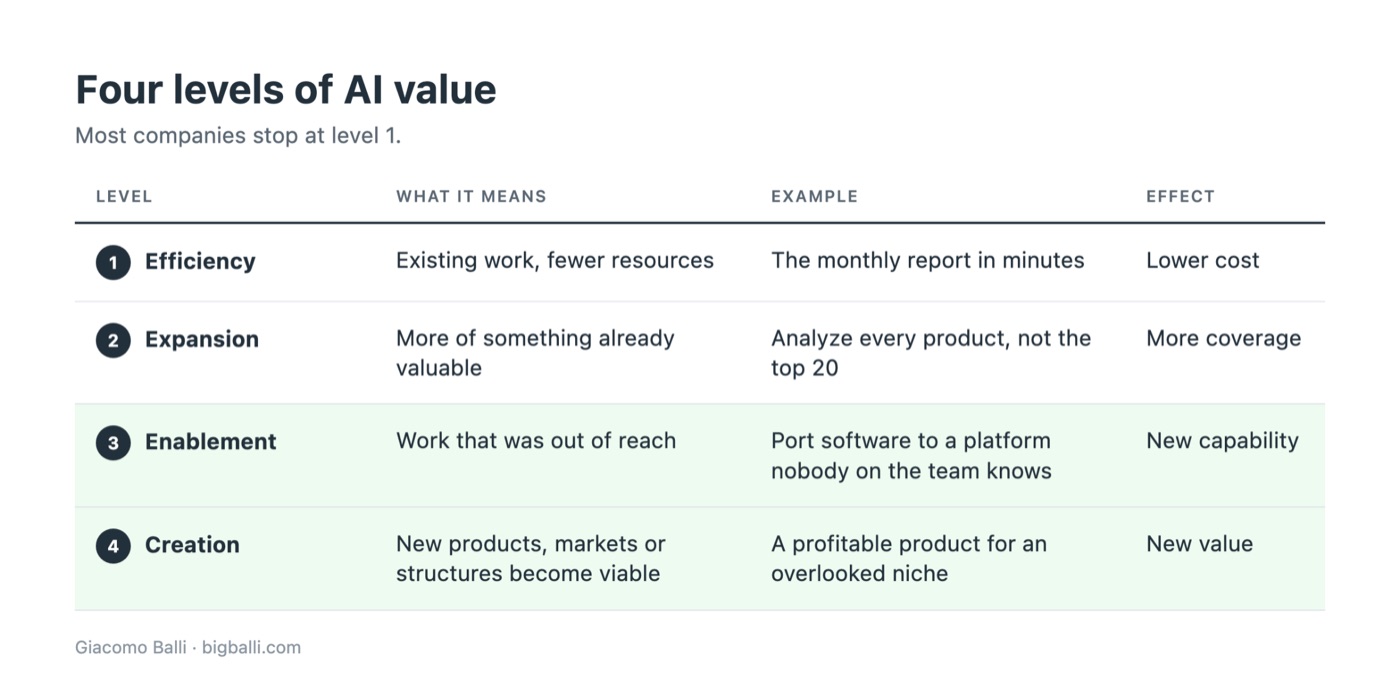
Level 4 is the most interesting, but it isn't automatically the most profitable. A 5% efficiency gain in a large business can be worth more than a whole new micro-market. The point is that most companies stop at level 1 and never look at the other three.
The seven constraints AI loosens
Underneath all of this, AI moves seven limits that have always decided what a business can attempt. Most real opportunities loosen several at once (the Android ports removed cost, expertise and capacity in one go).
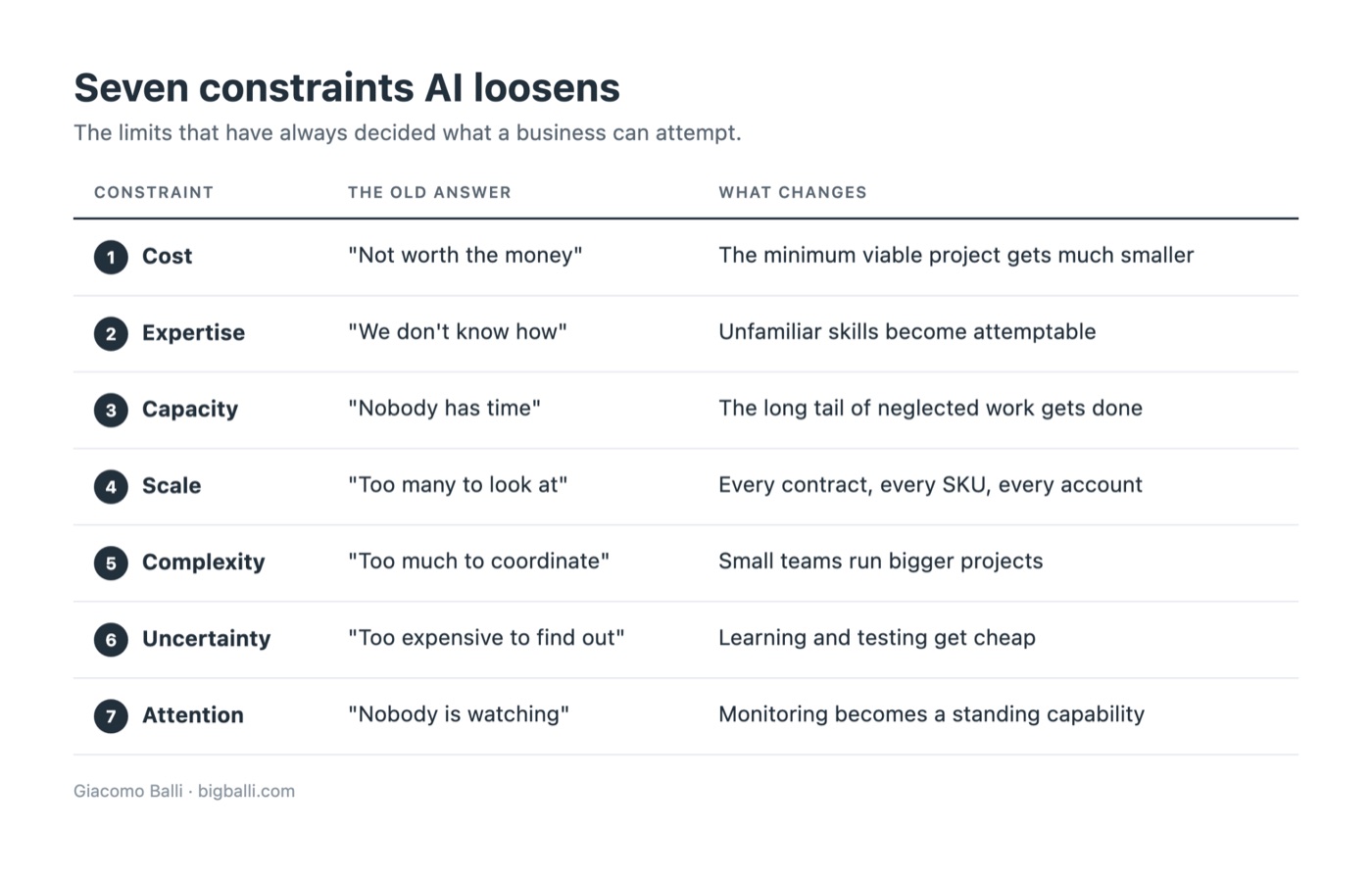
1. Cost: "not worth the money." The minimum viable project gets much smaller. Internal tools for a process someone handles in a spreadsheet, an integration between two systems nobody wanted to pay to connect, a modernization project that never cleared the budget. This changes which software gets built, beyond how fast it gets built.
2. Expertise: "we don't know how." A team can now work in a programming language, a statistical method or an industry it never learned. Draft a financial model, prepare a structured vendor evaluation, understand the economics of an adjacent market before a first meeting. Judgment, verification and accountability still need someone who knows the field, so this lowers the bar to attempt something more than the bar to get it right.
3. Capacity: "nobody has time." Every company has a long tail of valuable work that was never important enough to staff: documenting processes that live in one person's head, cleaning up records, re-evaluating suppliers, following up with smaller customers, writing down what went wrong in the last incident. A lot of this work was never done in the first place, so there's nothing to speed up. It's simply new.
4. Scale: "too many to look at." Thousands of contracts, every SKU, every page of a website, every account in the customer base. The minimum unit worth individual attention keeps getting smaller. Reviewing one contract carefully was always possible; reviewing all 3,000 of them wasn't.
5. Complexity: "too much to coordinate." Multi-vendor projects, work across languages and time zones, handoffs between teams that lose context every time. A small team can now run projects that used to need an administrative layer around them. AI won't settle conflicting incentives or replace whoever is accountable, though.
6. Uncertainty: "too expensive to find out." Test ten business ideas before committing to one, prototype three products before picking, model five pricing structures, explore a neighboring market or a new country. When finding out gets cheap, months of debate become hard to justify. Cheap experiments still need honest measurement, or you just learn the wrong thing faster.
7. Attention: "nobody is watching." Competitor pricing, regulatory changes, early signs of churn, an unusual jump in spending, a contract deadline coming up. Persistent monitoring used to need a dedicated person. Now it's closer to a standing capability, with the usual caveat that false positives and the cost of acting on every alert are real.
A better question to ask
Most companies ask: how can AI make our current activities more efficient?
That question anchors everything to today's processes, products, customers and assumptions. A more useful one: what would we choose to do if expertise, experimentation, execution and analysis cost a fraction of what they do?
Take a mid-size retailer. The efficiency list and the opportunity list look very different.
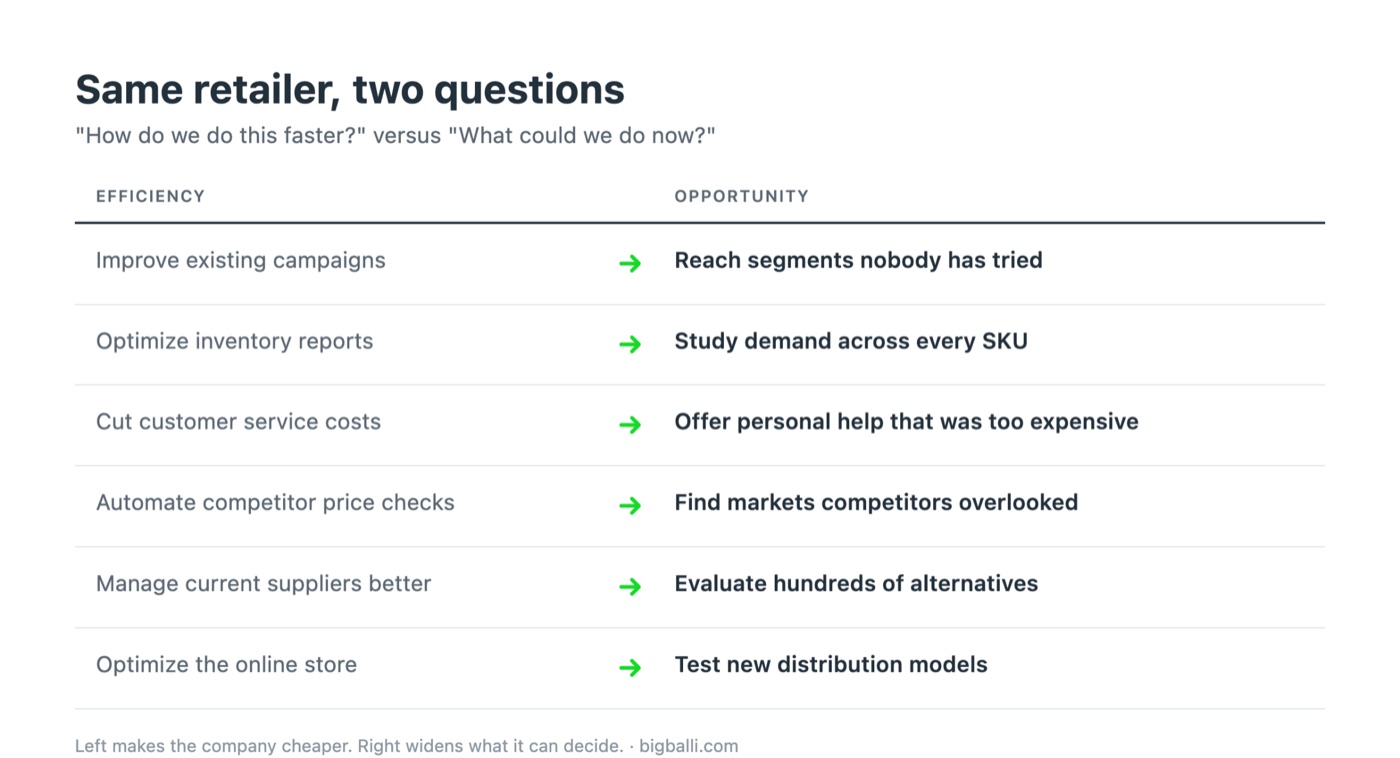
The left side makes the company cheaper. The right side widens the set of decisions it can make.
What doesn't get cheaper
A few second-order effects worth pricing in.
Execution stops being scarce. If everyone can build software, generate campaigns and run research cheaply, value moves to what can't be copied cheaply: proprietary data, distribution, customer relationships and judgment. My cruise pipeline only became worth something because the data was mine and nobody else had collected it.
The bottleneck moves. A company that generates 100 product ideas still has to find the customers who'll pay for one. A thousand campaigns still compete for the same customer attention, which didn't grow when content got cheaper. More output means more selecting, verifying and managing.
Producing something got cheaper much faster than getting a good outcome from it. A senior-care franchise owner I advised this year had studio quotes from $67K to $125K for one MVP. Then the owner's son built a working version with Claude in a short time. That prototype is real progress. It's also the first 80%: payments, refunds, security and hardening are where the remaining money and headaches live, and AI shrinks that part far less.
None of this argues against the opportunity. It argues for being clear about which costs fell and which didn't.
The boundary moved
Businesses have always operated inside a boundary set by money, people, expertise, time and attention, and they got good at optimizing inside it. AI pushes that boundary out, in three ways:
1. Work that was unaffordable becomes affordable.
2. Capabilities that were out of reach become reachable.
3. Opportunities that didn't exist become viable.
The first improves operations. The second widens what a company can attempt. The third changes which businesses can exist at all.
So the question I'd put to any owner: what's on your list of things you never tried because the math didn't work? Some of it works now.